_edited.png)
Jiu Jitsu Women Guide to Training in Sydney
You've been thinking about trying Brazilian Jiu-Jitsu, but the same questions keep getting in the way. Will you fit in? What happens if you're not strong, flexible, or athletic? Will training feel uplifting, or will it leave you overwhelmed and sore?
Those concerns are normal, especially when you're new to close-contact training. A well-structured class should give you time to learn, clear boundaries with training partners, and a gradual path from basic movement to live practice. For women in Sydney, jiu jitsu can offer much more than a generic self-defence message. It can become a practical way to build fitness, manage stress, develop technical skill, and find a supportive community.
Why Sydney Women Are Stepping Onto The Mats
You arrive for your first class after checking the timetable twice. Through the front door, you see people moving confidently across the mats and wonder whether you will know what to do. A good coach starts with practical details, introduces you to a suitable partner, and explains the boundaries that make close-contact training feel manageable.
That first class asks you to be a beginner in public. It also gives you a clear way to improve. You learn how to frame, move your hips, protect space, and respond when a partner changes position. Each small gain becomes something specific you can remember and practise again.
Australian participation data shows that women already make up a substantial share of adult martial-arts participation. The 2019 Judo NSW summary of AusPlay and State of Play data recorded 136,998 women among 248,351 martial-arts participants aged 15 and over, roughly 55% of adult participation (Judo NSW summary of martial-arts participation data). The same summary reports that 85% of adult participation was organised through clubs or academies. For a woman comparing Sydney BJJ academies, that highlights the value of coached instruction, clear safety practices, and a community she can attend consistently.
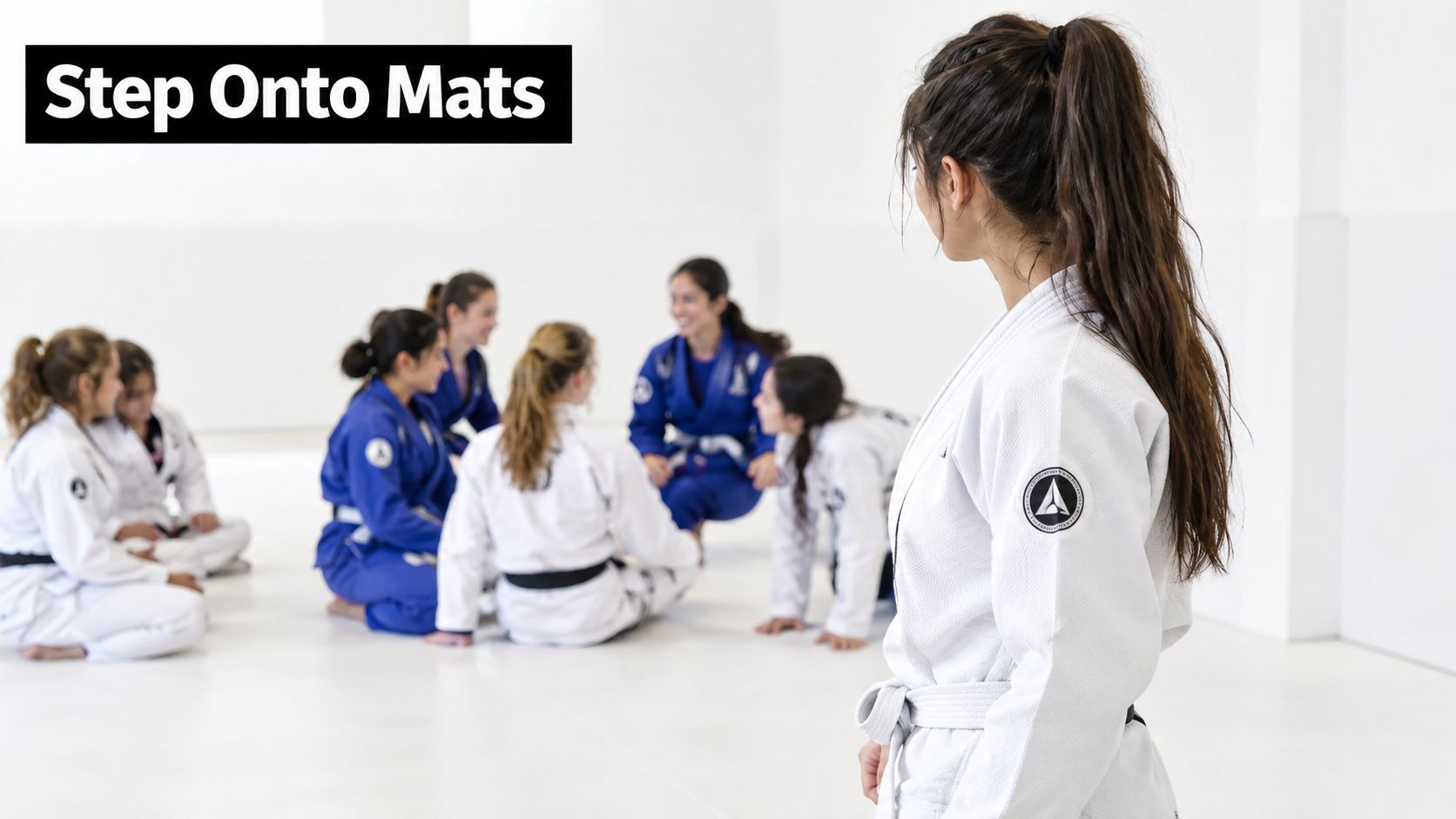
More than one reason to train
Self-defence can be part of your motivation, while fitness, stress relief, and skill mastery may keep you returning. Australian coverage describes women joining martial arts for fitness, skill development, and a supportive environment, with safety concerns forming only one part of the decision (ABC coverage of women taking up self-defence).
You might want a demanding workout after work, a structured outlet during a stressful week, or a technical challenge that rewards patience rather than appearance. BJJ gives progress a practical shape: better breathing, more controlled movement, sharper timing, and the ability to stay calm while solving a changing problem.
Women's competition has also gained formal recognition. The history of women's divisions in Brazilian Jiu-Jitsu includes the IBJJF adding women's divisions in 1998. Competition pathways have grown, although higher-grade fields can still be thin in Australia. Welcoming beginner classes and respectful training partners therefore help women remain part of the sport, whether they eventually compete or train for their own goals.
The Physical And Mental Benefits Of Grappling
Brazilian Jiu-Jitsu is often described as physical chess. The comparison works because you're constantly making decisions, but the board moves beneath you and your opponent actively changes the problem. You don't just repeat an exercise. You use posture, frames, timing, and angles to improve your position.
That doesn't mean strength is irrelevant. It means strength becomes more useful when you apply it in the right direction. A smaller practitioner may create space with a forearm frame, move the hips, recover guard, and use an angle rather than trying to push a larger partner straight backwards. The lesson is technical: position and technique can make effort more efficient.
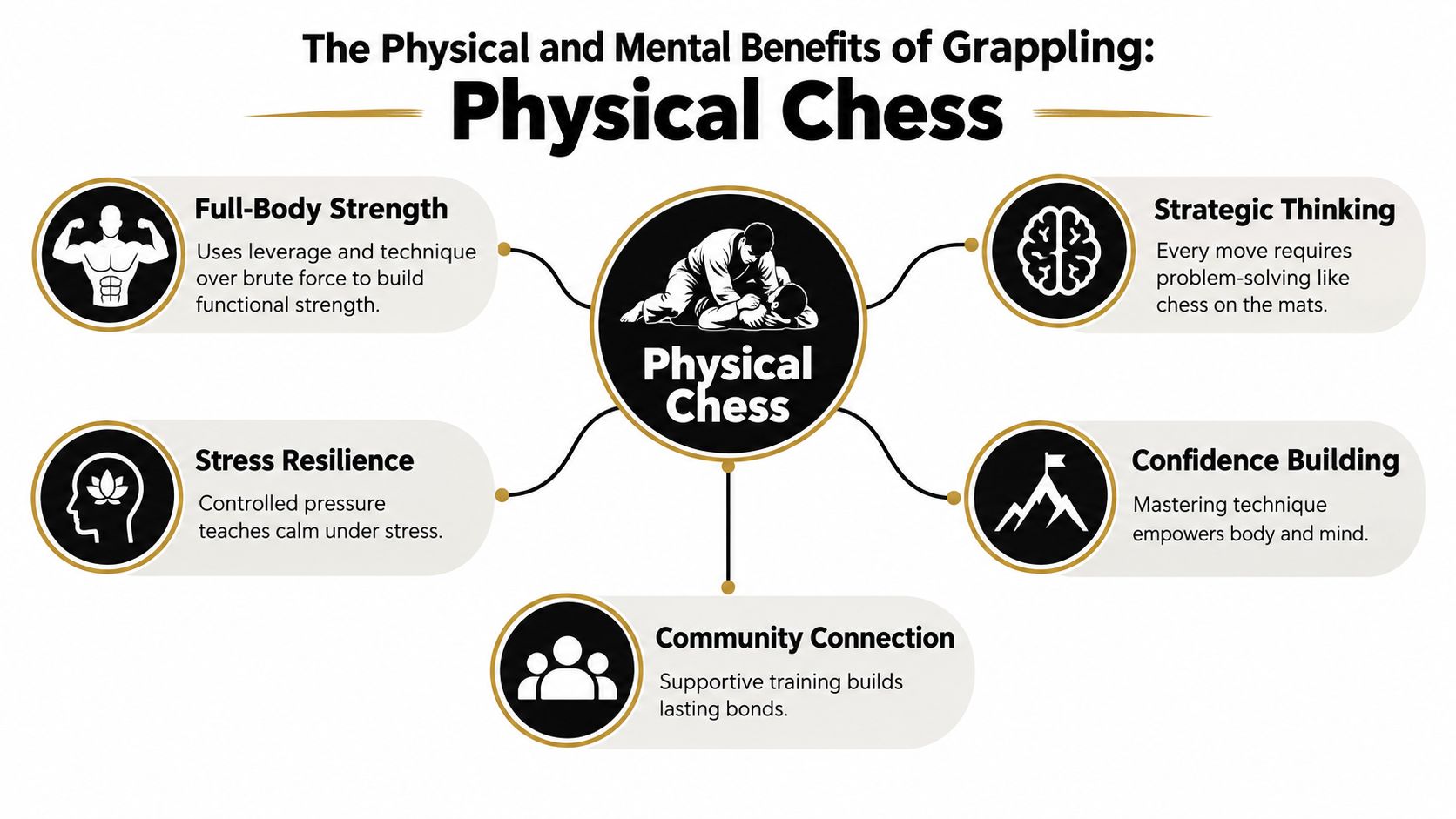
What your body learns
Grappling involves repeated transitions between standing, kneeling, sitting, and lying positions. You'll use your legs to bridge, your hips to create movement, your trunk to maintain stability, and your hands to manage grips and frames. Over time, this can develop full-body coordination, functional strength, mobility, and cardiovascular conditioning through a task that demands attention.
The physical benefits become easier to understand through everyday examples:
Hip mobility: Escaping from side control requires you to move your hips rather than relying only on your arms.
Core stability: Maintaining posture in guard or top position asks your trunk to transfer force between your upper and lower body.
Grip and pulling strength: Gi and No-Gi training challenge your hands and arms in different ways.
Endurance: Repeated technical rounds teach you to manage effort instead of sprinting through every exchange.
A detailed overview of Brazilian Jiu-Jitsu benefits can help you connect these training demands with broader goals such as fitness, movement quality, and confidence.
What happens under pressure
The mental challenge is just as important. When a partner holds a strong position, your first impulse may be to tense every muscle and rush. Coaching teaches you to identify the immediate problem, protect your breathing, choose a frame, and work through a sequence.
That process builds calm problem-solving under pressure. You learn that discomfort doesn't always mean danger, and that a difficult position can be divided into manageable tasks. You also practise communicating clearly, tapping when a submission is secured, and resetting without treating a failed attempt as a personal judgement.
Training isn't a substitute for professional mental-health support. If stress, anxiety, or past experiences affect your daily life, consider using these resources for mental health and speaking with a qualified health professional. On the mats, BJJ can still provide a structured hour in which your attention has a clear job, your body moves, and your progress is visible.
Practical rule: The best training goal isn't to look fearless. It's to make one clear decision while you're uncomfortable, then learn from the result.
What To Expect In Your First Beginners Class
Your first class should feel organised, not mysterious. You won't need to arrive knowing the names of submissions or understanding every position. Tell the coach that you're new, mention any injuries or limitations, and ask how partners are assigned.
At Locals Academies, including the environments associated with Locals Zetland and Locals Maroubra, a beginner pathway should build the session in layers. You first prepare your body, then learn a small technical sequence, and only later apply it through controlled practice.
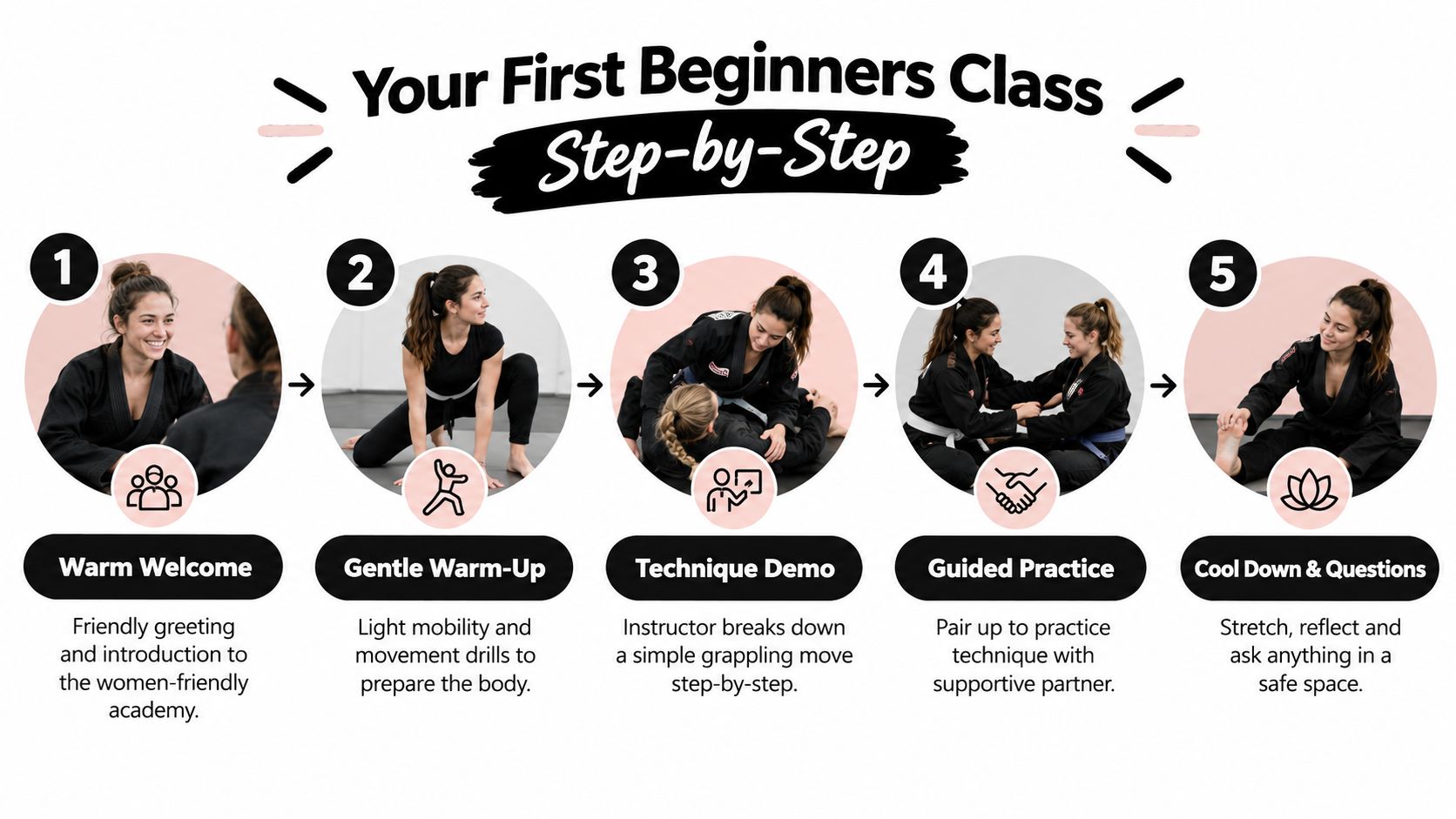
The class, step by step
Warm welcome: A coach or staff member should greet you, explain the mat rules, and help you understand where the class begins. You don't need to pretend you're confident. Saying “this is my first class” gives the coach useful information.
Gentle warm-up: Expect mobility work, movement patterns, and simple drills such as hip escapes, bridges, technical stand-ups, or controlled changes of level. These movements prepare the joints and introduce the body mechanics used later in class.
Technique demonstration: The instructor breaks down one position or sequence. You may learn how to frame from bottom side control, retain guard, escape mount, or establish a safe top position. Ask questions when the detail doesn't make sense.
Guided practice: You work with a partner and repeat the movement at a manageable pace. Mistakes are expected. A good partner gives you enough resistance to learn without turning a beginner drill into a contest.
Cool-down and questions: The class finishes with a reset, stretches, or an opportunity to ask about the technique. You should leave knowing what you practised and what to work on next.
The Brazilian Jiu-Jitsu beginners pathway is built around fundamentals, movement, and strategy rather than forcing new students into advanced sparring immediately.
Mat culture and boundaries
Hygiene is part of respect. Wear clean training clothes, keep your fingernails and toenails short, cover cuts, and avoid training when you're unwell. If you sweat heavily, follow the academy's cleaning procedures and keep personal items away from the training surface.
Tapping is also part of learning. You can tap with your hand, tap your partner, or clearly say “tap” if your hands are occupied. You don't need to wait until a submission hurts. Tap early, reset, and ask what you missed.
If physical contact makes you uncomfortable, tell the coach before class. You can ask for a particular partner, request a slower round, or sit out a drill while you regain composure. A respectful academy treats those boundaries as normal parts of training, not as obstacles.
You can also watch a beginner-class walkthrough here before attending:
Navigating Safety And Injury Prevention
Fear of injury shouldn't be dismissed, but it also shouldn't be treated as inevitable. Grappling places bodies in close contact, so safety depends on coaching, communication, partner behaviour, and the intensity of each drill.
Concussion deserves particular attention. A peer-reviewed BJJ injury study reported concussion during training among 41% of female practitioners compared with 20.5% of male practitioners, with the difference statistically significant at p≤0.001 (peer-reviewed BJJ injury study). The study also identified headache, dizziness, and loss of balance as common post-concussion symptoms regardless of gender.
That finding doesn't mean women should avoid BJJ. It means an academy should teach head-impact awareness as a technical skill. You should know how to fall, where to place your head, when to stop, and how to report symptoms without worrying that you're letting the team down.
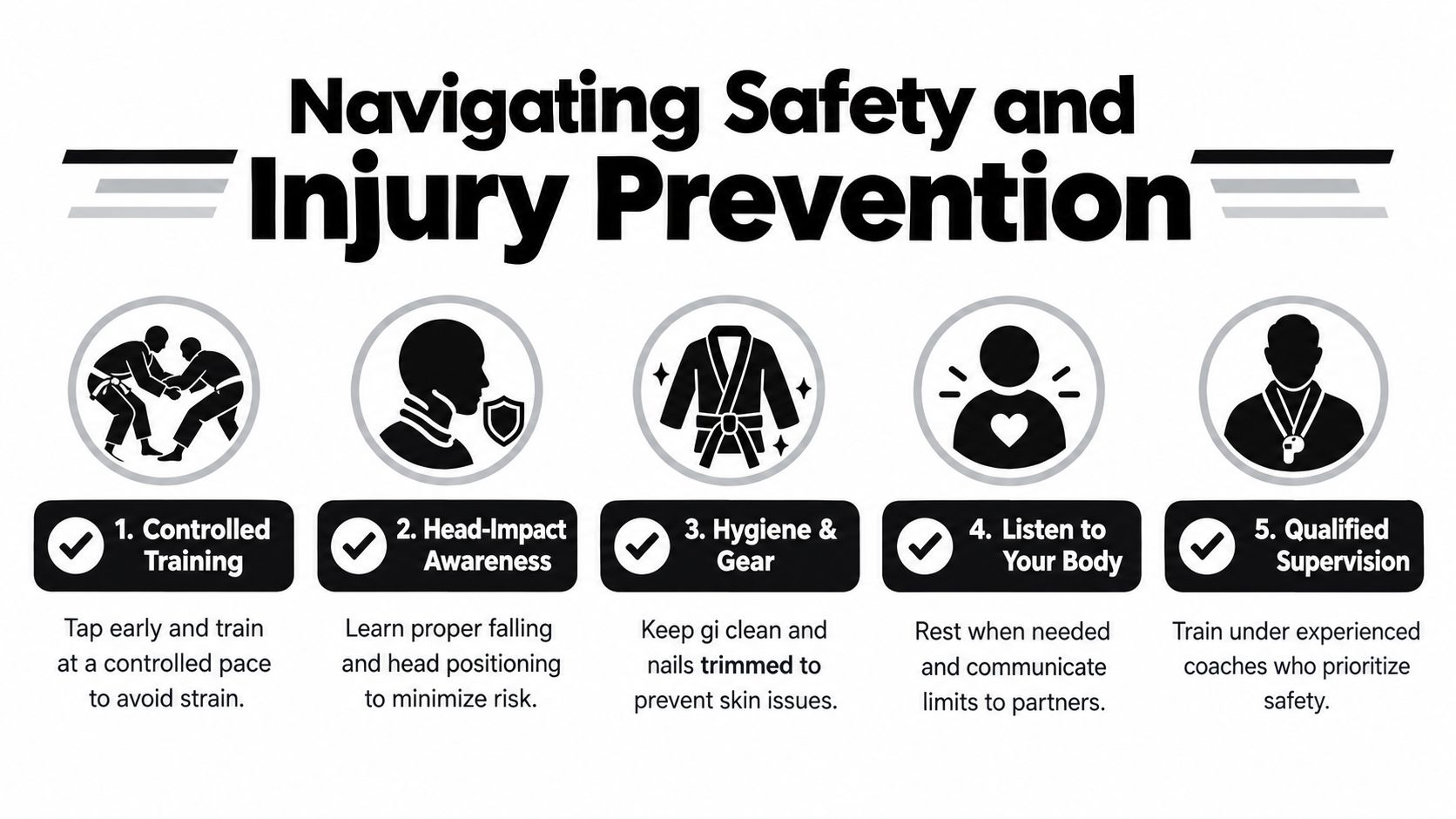
Safety is built into the lesson
Look for coaches who explain the “why” behind safe movement. Controlled takedown mechanics reduce chaotic falls. Positional drilling lets you practise escapes without adding unnecessary speed. Progressive sparring gives you time to develop awareness before you face a fast, unpredictable exchange.
Use these habits from your first session:
Tap early: A submission is a learning signal, not a test of stubbornness.
Protect your head: Keep your head positioned safely and avoid using it as a post during scrambles.
Control the pace: Beginners should practise clean movement before increasing resistance.
Choose partners carefully: Train with people who listen, release immediately, and match your intensity.
Report symptoms: Headache, dizziness, or loss of balance after contact requires stopping and seeking appropriate medical advice.
A coach should also explain what happens after a suspected concussion and how you return to training. The Australian Institute of Health and Welfare has documented injury patterns across martial arts, reinforcing that the sport carries a meaningful injury burden even though patterns vary by discipline and gender (AIHW martial-arts injury data).
If a partner ignores your tap, increases pressure after you ask them to slow down, or treats safety questions as weakness, stop the round and speak with the coach.
Returning students should be especially honest about old injuries, pregnancy-related considerations, recent surgery, or symptoms that haven't resolved. A progressive curriculum protects your long-term consistency better than a dramatic first week.
Choosing Between Gi And No-Gi Training Pathways
Once the beginner movements start to feel familiar, you may wonder whether to train in a traditional Gi or in No-Gi grappling. Neither option is automatically more suitable for women. The better choice depends on the type of problem-solving, pace, clothing, and competition rules you enjoy.
The Gi gives you a jacket and trousers that create additional gripping options. You can use lapel and sleeve control to slow an exchange, manage distance, and build methodical sequences. No-Gi removes those fabric grips and commonly places more emphasis on body locks, underhooks, wrist control, wrestling-style entries, and faster transitions.
Feature | Traditional Gi | No-Gi Grappling |
|---|---|---|
Main gripping options | Jacket sleeves, collars, and lapels | Wrists, arms, head position, underhooks, and body control |
Typical pace | Often more measured, with detailed grip fighting | Often faster, with frequent transitions and scrambles |
Technical emphasis | Friction, posture, grip sequences, and positional control | Movement, wrestling integration, leg positioning, and rapid reactions |
Training feel | Methodical and highly structured | Dynamic and conditioning-focused |
Useful starting question | Do you enjoy solving a position through layers of grips? | Do you prefer speed, movement, and body-control exchanges? |
How the pathways feel
Gi training can reward patience. A sleeve grip may limit your partner's movement while you build a guard, pass with controlled pressure, or work towards a submission. The extra friction can make details easier to study because positions may change more gradually.
No-Gi can feel more athletic and fluid. Without fabric grips, you need to manage distance through frames, underhooks, head position, and timing. The style often includes wrestling-based entries and transitions, which can provide a demanding cardiovascular session while developing practical control skills.
You don't have to choose permanently. Many students use Gi sessions to refine positional details and No-Gi sessions to test movement under a faster rhythm. The No-Gi versus Gi comparison from Locals Zetland can help you identify the differences before selecting your regular timetable.
Competition and personal goals
Competition is optional. If you want to compete, ask how the academy prepares students, how matches are selected, and how training intensity changes before an event. Women's competitive fields can become smaller as belts advance in Australia, and ABC reporting in 2022 described higher-level competitors who already knew many of their opponents because so few women remained in some advanced divisions (ABC reporting on women's BJJ competitors).
That makes a supportive development pathway valuable, but you don't need competition to justify training. Fitness, stress relief, technical curiosity, and community are complete goals on their own.
Finding Your Home Academy And Taking The First Step
You walk into a Sydney academy for the first time, hear the slap of bodies on the mats, and wonder whether you are ready. The answer depends less on your current fitness than on how the academy teaches beginners, manages contact, and responds when someone needs help.
Visit before committing if possible. Watch how coaches answer basic questions, correct technique, and adjust drills for different bodies or injuries. Notice whether students control their pace, release submissions promptly, and communicate during rounds. A welcoming atmosphere helps, while clear instruction and consistent boundaries matter more.
Green flags to look for
A defined beginner curriculum: Classes should introduce movement, positions, escapes, and basic submissions in a logical sequence. Like learning a new language, you need useful foundations before advanced combinations.
Approachable coaches: Instructors should welcome questions and explain how to modify drills for injuries, fitness levels, or limited mobility.
Respectful partner behaviour: Training partners should control pressure, respect taps, and check in when a round feels too intense.
A clean training environment: Mats, shared equipment, clothing, and personal hygiene all support a healthier class culture.
Visible progression: You should understand how students move from fundamentals into more advanced technical training, whether or not they plan to compete.
Room for different motivations: Fitness, stress relief, skill mastery, self-defence, and competition are all valid reasons to train. The academy should support your goal without treating another student's goal as more legitimate.
A structured club can offer coaching, regular training partners, progression, and accountability that informal practice cannot provide. As noted earlier in the Judo NSW participation summary, organised clubs and academies account for much adult martial-arts participation.
At Locals Jiu Jitsu Zetland, women can explore coached fundamentals, self-defence-focused training, and a respectful training culture. Locals Maroubra is another Sydney option if its location and timetable fit your routine.
You do not need to arrive fit, confident, or technically prepared. Wear comfortable athletic clothing, ask about the first class, and disclose relevant health concerns or previous injuries. Pay attention to the academy's response. Your first goal is to attend, learn one movement, and decide whether the environment supports your next step.
Locals Jiu Jitsu Zetland offers a structured beginners pathway where women can develop fitness, practical grappling skills, and confidence in a controlled community setting. Visit Locals Jiu Jitsu Zetland to book your free trial, meet the coaches, and take your first step onto the mats without pressure.
Comments