_edited.png)
6 Best BJJ Moves for Self Defense You Need to Know
You're walking home when someone steps into your space, grabs your clothing, or drives forward before you've had time to react. Your instinct might be to panic or swing wildly. Brazilian Jiu-Jitsu offers a more useful response: control, position, and a route to safety. The aim isn't to win a fight or stay on the ground longer than necessary. It's to protect yourself, disrupt the attacker's balance, create space, and leave.
The best BJJ moves for self defence are therefore not always the most impressive techniques in a competition. They're the movements you can practise under pressure, apply from bad positions, and use to disengage when the opportunity appears. Australia has a substantial personal-safety burden, with the ABS estimating that 7 million adults aged 18 and over, or 36%, had experienced physical violence since age 15 in the Personal Safety Survey for 2021–22 (Australian Bureau of Statistics Personal Safety Survey). The six techniques below focus on practical situations, conservative decision-making, and getting home safely.
1. Armbar from Guard
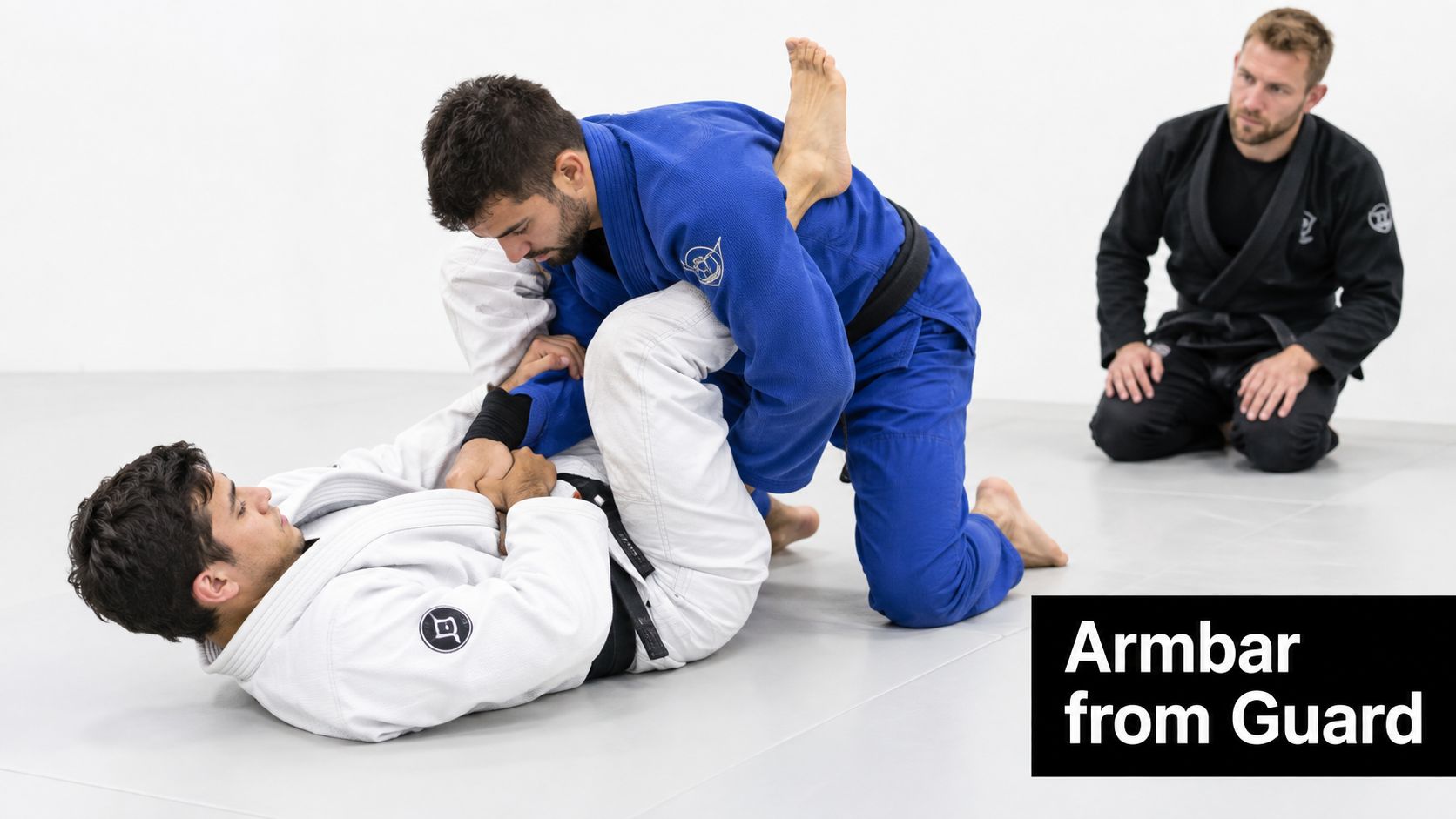
The armbar from guard gives a person on their back a way to control an attacker's arm with their legs and hips. If someone is between your legs after a takedown or tackle, the guard position can prevent them from freely standing, striking, or moving into a stronger top position. From there, you isolate one arm, control the upper body, and use your hips to apply pressure to the elbow.
The technique requires precision, not a frantic squeeze. Keep your knees close, maintain contact with your legs, and prevent the attacker from pulling the elbow free. Control the head or upper body so they can't posture up and escape. A high hip position creates the advantage, but the finish should be applied gradually during training.
For a clear foundation in guard positioning, work through this guide to the Jiu Jitsu guard.
What makes it useful outside the gym
The armbar can help when you've been knocked down and the other person is trying to stay on top. It may also give you enough control to stop an arm reaching toward your face or neck. That doesn't mean you should automatically pull guard in a street confrontation. Concrete, nearby people, weapons, and additional attackers make the ground dangerous.
Use the position to control the arm, protect yourself, and create an exit, rather than treating the submission as the only objective.
Isolate first: Secure the arm before committing your hips.
Keep the head controlled: Prevent the attacker from sitting upright and disengaging.
Lift your hips: Drive upward while maintaining leg connection.
Finish slowly in training: Learn the correct angle without injuring a partner.
Look for the exit: Release and stand when the threat has stopped or space opens.
Practical rule: A submission is a control option, not permission to keep applying force after you can safely escape.
2. Rear Naked Choke
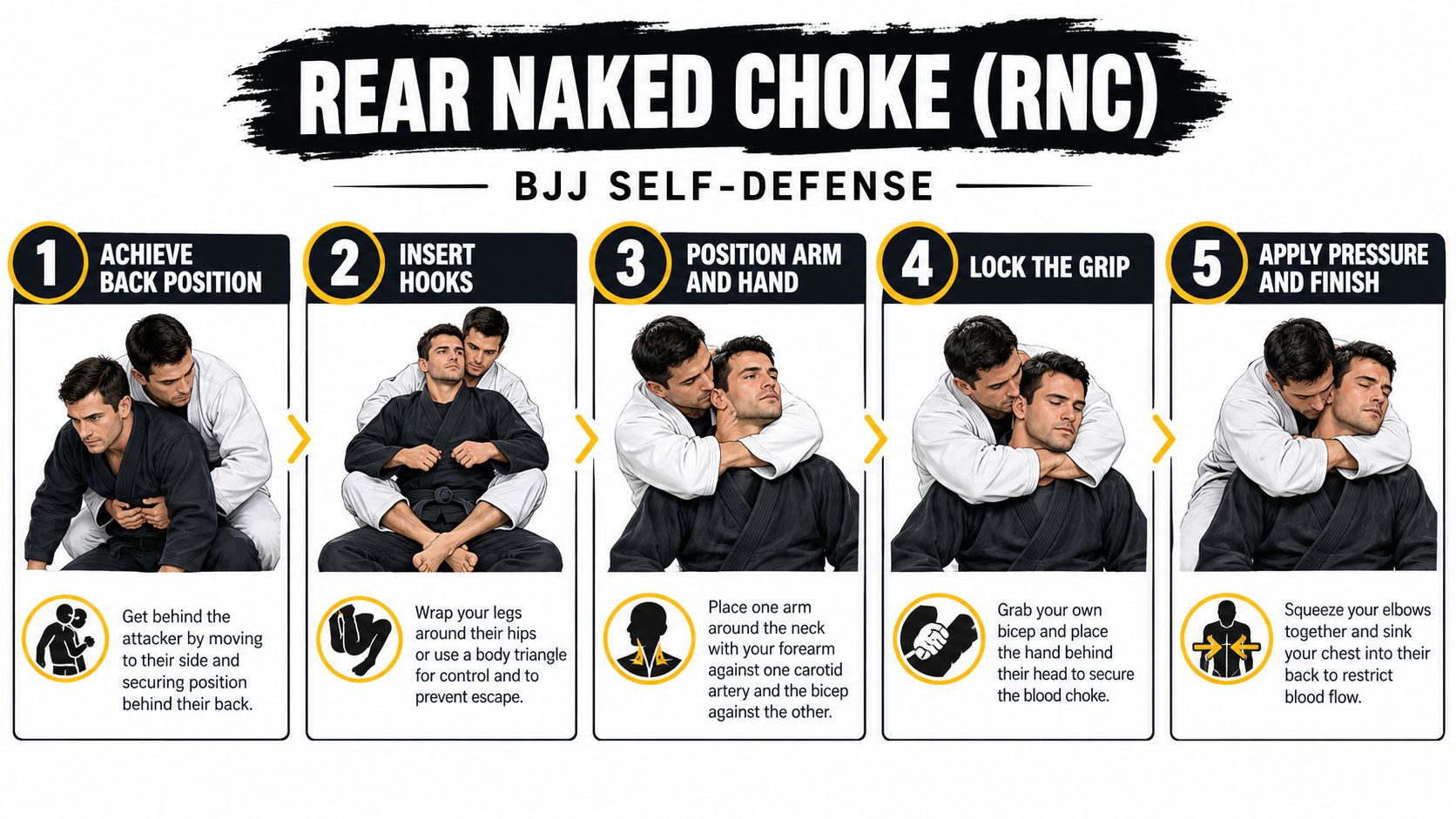
The rear naked choke is strongest when you've reached the attacker's back, where you're behind their striking line and can use your legs to control movement. You secure the position with hooks around the hips, keep your chest connected to their back, and place the forearm around the neck rather than pressing across the windpipe.
In training, coaches teach the mechanics carefully because the neck is vulnerable. The finishing arm should sit at neck level, while the other hand protects the grip and helps draw the elbows together. Your legs matter just as much as your arms. Without hooks or another form of control, the person may roll, stand, or turn into you.
A realistic example is a front attack that becomes a scramble. You move to the side, avoid staying directly in front of the person, establish back control, and hold the position while looking for a chance to disengage. If the attacker is trying to continue, the choke may provide a rapid way to stop the assault, but it must be released as soon as the danger ends.
Position before pressure
Many beginners chase the neck and lose the back. That's the wrong order. First secure your balance, hooks, and chest connection. Then establish the arm position. Only after the position is stable should you consider controlled submission pressure during practice.
The technique also carries serious responsibility. A choke can cause unconsciousness quickly, and an unconscious person can be injured by falling or being left in an unsafe position. Train only with qualified coaching, tap early, release immediately, and treat any real incident as a situation requiring emergency assistance.
Stay behind the shoulders: Don't let the attacker turn into you.
Keep your forearm high: Avoid crushing the windpipe.
Use your legs: Hooks stop the person from rolling away.
Control before finishing: A stable back position gives you more choices.
Disengage promptly: The safest outcome is distance and help, not prolonged restraint.
3. Escape from Mount Position
Mount is one of the clearest examples of why BJJ self defence starts with survival rather than attack. An attacker sitting across your chest has control of your upper body, limits your movement, and may be able to strike or grab you. Trying to bench-press them away usually wastes energy and leaves your arms exposed.
Your first task is to frame and protect. Keep your elbows close, use your forearms to create room, and stop the attacker from climbing higher. From there, combine a bridge with a hip movement. A strong bridge disrupts their balance. Turning onto a side and shrimping can then help you insert a knee, recover guard, or move toward a safer position.
The escape is the win
The common mistake is trying to reverse the attacker without first protecting your head and neck. A bridge escape works best when you control an arm or prevent a post. If that route fails, a hip escape can create the narrow channel needed to bring a leg inside.
Practise both sides, because real incidents won't place you neatly in your preferred direction. Start slowly with a cooperative partner, then add realistic resistance under coaching. The objective isn't to memorise a single sequence. It's to recognise pressure, build a frame, move your hips, and keep working until you can stand or establish a protective guard.
If you're pinned, don't spend your strength pushing straight up. Make space, move your hips, and protect the route to your feet.
The technique is especially important in Australia because the ABS recorded about 1.0 million adults experiencing physical assault and 2.1 million experiencing face-to-face threatened assault in the previous 12 months for 2021–22 (ABS Personal Safety Survey results). Those figures don't tell you how any individual incident unfolds, but they reinforce why positional survival deserves more attention than flashy submissions.
4. Kimura Lock
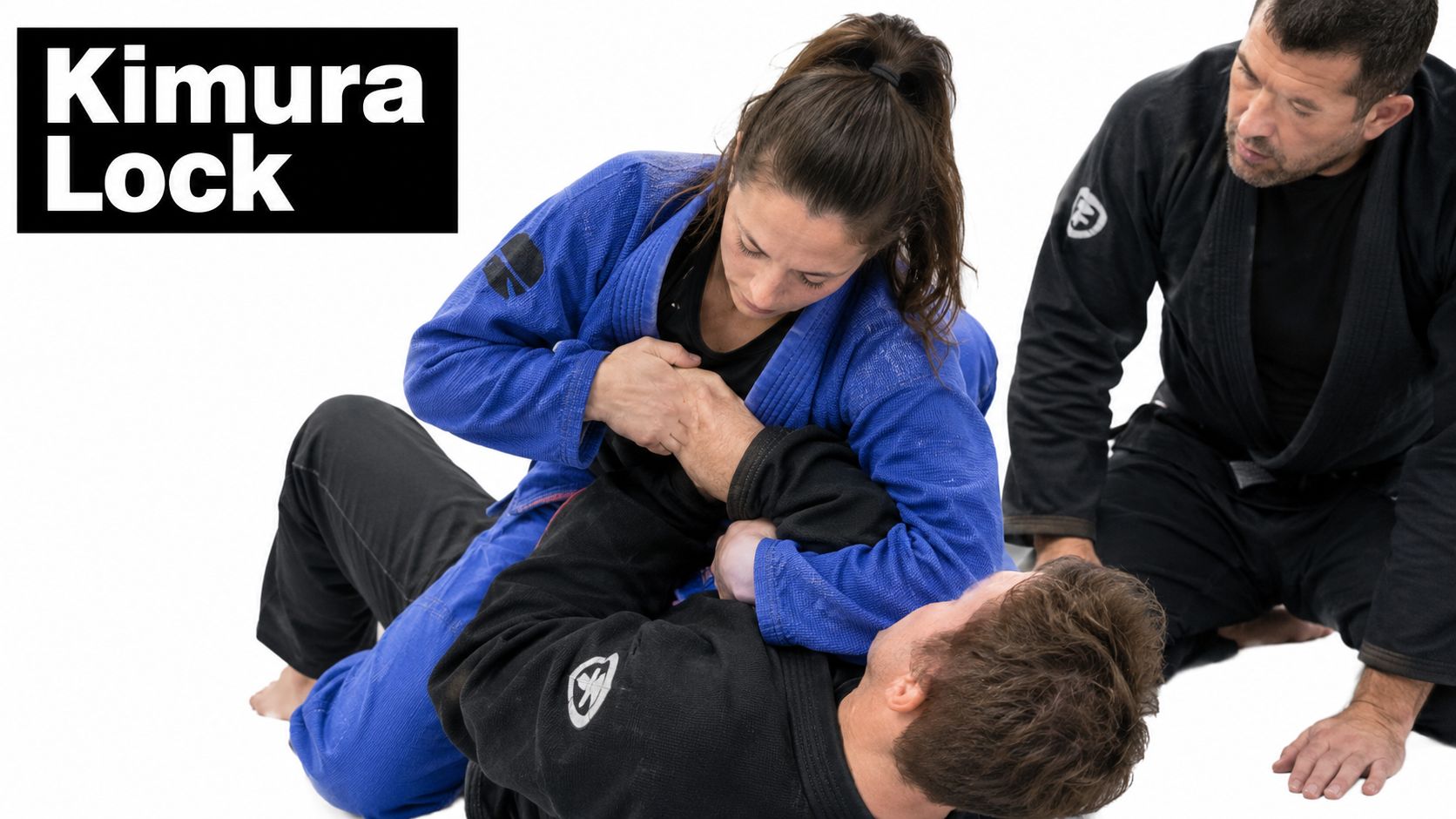
The Kimura is a shoulder-control technique built around isolating an arm and using a figure-four grip to manage the person's posture. You can find it from guard, side control, or during a scramble. Its practical value isn't limited to finishing the shoulder lock. The grip can help pin an arm, stop striking, prevent a person from posting, and create a route to improve your position.
From bottom side control, for example, you may secure the arm when the attacker reaches across your body. Keep their elbow controlled, connect both hands, and bring the arm close to your torso. Rather than immediately twisting, use the grip to limit movement and make space for an escape. You might recover guard, turn onto your side, or come up to a more stable position.
The Kimura also teaches a valuable self-defence habit: control the limb before attempting to move the whole person. That's useful against a stronger attacker because it reduces the number of directions they can use at once.
Use the grip as a steering wheel
The Kimura grip can guide an attacker's upper body, but it won't compensate for poor balance. Keep your elbows tight, maintain connection to your partner, and don't let the isolated arm drift away from your body. Apply pressure slowly in class so your training partner has time to recognise the danger and tap.
Learn the details alongside these arm lock techniques, then practise the position from more than one starting point.
Secure the figure-four grip: Connect both hands before trying to turn the shoulder.
Pin the arm: Keep it close to your body so the attacker can't retract it.
Control posture: Use the grip to stop strikes and limit forward pressure.
Move before forcing: Improve your position if the submission isn't available.
Respect the joint: Shoulder locks can cause injury quickly when applied carelessly.
The Kimura is less about showing strength than creating a dependable connection. In a self-defence setting, that connection can buy the moment you need to stand, call for help, or move away.
5. Guillotine Choke
The guillotine appears when an attacker drives their head forward, shoots for a takedown, or presses into you from the front. You wrap the arm around the neck, control the head and upper body, and use your hips to create an angle. The essential detail is placement. Your forearm belongs high around the neck, not across the windpipe.
It can be effective because the opportunity develops during forward movement. A person who lowers their head may give you access to the neck before they establish a secure takedown. But the guillotine is also easy to misuse. If you hang from the neck without controlling the attacker's posture, they may pass around you, lift you, or drive you into a harder surface.
Train the grip and body position as separate skills. First learn to control the head while keeping your balance. Then add the angle, leg position, and pressure with a coach. The aim is to understand when the technique gives you control and when releasing it is the safer choice.
Avoid tunnel vision
A front neck hold can draw your attention away from everything else around you. In public, you need to consider walls, kerbs, friends, children, and other people entering the situation. If the attacker breaks posture or the grip becomes unsafe, abandon the hold and return to frames, distance, and movement.
A practical sequence might look like this:
Meet the entry: Use your hands to protect your head and control the approaching person.
Secure the neck safely: Keep the forearm high and avoid direct windpipe pressure.
Angle your body: Turn your hips rather than relying on arm strength.
Monitor balance: Don't let the attacker drive you flat without a plan.
Release to escape: Once space appears, move away and seek assistance.
Self defence also has legal limits. The Victorian Law Reform Commission reported that self-defence succeeded in only 11 murder prosecutions in the reviewed cases, described as at least 1% and at most 5% of murder prosecutions (Victorian Law Reform Commission paper on defences to homicide). That's a reminder that force must be tied to an immediate threat and stopped when the threat ends. BJJ can help you control a dangerous moment, but it doesn't replace awareness, escape, or legal advice.
6. Clinch Control and Takedown Defence
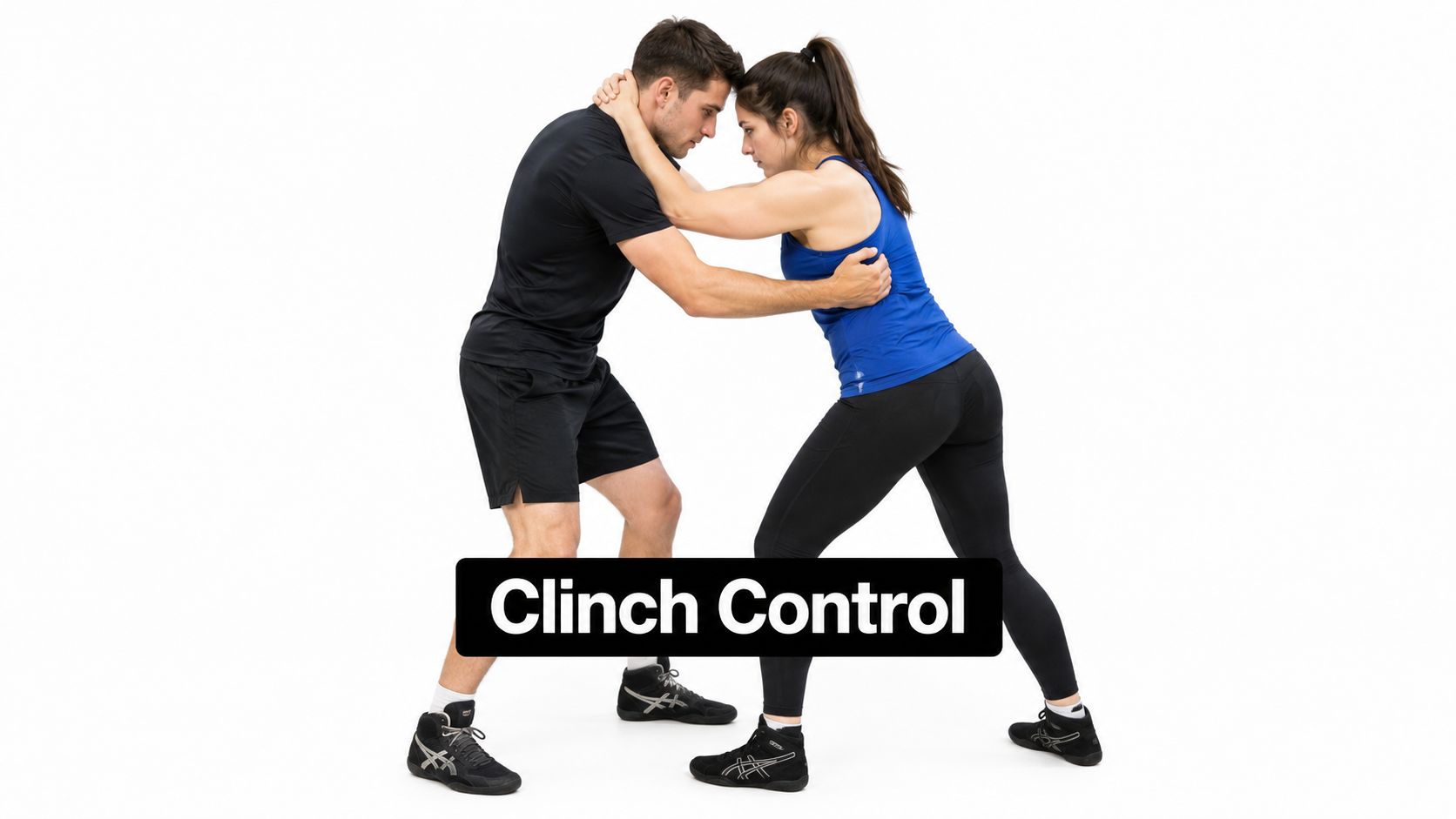
The clinch is the point where distance disappears. You're close enough to be grabbed, pulled, struck, or taken down, so posture and hand position become more important than a complicated technique. BJJ training teaches you to manage the head, neck, shoulders, and hips while keeping your own feet underneath you.
Start with a stable stance. Bend your knees, keep your hips away from the attacker's hips, and use underhooks or controlled collar ties to influence their posture. Head position matters too. Your forehead and shoulder can help deny their forward drive, while your hands monitor the arms and protect your own neck.
A street confrontation doesn't reward unnecessary takedowns. If you can maintain balance, create distance, and leave, that's usually preferable to taking someone to the ground. A controlled takedown may be useful when escape is blocked, but you must account for hard surfaces, unknown objects, and other people nearby.
Standing is a self-defence position
Many practitioners focus on what happens after the takedown. A better starting point is preventing the takedown or staying upright long enough to escape. This guide to Jiu Jitsu takedowns can help you understand the mechanics, but a coach should also teach you how to recognise when not to commit.
The Australian Institute of Health and Welfare recorded 248,643 martial-arts participants compared with 109,617 boxing participants, and hospitalisation data attributed 401 of 602 combat-sports injury cases to martial arts (AIHW combat-sports injury data). These figures aren't a prediction of what happens in a street incident. They do support a sensible training priority: practise controlled entries, posture, escapes, and exits rather than treating prolonged ground exchanges as the default.
Protect your base: Keep your feet active and your knees bent.
Manage the head: Control posture without blindly pulling the neck.
Deny the hips: Maintain enough distance to make the takedown harder.
Use underhooks: Connect to the torso and limit the attacker's control.
Keep moving: Step toward an exit instead of standing still and wrestling for pride.
6-Move BJJ Self-Defense Comparison
Technique | Implementation Complexity 🔄 | Resource Requirements | Expected Outcomes ⭐📊 | Ideal Use Cases 💡 | Key Advantages ⚡ |
|---|---|---|---|---|---|
Armbar from Guard | Moderate, requires precise hip positioning and timing 🔄 | Partner drilling, mat space, repetition; low strength needed | High effectiveness ⭐⭐⭐, isolates arm and creates escape/control 📊 | Ground defense when attacker is between your legs (guard) | Leverage-based vs larger opponents; multiple setups and safe escape options ⚡ |
Rear Naked Choke (RNC) | Moderate–High, must secure back and correct hand placement 🔄 | Positional sparring, back-control drills, trusted partners | Very high effectiveness ⭐⭐⭐⭐, rapid threat neutralization and control 📊 | After taking the attacker's back or during transitions to back control | Extremely efficient; minimal exertion, very difficult to defend when locked ⚡ |
Escape from Mount Position | Moderate, timing, hip explosiveness and shrimping required 🔄 | Repetitive drilling, hip/core conditioning, live-resistance practice | High survival value ⭐⭐⭐, restores guard or reverses position 📊 | When pinned under an attacker in mount; urgent escape situations | Fundamental for safety; reduces panic and builds mobility for follow-up moves ⚡ |
Kimura Lock | Moderate, grip accuracy and arm isolation are critical 🔄 | Partner practice from multiple positions, grip-strength work | High control/submission potential ⭐⭐⭐, versatile control and transition tool 📊 | Isolating an arm from guard, side control, or standing to control or submit | Works from many positions; transitions to other submissions and controls ⚡ |
Guillotine Choke | Moderate, fast setup but angle and timing are critical 🔄 | Reaction drills, timing practice, situational sparring | High immediate control ⭐⭐⭐, effective vs takedowns and close-range attacks 📊 | Opponent shoots for a takedown or leaves head exposed in close range | Quick to set up standing or on ground; adaptable variations (arm/leg assists) ⚡ |
Clinch Control & Takedown Defense | High, requires footwork, balance, and continuous adjustment 🔄 | Extensive drilling, conditioning, live partner work, timing practice | High prevention/positional control ⭐⭐⭐, prevents takedowns and reduces strike power 📊 | Managing distance before ground phase; preventing escalation and takedowns | Foundational for controlling posture and transition to dominant positions ⚡ |
Your First Move Start Your Self Defence Journey
Reading about these techniques is useful, but confidence comes from practising them in a safe, controlled environment. You need to feel what mount pressure does to your breathing, how quickly a clinch changes your balance, and how much hip movement matters during an escape. That understanding develops through repetition with a resisting partner, clear coaching, and gradual exposure to realistic positions.
BJJ for self defence isn't about aggression. It's about protecting your head and neck, maintaining posture, controlling an arm, escaping bad positions, and creating enough space to leave. Those priorities matter in family and domestic violence contexts as well as spontaneous confrontations. The ABS recorded 395,100 Australians experiencing physical assault and 463,400 experiencing face-to-face threatened assault in 2024–25, while police recorded 97,800 family-and-domestic-violence-related offenders, with assault the principal FDV offence for 52% of those offenders (ABS Recorded Crime Victims latest release). A self-defence lesson should therefore include escape planning and boundary-setting, not just submissions.
Partner violence also affects people across genders. An Australian Government summary states that 23% of women, or 2.3 million, and 7.3% of men, or 692,000, have experienced violence by an intimate partner since age 15 (Australian Government gender-based violence summary). Training can build physical confidence, but it should never suggest that a person is responsible for preventing abuse through technique. Safety planning, support services, and professional assistance remain essential.
Locals Jiu Jitsu Zetland and Locals Jiu Jitsu Maroubra provide structured training for children, beginners, adults, and experienced practitioners. Locals Jiu Jitsu Zetland offers a free trial class, with coaching focused on movement, control, fitness, resilience, and practical self defence in a safety-first environment.
Visit Locals Jiu Jitsu Zetland to try a coached class and learn how guard escapes, clinch control, and positional movement work against realistic resistance. Book your free trial, speak with the coaching team about your goals, and start building self-defence skills you can practise consistently.
Comments