_edited.png)
Jiu Jitsu Family Classes: Sydney Parent Guide 2026
You're probably looking at two problems at once. One child wants to try jiu jitsu, another sibling may or may not follow, and you're wondering whether you need to sit on the side of the mat for an hour or get involved yourself. That's where Jiu Jitsu family classes start to make sense.
Most Sydney articles stay at the sales-pitch level. They say family training builds confidence, discipline, or bonding, then stop there. What parents usually want to know is more practical: how the class is run, whether mixed ages are handled sensibly, what safety checks matter, and whether a family plan really saves money once uniforms and extra fees are included.
That detail matters because martial arts isn't a passing fad in Australia. The ABS reported children's martial arts participation rose from 6.2% in 2003 to 7.5% in 2009, and later noted a 24% increase between 2003 and 2012 in children's martial arts participation, with strong uptake in primary-school ages through organised sport ABS children's participation data. For parents in Zetland, Waterloo, Kensington, and Alexandria, that lines up with the age when kids are trying structured after-school activities and parents are deciding what feels safe, useful, and realistic to keep up.
What a Family Class Actually Looks Like
Walk into a real family class a few minutes early and the room tells you a lot. The mats have that fresh disinfectant smell. You hear the tap of bare feet, kids whispering to each other, a parent asking where to leave water bottles, and a coach clapping once to bring the room together. Some people are in gis, some are in rashguards and shorts, and younger siblings often sit on the edge of the mat playing with spare belts or watching closely.
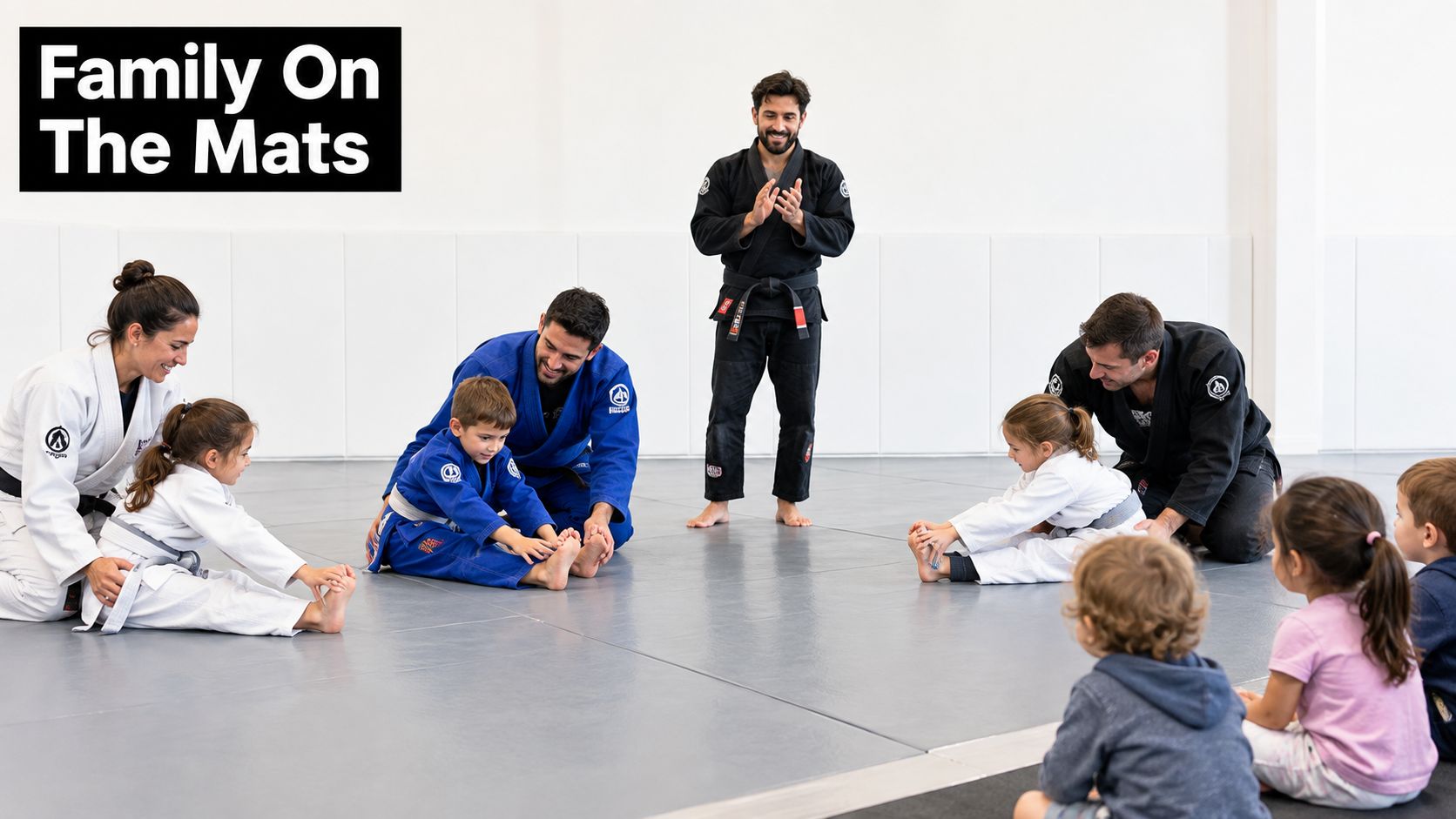
A family class isn't a kids class with adults standing against the wall. It also isn't an adult class where children are allowed in the room. It's a shared session where both groups learn the same idea on the same mat space, but at different levels and with different expectations.
Before the class settles
At the start, the energy is a bit loose. A six-year-old may bounce in place. A parent may kneel beside them to help tie a belt. Instructors who work well with children usually drop to eye level when correcting them, rather than calling instructions across the room.
If you want a useful local explanation of how shared sessions are meant to work, family martial arts classes in Zetland gives a straightforward picture of parents and children training under one coaching system instead of being split into totally separate experiences.
Practical rule: If the room feels chaotic from the first minute to the last, that's not “kids being kids”. A good family class has noise, but it also has clear switches between play, instruction, and control.
During the warm-up and after
Once the class begins, the feel changes quickly. Parents and kids warm up side by side. You'll see simple movements, light games, and partner work that gets everyone moving without throwing beginners into anything complicated. The pace is brisk enough that children stay engaged, but not so rushed that adults spend the whole hour trying to catch up.
After warm-up, the room usually gets quieter. That's when coaches demonstrate a position, then pairs spread out and repeat it. By the end, everyone is a little sweaty, belts are slightly crooked, and the mood is often more settled than when people arrived. That shift is one of the clearest signs the class is being run properly.
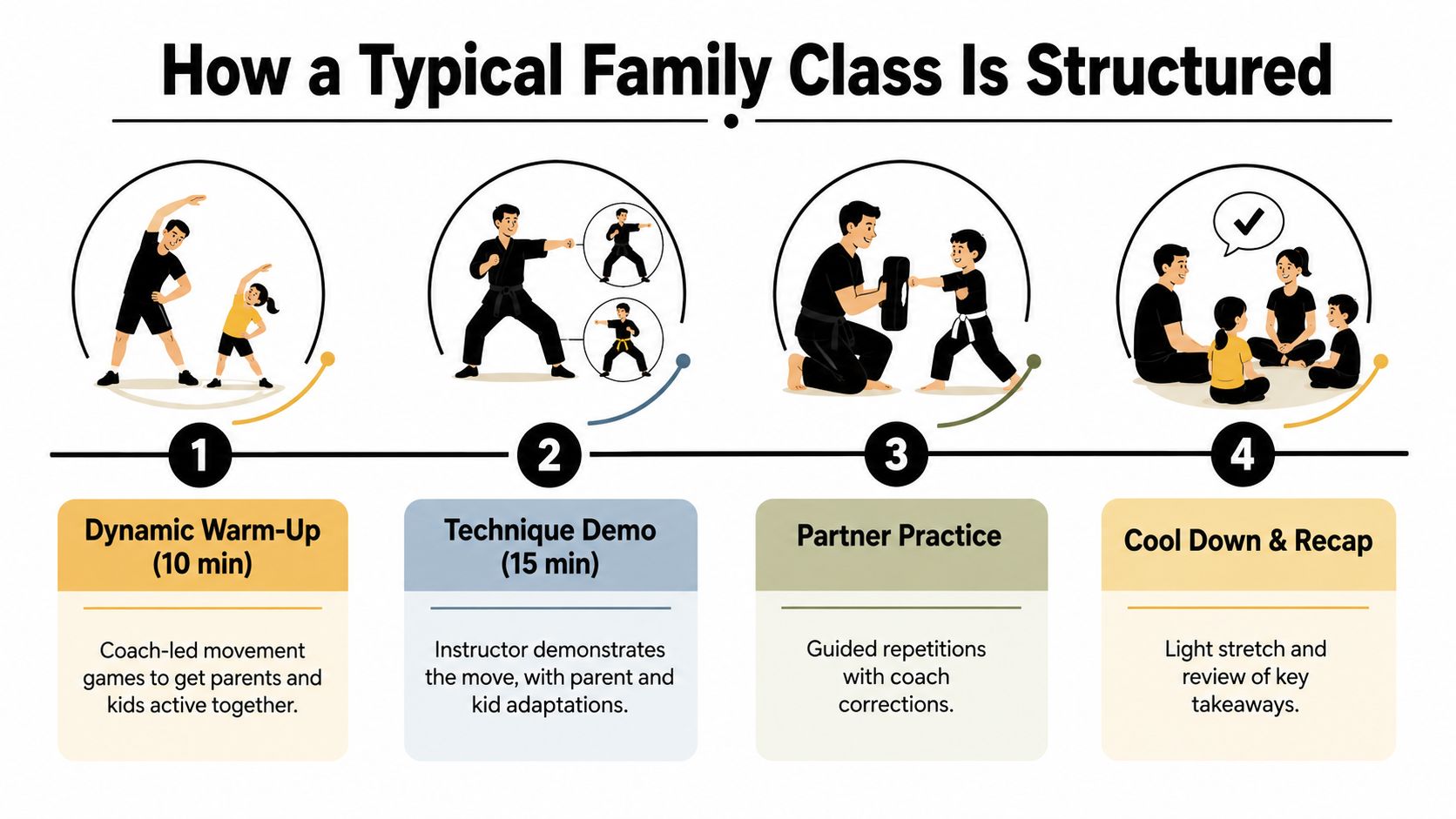
How a Typical Family Class Is Structured
Most family classes follow a simple progression because it helps attention, safety, and learning. A swimming lesson follows a similar pattern. You don't throw people into the deep end and hope they work it out. You start with entry, then instruction, then controlled practice, then a carefully watched test of what they've learned.
The four blocks most parents will see
Dynamic warm-up This usually runs for about 10 minutes. The coach leads movement drills that raise the heart rate, wake up coordination, and get children listening early. In family classes, the warm-up often doubles as a behaviour reset. Everyone starts together, everyone learns the rules together.
Technique demonstration This block is commonly about 15 minutes. The coach shows one main movement, then adapts it. A child might learn where their hands go and how to balance. A parent gets the same idea with more detail about pressure, posture, and timing.
Drilling with a partner
Another 15 minutes often goes here. People repeat the movement again and again. Coaches move around correcting grips, spacing, and pace, usually with simpler instructions for children and more technical notes for adults.
A clean room is part of that structure, not a side issue. If you want to understand what proper cleaning looks like between sessions, these science-backed mat sanitation methods are a useful benchmark for what parents should ask about.
Later in the class, many coaches add a visual recap or cue before the final activity.
The last block is controlled, not chaotic
The final segment often runs for about 10 minutes and can look different depending on the age mix. Sometimes it's very light positional sparring. Sometimes it's a game built around one objective, such as holding top position or escaping safely. The key is that intensity is capped.
A good family class doesn't save all the excitement for the end and let it turn sloppy. The coach should narrow the task as the pace rises.
Australian school risk guidance is helpful here because it treats martial arts on a spectrum, from non-contact practice to higher-risk light-contact work, and recommends controls such as a 3-metre safety zone, matting, equipment checks, and immediate management of open wounds Queensland school martial arts guidance. That's why many instructors put supervised live work at the end, when the room is already organised and everyone knows the task.
Why Families Train Together
Parents and children don't get the same thing from family training, and that's part of the value. Kids usually gain familiarity with challenge. Adults usually gain consistency. Both matter, but they show up differently.
Australia's broader participation picture supports the idea that family-oriented martial arts isn't unusual. The Australian Sports Commission's AusPlay datasets track martial arts across children and adult age bands, and the archived taekwondo material shows a strongly youth-skewed profile, with 39,000 children aged 0 to 14 in 2025 compared with 26,000 Australians aged 15+ in the same sport Australian Sports Commission taekwondo archive. That doesn't prove every family should train together, but it does show why shared formats appeal to households making one after-school decision for several people.
Kids usually gain one kind of confidence
For a child, jiu jitsu teaches calm in small, manageable doses. They learn what to do when someone is heavier, when they can't get out on the first try, or when they need to stop and start again. That's different from the vague “confidence” language you often hear. It's confidence tied to a task.
Belt progress also helps because children can see progress in concrete steps. They remember the sweep they couldn't do three weeks ago and can now repeat with decent timing. That sort of visible progress often matters more than speeches about resilience.
Adults usually gain a routine that includes their child
For a parent, the benefit is often practical. You get a structured hour off screens, a full-body session that doesn't rely on endless running, and one shared schedule instead of separate drop-offs. It's also one of the few activities where a child can see you struggle, listen, improve, and keep going.
Benefit Area | For Kids | For Parents |
|---|---|---|
Pressure | Learn to stay calm when stuck or outmuscled | Practise staying composed while learning something unfamiliar |
Physical habit | Build a regular training rhythm | Get a low-impact strength and movement session |
Progress | Belt steps and repeated skills make improvement visible | Skill development gives exercise a clear purpose |
Family routine | Train with a trusted adult nearby | Avoid juggling separate activity timetables |
Conversation off the mat | Shared effort makes stories from class easy to revisit | Shared effort can open up better post-class chats |
Training together can help families connect. It isn't a substitute for all family time, and parents shouldn't feel they have to join every session for the experience to matter.
Age Ranges, Supervision, and Mixed-Group Coaching
Many parents get stuck. They hear “family class” and picture a five-year-old, a teenager, and a beginner parent all being paired randomly. In a well-run room, that isn't how it works.
How age groups are usually handled
A common structure looks something like this:
Age Group | Typical Ratio | Format | Trains With Parents |
|---|---|---|---|
Little Grapplers, 4 to 6 | 1 coach to 6 | Shorter warm-up, simple movement, quick transitions | Sometimes for shared drills, often partly separated |
Juniors, 7 to 12 | 1 coach to 8 to 12 | Main family format, technique and guided partner work | Yes, often during technique and drilling |
Teens, 13 to 15 | Varies by maturity and experience | Closer to standard technical class expectations | Often, with more care in partner matching |
Adults, 16+ | Grouped by experience where possible | Full participation with adjusted intensity | Yes |
Younger children often start with a more separate warm-up, then rejoin for a shared technical segment. That's not a contradiction. It's usually the best way to manage short attention spans without dragging older students backwards.
The important part is partner matching
Most sensible programs let a family learn the same concept while still drawing lines around who does live rounds with whom. A ten-year-old may drill a movement with a parent. That doesn't mean they'll do fully resistant sparring with a much larger adult.
Mixed-age coaching works when the whole room studies the same idea, but the coach still filters by age, size, experience, and control.
Youth safety in martial arts still isn't covered very thoroughly in neutral Australian writing. Current discussion is often promotional, while a 2026 youth safety report referenced in Australian commentary noted that only 4% of respondents named martial arts as their sport context, which suggests the broader child-sport safety conversation is still relatively thin for grappling classes Australian commentary on family classes and youth safety coverage. Parents usually need more operational detail than they get.
When siblings stay together and when they don't
Siblings close in age may spend much of the session near each other. Siblings with a wider gap often split for at least part of the class. That's normal. It's often safer and more productive than forcing a shared experience from start to finish.
A parent can usually expect three layers of filtering during live work:
Age buffer so very young children aren't put into adult-style rounds
Size buffer so pairings stay sensible, especially for newer students
Skill buffer so beginners aren't overwhelmed by experienced partners
If a class ignores those buffers, the “family” label doesn't make it safer.
Safety Standards Parents Should Expect
Some parents worry too much about the wrong things and not enough about the right ones. The right question isn't whether jiu jitsu can ever produce bumps, mat burns, or finger jams. It can. The better question is whether the class is built to reduce avoidable risk from the moment you walk in.
What should happen on day one
A safety-conscious academy should collect a waiver, ask about injuries or medical issues, explain basic mat rules, and tell families what hygiene standard is expected. Clean uniform, trimmed nails, no shoes on the mat, and stopping immediately when a partner taps are all basic, but they matter because they prevent the small avoidable problems that become big distractions.
Australian child-safety and martial arts guidance also gives parents useful benchmarks. Instructors working with under-18s should hold a current Working With Children Check or equivalent, maintain first-aid and CPR capability, and have response tools such as AED, ice, and compression equipment available Australian martial arts consumer guidance. If you want a plain-language overview of Background checks for martial arts instructors, that can help you frame the right questions before enrolling.
What to watch during the class
The first live clues come during warm-ups and partner changes. Are coaches scanning the room, or mostly teaching from one spot? Do they stop unsafe movement quickly? When a child taps because a grip feels wrong or pressure comes on too fast, does the partner release straight away?
A useful beginner reference on expected etiquette is basic BJJ rules for beginners, especially for families who've never been in a grappling room before.
Parents don't need to become safety experts. They do need to notice whether the coach corrects behaviour early, not after the room gets rough.
Injury risk is real, but context matters
The honest version is simple. Minor knocks happen. Fingers get caught in fabric. People bump heads during scrambles. Children can get overexcited and forget spacing. That's why age structure and supervision matter so much.
Current local injury guidance summarising Australian martial arts patterns notes that children under 10 had lower injury incidence than older groups, while 10 to 14-year-olds showed higher rates when exposure time was considered, and about one-third of injuries were moderate to severe local summary of youth martial arts injury guidance. That doesn't mean family classes are unsafe. It means coaches need to organise them carefully, especially for that middle age band.
Pricing, Packs, and the Real Cost of Training
This is the part families often underestimate. The weekly fee is only one layer. The question is what you'll pay over a school term once attendance patterns, uniforms, and add-ons are included.
The main pricing models
Most family programs fit into a few broad structures. You'll usually see single drop-ins, class packs, recurring memberships, and some kind of family discount. On paper, a family plan can look cheaper. In practice, it only saves money if your household can attend often enough to use it.
The value question is increasingly relevant because Australian operators are actively promoting family offers and combined schedules, but neutral local content rarely explains when those offers help and when they don't family program structure and value questions in Australian marketing. Convenience around after-school timing in suburbs like Zetland, Waterloo, Kensington, and Alexandria often decides more than the headline rate.
What families forget to count
Cost Item | Typical Range | Frequency |
|---|---|---|
Drop-in or casual class | Varies by academy | Per visit |
Class pack | Varies by academy | Used over a set block |
Monthly membership | Varies by academy | Ongoing |
Family discount | Varies by academy | Depends on plan |
Gi or rashguard | $80 to $150 each | Usually upfront, sometimes replaced later |
Grading fee | Varies by academy | Periodic, where charged |
Competition entry | Varies by event | Optional |
Insurance or affiliation levy | Varies by academy | Usually annual if charged |
One practical way to compare options is to list everyone in the household, estimate realistic attendance, then ask what happens when one child misses a week or a parent can only come once. A flexible pack can beat an unlimited plan if your schedule is patchy.
For a Sydney-specific starting point, how much jiu jitsu costs is worth reading before you compare term totals.
A better way to judge value
Don't just ask, “What's the weekly fee?” Ask:
What's included in the membership. Open mat, holiday sessions, or beginner pathways can change the value.
How sibling pricing works in real terms. Some discounts sound generous until uniform and grading costs are added.
Whether sessions fit your calendar. Paying for access you won't use is still overpaying.
A parent with one child may do better with a simpler plan. One parent training with two children may get better value from a family structure if the timetable lines up and everyone attends.
Getting Started at Locals Zetland or Locals Maroubra
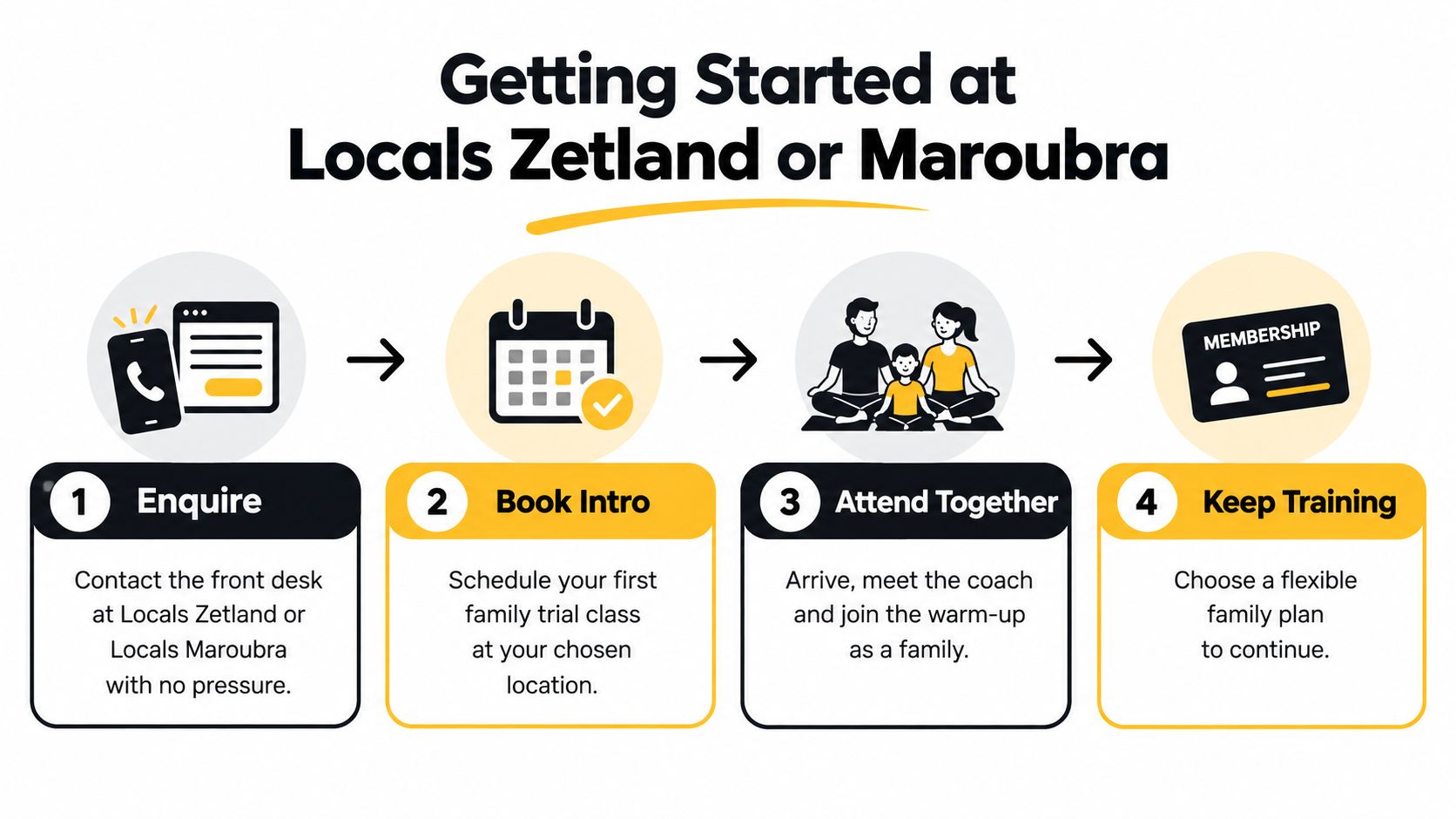
Starting should feel simple, not theatrical. A proper first step is a short phone call or web form where staff ask each child's age, whether anyone has trained before, and what the parent is hoping for. Some families want confidence and coordination for the kids. Others want one shared activity after school. Both are normal starting points.
What the first visit should involve
The most useful first class is a trial placed into a normal family session, not a polished one-off demonstration. That lets you see the actual rhythm of the room, how the coach manages mixed ages, and whether your child responds well to the format. For a family considering one local option, Locals Jiu Jitsu Zetland offers structured kids, beginner, and family-oriented training pathways within a community setting, which makes it easier to judge fit against your household's schedule and goals.
Arrive about ten minutes early in comfortable clothes. No gi should be necessary for the first visit. Staff can show you where bags go, where siblings can wait, and whether parents are expected to step straight onto the mat or watch the opening minutes first.
What happens after the class
A good post-class debrief is short and clear. The coach should be able to tell you what your child practised, how they handled instruction, whether parent participation worked well, and what the next few weeks would look like. That matters more than any hard sell.
Parking and public transport will differ between Zetland and Maroubra, so it's worth checking the easiest route before booking. For many families, convenience decides whether enthusiasm survives past the first fortnight.
If the first conversation feels pressured, keep looking. Family training works best when the academy is calm about fit, not desperate for a sign-up.
The enrolment step should also be straightforward. Expect a membership option, a starter gi or rashguard pathway, and a sensible review point after the first few weeks so the family can decide whether the format is right.
Locals Jiu Jitsu Zetland offers structured training for kids, beginners, adults, and families who want one safe, organised way to train together rather than juggle separate activities. If you want to see how a real family class feels on the mat, visit Locals Jiu Jitsu Zetland and book a trial that shows the actual class format, not a staged demo.
Comments