_edited.png)
8 Kids Jiu Jitsu Drills for Safe Skill Progress
A child starts class with a playful movement game, laughs through a few safe falls, then works with a partner to escape a carefully controlled mount. Nothing is rushed. The coach adjusts the distance, slows the pace and reminds both children to communicate before the next repetition. By the end, the child has practised movement, body awareness, technical repetition and decision-making without needing hard sparring.
That's the purpose of effective kids jiu jitsu drills. They should build skill through safe, playful progressions, not turn every exercise into a test of strength or intensity. At Locals Jiu Jitsu Zetland, instructors can use drills to help children learn safe falling, hip movement, guard work, positional control and partner responsibility in a structured setting. Locals Maroubra is part of the broader Locals community, but the examples here are designed for parents and instructors around Zetland, Waterloo, Kensington and Alexandria.
The eight drills below move from movement literacy and isolated technique towards positional decision-making. They include age-aware adjustments, coaching cues, partner communication, session structure and observable progress markers. For parents comparing training resources, Vanta Sports training resources can provide another useful point of reference, but the safest progression always depends on qualified coaching, suitable mats and a child's readiness.
1. Shrimp Escape Drills
A child lying on their back can feel stuck before they understand how to create space. The shrimp escape gives them a simple movement pattern: plant the feet, lift the hips, move the body sideways and recover a useful position. It's one of the most important early kids jiu jitsu drills because it links body awareness to defence.
At Locals Jiu Jitsu Zetland, an instructor might begin with children spread across padded mats. Each child lies on their back with feet planted and arms positioned safely beside the body. The coach demonstrates how to lift the hips, turn slightly onto one side and slide away, rather than wriggling quickly across the mat.
Build movement before adding pressure
Younger children can practise static shrimping as a movement game. For example, the coach can call “left” or “right”, and the children move in the nominated direction while keeping their feet connected to the mat. Developing students can work in timed intervals of 20 to 30 repetitions, using the interval guidance in the drill plan rather than racing through poor-quality movements.
A sensible progression looks like this:
Static movement: The child practises hip elevation and lateral movement alone.
Partner connection: A partner places a hand lightly near the shoulder or hip, without driving weight into the child.
Gentle resistance: The partner applies controlled pressure while the moving child creates space and turns into a defensive position.
Coaching cue: “Lift, turn and slide.” Speed matters less than making enough space to move safely.
The coach should monitor breathing and tension. A child holding their breath, lifting with the neck or throwing the legs wildly needs a reset. Mirrors or short video feedback can help older children recognise whether their hips are moving far enough, provided the feedback remains encouraging and simple.
Parents should look for smoother movement, better awareness of direction and a willingness to use the escape when placed underneath a partner. The Locals Jiu Jitsu guide to BJJ defence techniques can support further discussion about defensive movement, but children should learn the drill under direct supervision.
2. Guard Passing Ladder Drills
A child reaches open guard, steps too close, and gets pulled forward. The coach pauses the round and asks, “Where is your balance?” This moment shows why guard passing should develop as a sequence of decisions, not a race around the legs. At Locals Jiu Jitsu Zetland, instructors can build the sequence from distance management to a controlled finish, adding complexity only after the child understands the earlier movement.
Begin with a cooperative standing pass. Partners of similar size alternate roles. The guard player places their feet in a clear position, while the passer establishes posture, manages distance and waits for the opening. After the pass, both children pause so the coach can check whether the passer has control rather than moving past the legs.
Build choices one at a time
The ladder works like learning to cross stepping stones. Each movement gives the child a stable place to solve the next problem:
Open guard entry: The passer keeps balanced feet, avoids careless steps and learns to move the legs aside without rushing.
Knee slice: The coach isolates the angle, knee position and upper-body connection before adding resistance.
Toreando movement: The child redirects the legs, changes direction and moves around the guard while staying upright.
Positional hold: The passer settles safely after the pass and shows control for a short count.
Use simple coaching cues such as, “Posture first,” “Move the legs, then move your body,” and “Find your base before you continue.” Younger children can practise one choice at a time with brief rounds and frequent resets. Older or more experienced students can switch sides, change partners and respond when the guard player recovers position.
Resistance must be agreed before contact. Progress from 50% resistance to 75% resistance only when the child can keep safe posture, communicate pressure and complete the movement without panic. These levels guide the coach; they are not goals every child must reach.
“Tell your partner what pressure feels manageable before you start.”
Observe the decision, not only the result. Progress appears when a child stops forcing the pass, recognises an open side, protects balance and resets calmly after losing position. Pause immediately for discomfort, confusion or unsafe pressure, then return to the last successful step.
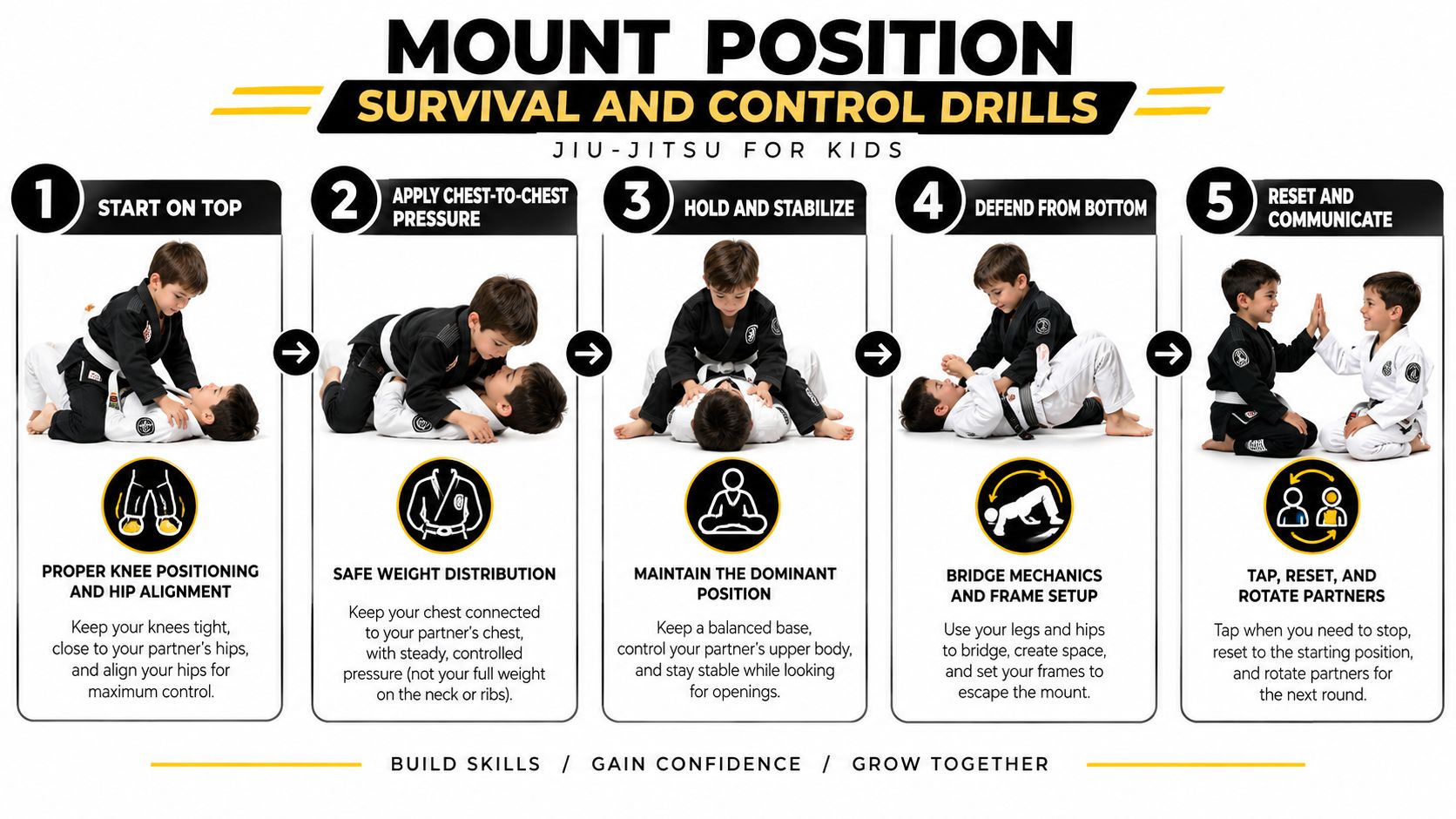
3. Mount Position Survival and Control Drills
A child may hold mount correctly yet still feel lost underneath it. This position develops two connected skills: the top partner learns to balance and control weight, while the bottom partner protects space, moves the hips and searches for a safer position. Coaches at Locals Jiu Jitsu Zetland can present both roles as progress, so defensive work feels like problem-solving rather than failure.
Begin with a quiet, static mount. The top child places the knees securely, keeps the hips centred and uses chest contact without pressing heavily on the partner's ribs or neck. The bottom child protects the head, keeps breathing steadily and waits for the coach's signal. For younger beginners, practise only the posture and breathing first. Older or experienced students can hold the position while the bottom partner adds a bridge and hip movement.
Build the round around a clear decision
Use a short hold, then give the bottom partner one task, such as bridging to make space or turning towards a protected side. The top partner responds by widening the base and following the movement without squeezing. Stop, name the useful action, and reset with partners changing roles. This structure makes the drill resemble a simple puzzle: one child creates space, and the other closes it while staying balanced.
Agree on communication before contact. Partners choose a manageable pressure level and confirm the tap signal. Either child may say “pause,” and the top partner releases immediately after a tap. During feedback, the coach can identify one successful action before giving one correction.
Submission setups can wait until children show stable knee position, hip alignment, hand placement and safe chest contact. More experienced students may recognise submission threats, but they should not apply them quickly or force a reaction.
Use the failure round to measure decision-making, not dominance. The bottom child aims to return to a protected posture; the top child maintains control for a brief, manageable period. Praise calm breathing, sensible defence, safe pressure and an immediate reset after losing position. A parent can ask whether their child knows when to tap and can restart without embarrassment. Those behaviours show progress more clearly than holding mount for a set duration.
4. Takedown Fundamentals Drills
A child rushes forward, reaches for a partner and forgets to set their feet. The safest response is to return to the basics. Takedown practice should begin with posture, stepping, balance and safe falling before children attempt to lift, throw or complete a takedown.
Use a progression that feels like learning to walk before running. First, children practise bending their knees, lowering their centre of gravity and moving around a partner with a light connection. Next, they rehearse a stationary foot-sweep motion, guiding the foot towards the partner's balance point without trying to make the partner fall. The partner stays stable and reports whether the movement felt controlled. Older or experienced students can add gentle resistance, while younger children may work from a marked stance with the coach counting each step.
Make falling part of the routine
Safe falling gives children a reliable exit when balance is lost. On crash pads or soft mats, practise the landing separately before connecting it to a takedown. A coach can demonstrate, use a stationary partner and add movement only after the child follows the landing instruction calmly. Mirrors or balance equipment may help with foot placement, but they should support technique rather than add speed.
Keep these checks visible:
Check the surface: Provide adequate mat padding and clear the practice area.
Control the landing: Teach safe landing mechanics before any takedown finish.
Use support: Start with a stationary partner or coach-assisted version.
Watch the head: Stop movement that could cause uncontrolled contact.
Reset often: A clean repetition teaches more than a fast sequence.
Better Health Victoria recommends a thorough warm-up and sustained stretching for at least 15 minutes before kicks or punches, followed by a cool-down, in its martial arts injury prevention guidance. Children should be physically prepared before demanding standing movements. Better Health Victoria's martial arts injury guidance gives parents and instructors useful safety context.
The video below shows the kind of controlled movement an instructor may demonstrate. It cannot replace hands-on coaching.
Parents can also consult Locals Jiu Jitsu Zetland's takedown guide for a technique-specific explanation. Progress when the child keeps balance, follows the landing cue, communicates comfortably with a partner and stops immediately when the coach calls.
5. Side Control Position Drills
A child in bottom side control may feel pinned before understanding what to do. The drill should turn that pressure into a clear sequence: frame, create space, move the hips and recover a safer position. The top child learns a matching lesson, staying connected through balanced chest-to-chest control while responding to movement without relying on force.
Start with a partner demonstration and a still position. The coach checks head placement, hip distance, arm position and breathing. Ask the bottom child to name a frame and show where the hips will move before the round begins. Younger children can practise one action at a time, while older or more experienced students can connect the actions into a guard-recovery pathway.
Use a “hold and recover” activity rather than an open scramble. The top partner maintains a stable position as the bottom partner follows the planned escape. Once the bottom child creates enough space or returns towards guard, both partners freeze, acknowledge the result and reset. This makes progress visible: the child is not surviving longer, but choosing a frame, moving with purpose and returning to a safer position.
Build the round in layers
Keep the first exchange brief and quiet. The top child adjusts with small steps and hip movement, without squeezing, dropping weight suddenly or chasing a fast finish. The bottom child uses steady frames and controlled hip movement instead of pushing blindly.
A coach can progress the task through these stages:
Position recognition: Partners freeze while the instructor checks alignment and comfort.
Single-action escape: The bottom child performs one previously taught frame or hip movement.
Responsive control: The top child follows the movement while preserving balance.
Decision point: The bottom child chooses whether to recover guard or reset safely.
Use 30 to 60 second intervals only when both children remain calm and technically organised. A shorter round is better when a child becomes tense, loses breathing rhythm or asks to pause. Its consumer safety guidance explains why supervised, progressive training, suitable mats and controlled sparring practices support safer martial arts instruction.
Parents and instructors should listen for clear communication. Saying “lighter”, tapping clearly or requesting a reset shows that a child understands both technique and shared responsibility.
6. Collar and Sleeve Grip Drills
A child in guard may grab quickly, then pull harder when the partner resists. Grip drills replace that reaction with a clearer skill: connect, feel the partner's balance and choose whether to hold, break or disengage. Collar and sleeve work therefore develops distance control while reinforcing consent. Clothing is a training connection, never a handle for yanking.
Begin with a quiet partner check. One child establishes a relaxed collar and sleeve grip, holds it briefly, releases and reconnects. The coach watches finger placement, wrist comfort and shoulder tension. Younger children can practise this without movement, while older or more experienced students can add a small step after both partners show control.
Build decisions through short games
Use a nominated grip game once the connection is safe. One child tries to establish the agreed collar or sleeve grip; the other removes it with correct hand position and posture. Stop as soon as the grip is secured or broken, then swap roles. The goal is accurate timing, not winning through force.
Coach the progression by changing one demand at a time:
Connection: Make the grip with relaxed fingers and a comfortable wrist.
Release: Hold for 20 to 30 second intervals, then let go and shake out the hands.
Grip breaking: Peel or redirect the connection without twisting fingers.
Movement: Add small steps while both children keep their balance.
Choice: Let the child establish, break or disengage according to the partner's movement.
Use a simple class scenario. If the sleeve hand is removed, the child may reconnect, change grips or create space. Ask, “What did you feel?” before correcting the next action. This turns grip fighting into a decision rather than a repeated tug.
Pain or finger discomfort ends the exchange immediately. The coach checks the gi grip, lowers resistance and resets the position. Grip-strength exercises may appear in the warm-up, but technique and partner comfort remain the purpose.
Observable progress includes establishing a grip without staring at the hands, breaking one without twisting the partner's fingers and releasing on command. Those habits transfer into guard passing and positional games.
7. Positional Sparring and Rolling Progressions
Positional sparring connects isolated drills to real decisions. Instead of beginning from standing and asking children to solve everything at once, the coach starts them in guard, mount or side control. Each child knows their immediate task, which makes the round more understandable and easier to control.
A beginner might start from a predetermined position for 30 seconds. An experienced child may work towards rounds lasting 2 to 3 minutes, provided the coach believes the child can maintain safe intensity and clear communication. These durations come from the progression plan and should be adjusted for age, fatigue, behaviour and technical readiness.
Give every round a narrow focus
One round could ask the bottom player to recover guard while the top player maintains posture. Another could ask the mount player to stabilise while the bottom partner works on a bridge and escape. The coach can use a timer, stop the round after a clear outcome and explain one technical observation before the next pairing.
Flow rolling is a useful first step. Partners cooperate enough to keep movement continuous, then gradually add resistance over several sessions. Children should rotate partners regularly, with instructors choosing matches based on size, maturity, experience and ability to follow safety rules.
Practical rule: Increase only one demand at a time. Add resistance, duration or complexity, but don't increase all three together.
The instructor should establish the tap signal before the first round. Children need to know that tapping ends the action immediately, and that verbal communication remains available throughout. Queensland Education guidance says equipment should be checked for damage before and during activity, and that a student should not return to play after an injury when there is doubt until they've received medical clearance. Queensland's martial arts activity guidance offers a clear reference for this cautious approach.
Parents can judge progress through problem-solving. A child who tries a new escape, stays composed after losing position and helps a partner reset is developing more than a submission count can show. For ideas about training in a supervised group setting, parents can explore Locals Jiu Jitsu Zetland's open mat information.
8. Repetition Drilling and Technique Isolation
Repetition works best when children understand what they're repeating. The coach selects one technique, removes unnecessary speed and gives the child enough time to feel the body mechanics. The partner remains compliant at first, then becomes semi-compliant only when the moving child can perform the sequence safely.
An instructor might use arm drags, collar chokes or armbar escapes as examples, but the choice should match the child's age, experience and current class focus. Younger children can practise 10 to 15 repetitions of a simple movement before switching activities. Older children may complete 20 to 30 repetitions of a fundamental technique in a session, as long as form remains controlled.
Keep repetition purposeful
The first repetitions should be slow. The child checks hand placement, foot position, breathing and the direction of movement. Partners can offer one useful piece of feedback, such as “your elbow moved away” or “your hips turned too early”, rather than giving a long list of corrections.
A session might follow this pattern:
Coach demonstration: Show the complete technique at a child-friendly pace.
Isolation: Practise the first movement without resistance.
Linked sequence: Add the next action once the first is reliable.
Partner feedback: Allow the partner to describe comfort and pressure.
Smooth repetition: Increase flow only when control remains consistent.
Partners should rotate regularly so children experience different body shapes and movement responses. Mirrors or short video feedback may help older students understand posture, but the coach's immediate observation remains more important than reviewing every attempt.
The guiding principle is that practice should build a reliable movement habit, not reward mindless volume. This explanation of how practice builds lasting skills can help parents understand why careful repetition matters.
A visible progress marker is improved consistency. The child completes the technique on both sides, communicates pressure, accepts correction and maintains smooth movement as the partner becomes less cooperative. If the child rushes, forgets the sequence or loses safe posture, reduce the repetitions and return to isolation.
Kids Jiu-Jitsu: 8-Drill Comparison
Drill | Implementation Complexity 🔄 | Resource Requirements ⚡ | Expected Outcomes 📊⭐ | Ideal Use Cases 💡 | Key Advantages ⭐ |
|---|---|---|---|---|---|
Shrimp Escape Drills | 🔄 Low, basic movement patterns | ⚡ Minimal, mats, partner optional | 📊 Core strength, hip mobility; ⭐ Improved escape mechanics | 💡 Warm-up, fundamentals, beginners | ⭐ Accessible, low‑impact, minimal gear |
Guard Passing Ladder Drills | 🔄 Medium→High, progressive sequencing | ⚡ Moderate, partners, experienced coach | 📊 Positional control & decision‑making; ⭐ Competition readiness | 💡 Structured classes, skill progression, comp prep | ⭐ Clear progression; develops tactical thinking |
Mount Position Survival and Control Drills | 🔄 Medium, safety & partner matching required | ⚡ Moderate, partners, close supervision | 📊 Mount control and escape proficiency; ⭐ Defensive confidence | 💡 Teaching top/bottom roles; resilience building | ⭐ Teaches weight management; high real‑world relevance |
Takedown Fundamentals Drills | 🔄 Medium, progressive spotting and falls | ⚡ Moderate→High, crash pads, spotters, space | 📊 Safe takedowns, balance, explosive power; ⭐ Standing‑range confidence | 💡 Stand‑up skill development, cross‑sport transfer | ⭐ Practical self‑defence; engaging for kids |
Side Control Position Drills | 🔄 Low→Medium, positional focus | ⚡ Minimal, partners, mats | 📊 Pressure control & transitions; ⭐ Strong positional foundation | 💡 Positional control training, submission setups | ⭐ Effective for smaller practitioners; control‑oriented |
Collar and Sleeve Grip Drills | 🔄 Low, isolated repetitive work | ⚡ Low, gi required, minimal space | 📊 Improved grip strength & gi control; ⭐ Essential gi skill | 💡 Gi classes, warm‑ups, conditioning | ⭐ Builds grip naturally; low‑risk and space‑efficient |
Positional Sparring and Rolling Progressions | 🔄 High, intensity & progression management | ⚡ High, experienced partners, timers, coach supervision | 📊 Realistic application, adaptability; ⭐ Best for competition prep | 💡 Bridge between drills and full sparring | ⭐ Applies skills under pressure; builds strategy |
Repetition Drilling and Technique Isolation | 🔄 Low, controlled, repetitive practice | ⚡ Minimal, partners/solo, coach feedback | 📊 Muscle memory and technical precision; ⭐ Foundation building | 💡 Beginners, learning new moves, technique refinement | ⭐ Safest and most effective for fundamentals |
Turn Drills Into Confident Training Habits
The eight drills work best as a connected learning pathway. Younger children need playful movement, safe falling and short activities that help them recognise body positions. They can shrimp across the mat, practise bridging, play simple grip games and learn to stop when a partner says “pause”. The coach's job is to keep instructions short, demonstrate clearly and change the activity before fatigue turns movement into unsafe behaviour.
Developing students can spend more time on technique isolation and partner progressions. A class might combine shrimp escapes with mount survival, then move into a guard passing ladder where both partners alternate roles. The instructor can ask children to repeat the same movement on both sides, describe what pressure feels manageable and recognise when a position is becoming unstable.
Experienced learners can add controlled positional sparring and more complex decisions. They may begin from mount, side control or guard, then work within a specific technical rule. One child could focus on maintaining posture while the other seeks a guard recovery. The coach can increase resistance only after the children show that they can communicate, tap and reset without losing control.
A simple session structure keeps the class focused:
Warm-up: Use movement games, shrimping, bridging and safe falling.
Technical focus: Teach one main technique with clear demonstrations.
Partner progression: Move from cooperative repetitions to gentle resistance.
Positional game: Start from a known position and give each child a narrow task.
Calm review: Ask what worked, what felt difficult and how partners communicated.
Safeguarding belongs in every stage. Australian sport guidance emphasises child-safe systems and reporting pathways, while Victorian school-sport policy highlights qualified instruction, insurance and mouthguard guidance for martial arts. The Australian Sports Commission's safeguarding guidance provides broader information for organisations building safer environments.
Parents should look for controlled movement, clear communication, safe tapping, balanced participation and growing confidence. A child doesn't need to move fastest or collect the most submissions to be making progress. Better indicators include recovering posture after being moved, using a taught escape, accepting a partner's feedback and making a sensible decision under manageable pressure.
The wider Australian participation picture supports the value of structured youth martial arts. The Australian Bureau of Statistics reported that martial arts participation among children aged 5 to 14 increased by 24% between 2003 and 2012, while children's dance participation rose 27% over the same period, indicating a broader expansion of organised after-school movement activities. The ABS release also recorded girls' martial arts participation rising from 2.5% in 2003 to 3.6% in 2006, showing that technical, drill-based training had already gained traction among school-age children.
The national base is substantial. The Australian Sports Commission's ERASS 2010 Children's Report estimated that 2.6 million children aged 5 to 14, or 93.3%, participated at least once outside school hours in physical activity during the previous school term, while 1.7 million, or 61.8%, participated seven times a week or more. The same report estimated martial arts participation at 186,600 children, including 139,400 boys and 47,200 girls, with an overall participation rate of 6.8%. The ERASS report places kids jiu jitsu drills within a broader Australian pattern of organised, repeatable skill-building sport.
Local benchmarking still matters. AusPlay reporting for 2016 to 2018 recorded 160 martial arts participants among 10,285 surveyed Australian children aged 0 to 14 in the cited state-of-play sample, which shows why individual programmes should track their own catchment, class fill and drill adoption rather than relying only on national narratives. The local participation discussion supports a practical approach for schools serving specific suburbs.
For Locals Jiu Jitsu Zetland instructors, that means setting the resistance, duration and partner matches rather than leaving those decisions to children. For parents, it means asking how a class manages contact, injury concerns, age differences and progression. A well-run session helps children learn to move safely, solve manageable problems and enjoy returning to the mat.
Locals Jiu Jitsu Zetland offers structured kids Brazilian Jiu-Jitsu classes built around guided drills, movement games, basic takedowns and age-appropriate self-defence skills. Visit Locals Jiu Jitsu Zetland to learn about the programme, ask about a free trial and find a safe starting point for your child.
Comments