_edited.png)
Brazilian Jiu Jitsu Uniform Guide for Training and Comp
You've bought a uniform, packed your water bottle, and arrived at Locals Zetland or Locals Maroubra ready for your first Brazilian Jiu-Jitsu class. Then you notice that everyone's wearing a sturdy jacket, reinforced trousers and a coloured belt. It looks simple, but the fit, fabric, cleanliness and colour all affect how safely and confidently you train.
A Brazilian Jiu Jitsu uniform, usually called a gi, isn't just clothing. It's a piece of sporting equipment that creates grips, withstands pulling and helps practitioners learn control. It also becomes important if you decide to compete, because Australian events that follow IBJJF-style standards can inspect the uniform closely.
This guide is for kids, parents, adult beginners and No-Gi-curious grapplers. By the end, you'll know what each part of a gi does, how fabric weight changes the feel, how to measure for a better fit, and which details to check before buying a uniform for training or competition.
Introduction to the Brazilian Jiu Jitsu Uniform on the Mats
On a first class, a new student often reaches for the nearest martial arts uniform. A parent might choose a white outfit from a general sports shop, assuming that all cotton jackets and trousers work in the same way. At Locals, a coach can quickly explain the difference between a uniform that looks suitable and one that can handle repeated gripping, washing and rolling.
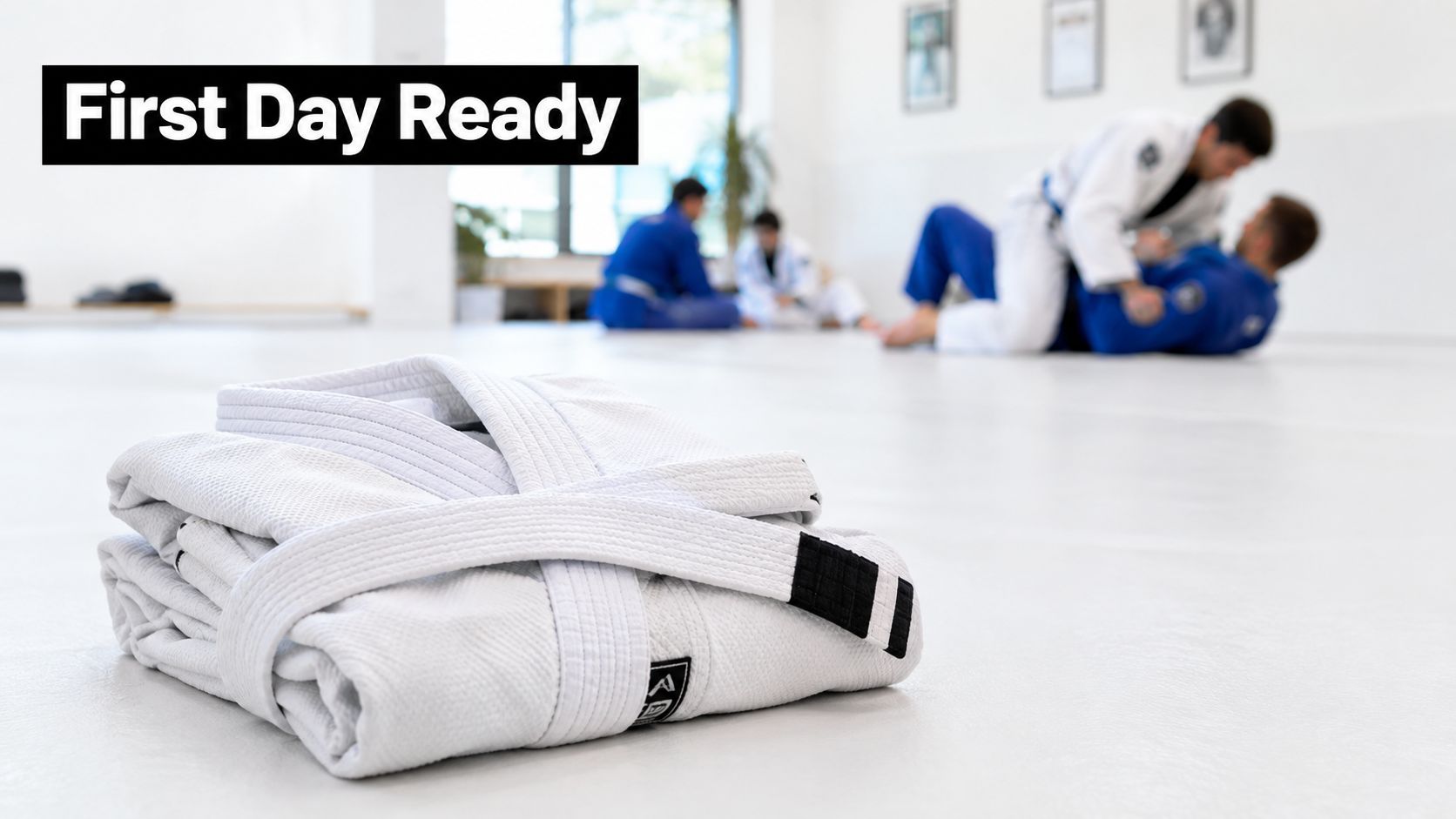
The jacket gives your partner handles for controlled grips. The trousers need to move with your hips and knees without restricting footwork. The belt keeps the jacket closed and shows rank, but it also becomes part of the way coaches organise learning on the mat. A well-fitted gi lets you focus on posture, frames, escapes and movement instead of tugging at sleeves or worrying about loose fabric.
Why the uniform matters from day one
Gi training changes the problems you solve. Your partner may grip a lapel to control distance, use a sleeve to guide an arm, or hold the trouser fabric while setting up a sweep. You'll learn to defend those grips and create your own, so the uniform teaches both attack and defence.
That doesn't make Gi better than No-Gi. They're different training environments, and Locals offers structured pathways for both. Gi classes can slow an exchange enough for a beginner to recognise position and pressure, while No-Gi develops movement around body grips, wrestling-style control and faster transitions.
The useful question isn't “Which gi looks nicest?” It's “Will this uniform fit, stay clean, survive training and remain legal if I compete?”
Parents can use that question when choosing a child's first uniform, and adults can use it before spending money on a gi that shrinks or falls outside event requirements. The right choice supports safety, learning and participation without making a new student feel out of place.
What Makes a Brazilian Jiu Jitsu Gi Different
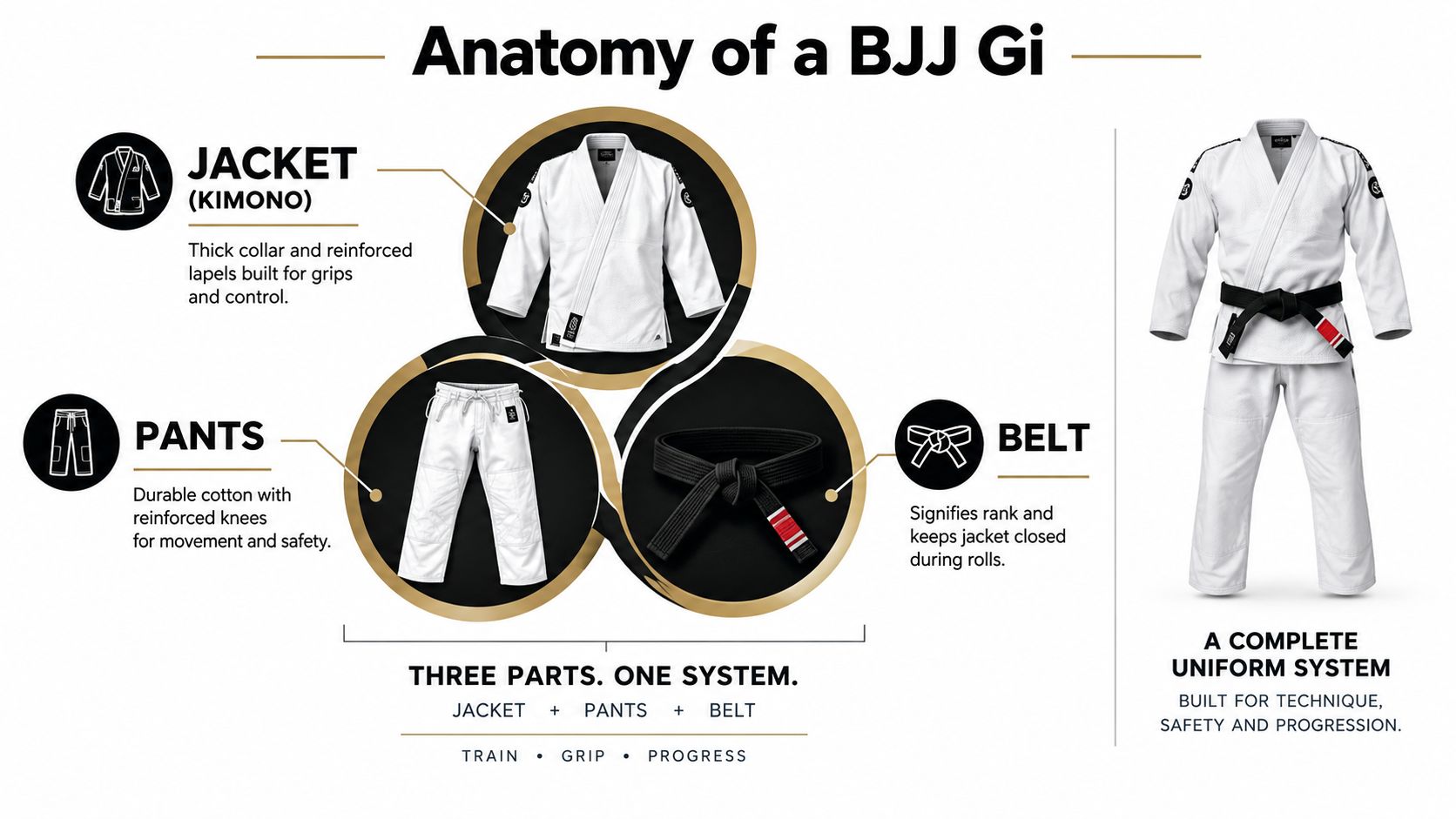
A gi works as a three-part system, not as a loose collection of clothing. The jacket, trousers and belt each perform a different job, and their relationship becomes clear once you start drilling and rolling.
The jacket creates controlled handles
Think of the jacket as a durable work jacket designed for grappling. The lapel is the folded front section, while the collar and sleeves give your partner secure places to grip. Those grips let practitioners manage distance, break posture and guide movement without grabbing skin or clothing that can tear easily.
The jacket needs enough structure to resist constant pulling, but it can't be so stiff or poorly fitted that it limits shoulder movement. Reinforced stitching around high-stress areas helps the garment tolerate repeated rounds. A loose jacket can bunch around the neck or arms, while an overly tight one can make ordinary movements uncomfortable.
The trousers support movement
Gi trousers need to cope with guard work, hip movement, technical stand-ups and repeated contact with the mat. Reinforced knees are particularly useful because the fabric often presses against the floor while you shrimp, stand, kneel or practise passing drills.
The cut should leave room for movement without producing excessive loose material. Trousers that are too short may feel restrictive and can affect comfort during training. Trousers that are too long can interfere with footwork and may fail a competition inspection.
The belt closes the system
The belt holds the jacket together and identifies rank. In practice, it also gives students a simple visual language on the mat. Coaches can organise beginners, experienced students and more advanced practitioners while keeping training respectful and structured.
The belt shouldn't be tied so loosely that the jacket opens constantly, or so tightly that breathing and movement become uncomfortable. Its position matters during drills, and you'll quickly learn to retie it between rounds.
The gi also changes how you think. A sleeve grip is not just fabric in your opponent's hand. It's a lever that can affect your balance, posture and ability to create space. Learning to use and deny those grips develops skills that complement No-Gi training.
A gi isn't a costume for Brazilian Jiu-Jitsu. It's a training tool that gives both practitioners the same material challenges.
Materials Weaves and Weight That Change How a Gi Feels
Two gis can look almost identical on a hanger yet behave differently during a hard round. The main reasons are the weave and fabric weight, particularly in the jacket. The weave is the fabric's construction, while GSM describes its weight per square metre. Together, they affect how the uniform feels when you move, grip and wash it.
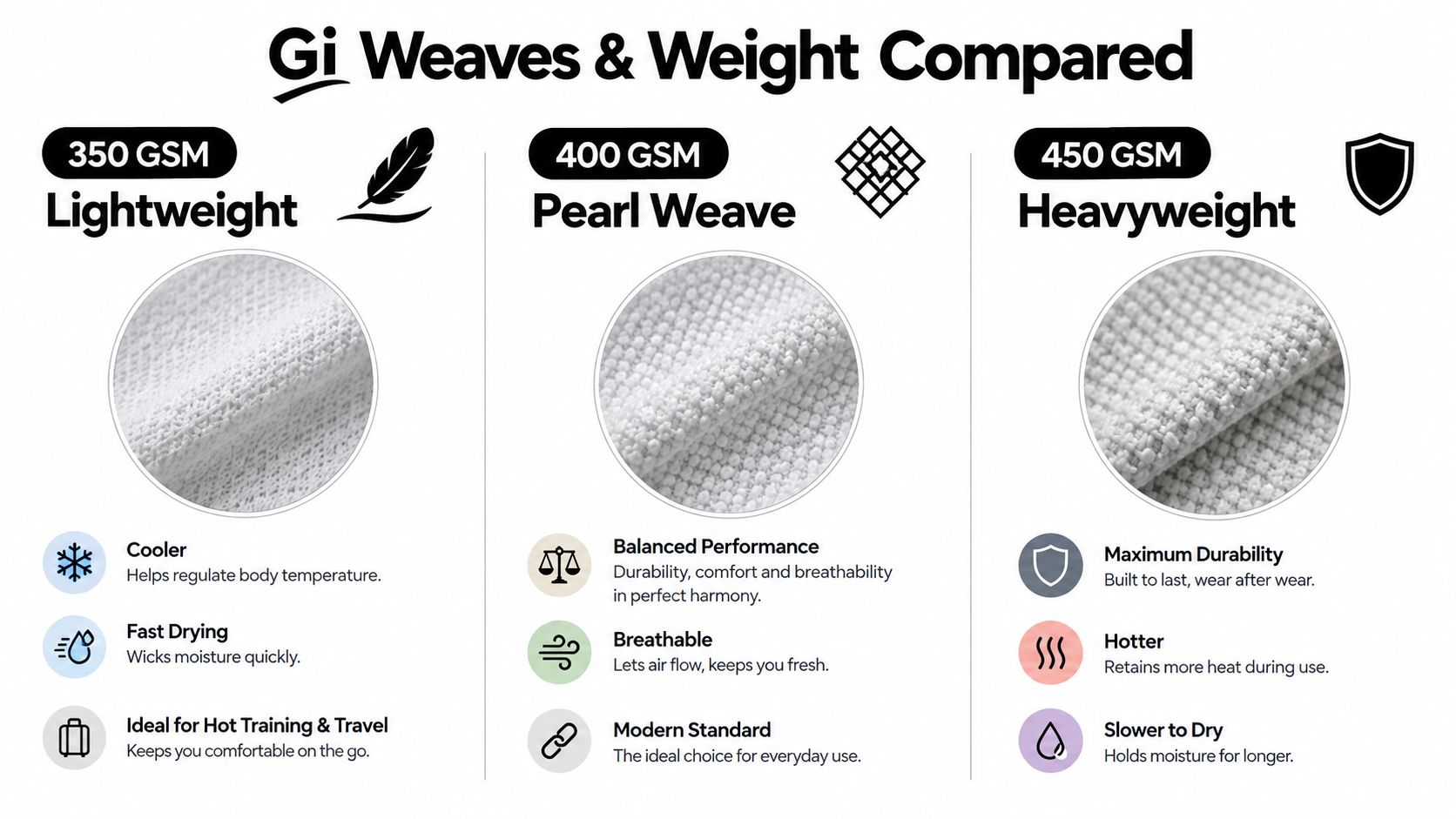
Pearl-weave jackets are common in Australian stores, with 350, 400 and 450 GSM options. The practical differences between these weights are summarised in this comparison of Brazilian Jiu Jitsu gi choices for Australian training.
What the weave changes
Pearl weave is popular because it balances structure with a manageable feel. Its texture supports strength, flexibility and breathability without making the jacket unnecessarily stiff. Other weaves are available, but the name alone cannot tell you whether a gi suits your body, training room or washing routine.
A lighter jacket usually feels easier to carry through repeated movement. It may reduce heat buildup and dry faster after washing, which helps in Sydney's warmer conditions or when you need to pack a gi for travel.
A heavier jacket feels more substantial and may handle repeated collar and sleeve gripping with greater abrasion resistance. The trade-off is extra warmth and a longer drying time. The fabric is part of the decision, much like choosing a shoe for the surface you train on.
Choosing between 350, 400 and 450 GSM
These common weights create a useful progression:
350 GSM: A cooler, lighter choice for high-volume training, warm weather and quicker drying. Its lighter construction may show wear sooner around the lapel, knee and armpit seams.
400 GSM: A balanced everyday option. It offers comfort while retaining more structure and durability than the lightest choice.
450 GSM: A heavier, more substantial jacket for frequent live grappling and competition-style training. It may feel hot during a Sydney summer and require more time to dry.
Those are tendencies, not promises. Stitching quality, fabric treatment, fit and washing habits also affect durability. A lighter gi is not automatically fragile, and a heavier gi may be uncomfortable if the wearer overheats easily.
Match the fabric to the room
For regular live grappling, a 400 or 450 GSM pearl-weave jacket may suit someone who values resistance to repeated gripping. A 350 GSM option may feel better in warm conditions, especially for someone who struggles with heat or needs a uniform that dries quickly.
Adults can choose by considering training frequency, climate and personal preference. Parents should also account for washing and growth. A child may outgrow a gi before the fabric wears out, so buying the heaviest option is not always the practical choice.
For a beginner-friendly buying framework, read this guide to choosing a Jiu Jitsu gi for beginners.
Finding Your Fit and Understanding Cut and Sizing
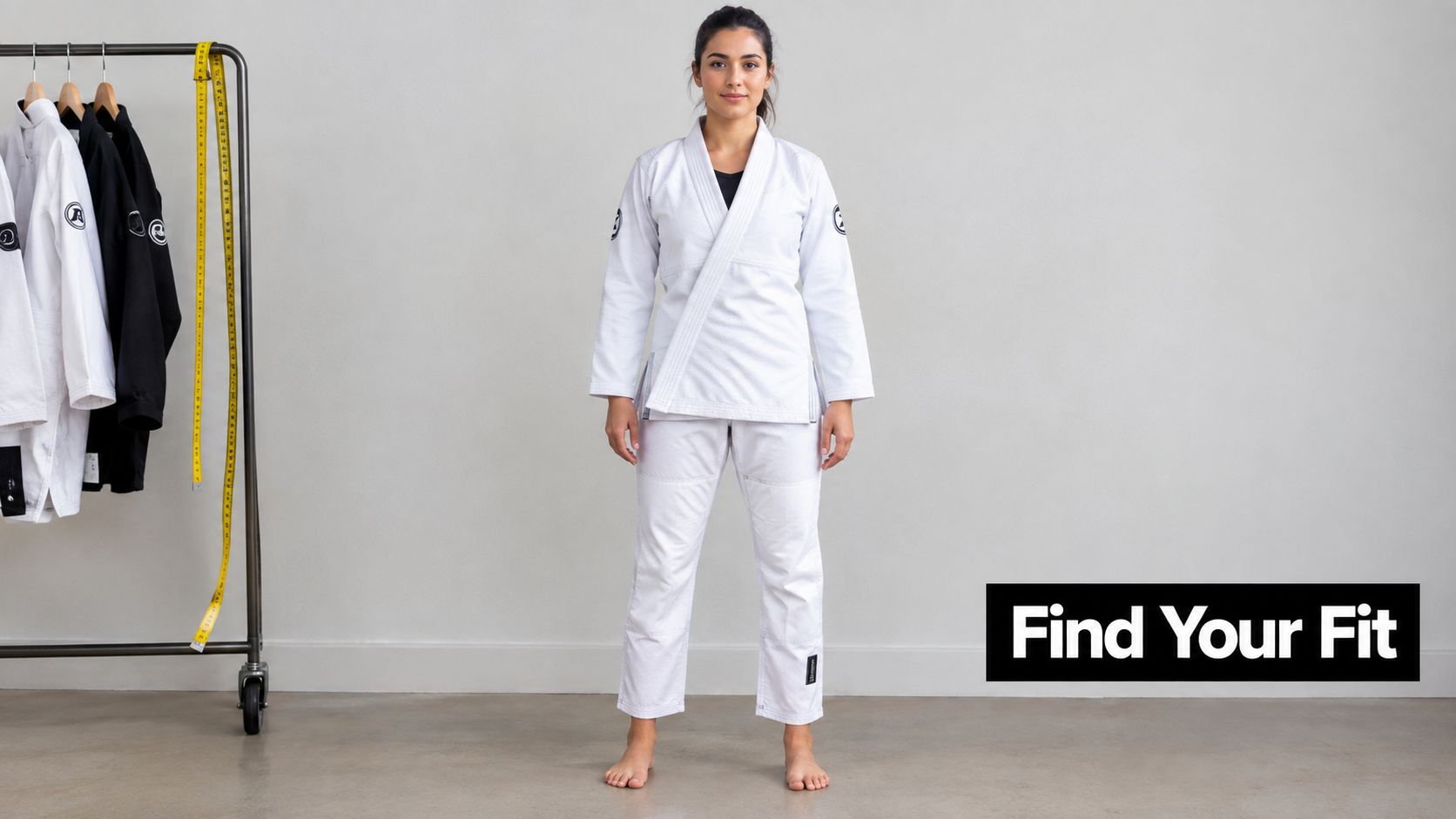
A gi should feel secure without making you fight the uniform. The most reliable starting point is your height, chest and waist measurement, not your usual T-shirt size. Retailers often use size ranges such as A0 to A4, but labels vary, so the measurement chart matters more than the letter.
Measure before you order
Use a flexible tape measure and record:
Height, standing naturally without stretching.
Chest, around the fullest part of the torso.
Waist, around the area where the trousers will sit.
Keep the tape close to the body without pulling it tight. Parents measuring children should write the numbers down and compare them with the specific brand's chart. This guide to taking body measurements at home can help if you're unsure where to position the tape.
A traditional cut usually offers more room through the jacket and trousers. An athletic cut sits closer to the body and may feel less bulky, but it needs to provide enough space for comfortable movement. Neither cut is universally correct. Your proportions, mobility and preference decide the better option.
Check the sleeves and trousers
The sleeves should allow full arm movement while staying within the competition inspection range if you plan to compete. Trousers should cover the legs appropriately and remain comfortable during guard work, squats and technical stand-ups.
Try moving through a few simple positions. Raise your arms, bend your knees, sit into a technical stand-up and rotate your hips. If the jacket pulls across the shoulders or the trousers restrict your knees, the size or cut may be wrong even if the garment looks tidy while standing.
Plan for washing and shrinkage
Pre-shrunk fabric gives you a more predictable starting point. Non-pre-shrunk cotton can shrink if exposed to high heat, and that change may affect sleeve and trouser length. Controlled shrinkage can sometimes help refine a loose fit, but it shouldn't replace accurate sizing.
Cold washing is the safer default for protecting fit. Children also need a different approach from adults. A child may need some growing room, but excessive extra fabric can make movement awkward and may create a poor fit during class. An adult should prioritise current measurements and intended use rather than buying far outside the chart.
At Locals Zetland or Locals Maroubra, coaches can help you assess whether the jacket, sleeves and trousers sit comfortably before you commit to a uniform. That hands-on check can prevent a common mistake, buying for the label instead of buying for the person wearing it.
Competition Rules and Colours That Keep Gis Legal in Australia
A competition gi is regulated sporting equipment, not training clothing. Before a Sydney beginner buys one, check its colour, construction, measurements, belt and patch placement. Australian retailers may label suitable products IBJJF-legal and pre-shrunk, but that label should support your own checks rather than replace them.
The permitted competition colours are white, royal blue or black. The jacket and trousers must match, including the collar. A mixed-colour uniform may be fine for ordinary classes but cause a problem at inspection. The IBJJF uniform rules set out the formal requirements.
Gi competition legality quick check
Requirement | Legal Standard | How to Check |
|---|---|---|
Gi colour | White, royal blue or black | Confirm the jacket, trousers and collar use an allowed matching colour |
Jacket and trousers | Same colour | Lay both pieces together before buying or packing |
Lapel thickness | 1.3 cm | Check the product specification or ask the retailer |
Collar width | 5 cm | Compare the collar with the stated measurement |
Sleeve opening | 7 cm at full extension | Check the measurement or have it inspected |
Belt width | 4 to 5 cm | Measure the belt rather than relying on appearance |
Belt presentation | Matched to rank, worn over the gi, wrapped twice and tied in a double knot | Tie it securely and leave 20 to 30 cm tails |
Cleanliness and patches | Clean uniform with patches placed within permitted areas | Inspect stitching, patch position and general condition before the event |
These measurements make the gi's grips and fit more predictable for both athletes. A collar that is too wide, a sleeve opening outside the stated range or trousers altered by washing can turn a new purchase into an inspection issue.
Patches and presentation
Patches are part of the legality check, not decoration that can go anywhere. Competition rules limit where branding and patches may be placed. Officials may reject a gi if the patch position, stitching or garment condition does not meet those requirements.
Wash the gi before competition and inspect it under good light. Check for stains, loose threads, damaged seams and uneven shrinkage. Correct colour alone does not guarantee approval. A visibly dirty or poorly maintained uniform can still fail a practical check.
For a beginner-friendly buying reference, read this Brazilian Jiu Jitsu gi guide for Australia before ordering. If you are preparing for a particular event, confirm its current rules with the organiser and inspect the gi well before competition day. That gives you time to replace a non-compliant item instead of discovering the problem at the venue.
Gi Versus No-Gi and How to Choose Your Training Kit
Gi and No-Gi aren't two versions of the same outfit. They create different gripping problems and encourage different movement choices. In Gi, the fabric gives you lapels, sleeves and trousers to control. In No-Gi, practitioners rely more on body positioning, underhooks, overhooks, head control and grips around the body.
A No-Gi kit usually includes a tight rash guard and grappling shorts. The rash guard needs to use elastic, skin-tight material and cover the torso to the waistband. IBJJF-style standards allow black, white, black-and-white or rank-colour patterns, with at least 10% of the fabric showing the athlete's belt-rank colour, as described in the Australian Brazilian Jiu-Jitsu competition rules.
Shorts should allow movement without creating hazards. For competition-style No-Gi, choose shorts without pockets, zips, buttons or exposed hard parts. Those details can catch on fingers, press into a partner or interfere with safe movement.
A practical choice guide
Training profile | A useful starting kit | Why it may suit |
|---|---|---|
Kids | Gi or No-Gi, based on the class | A coach can help match the child's comfort and movement needs |
Adult beginners | Gi for structured grip learning, or No-Gi for a lighter feel | Both formats teach core grappling skills through different controls |
Women seeking fitness and self-defence | The format that feels comfortable and encourages consistent attendance | Confidence grows through regular, supervised practice |
Fitness-focused grapplers | No-Gi for fast movement, or Gi for grip-heavy rounds | The choice depends on whether you prefer speed or fabric-based control |
Locals programs let students build skills through both formats rather than treating the uniform as a permanent identity. A beginner who starts with a gi can later add No-Gi, while someone drawn to No-Gi can learn the value of jacket grips and slower positional work.
The No-Gi versus Gi Jiu Jitsu guide can help you compare the training feel before your first class. You don't need to decide which format is superior. Choose the class that matches your immediate goals, then stay open to learning the other.
Caring for Your Gi and Making a Smart First Purchase
A clean gi protects your training partners and helps preserve the fabric. Wash it after every class, follow the garment's care label and use cold water as the default. Air drying gives you more control over fit than exposing cotton to high heat.
Non-pre-shrunk fabric can change shape in hot washing or drying. If sleeves or trousers shrink beyond a comfortable or legal fit, the original purchase may no longer serve its purpose. That's why pre-shrunk fabric can be a sensible choice for beginners who want predictable sizing.
A simple buying filter
For adults: Start with accurate height, chest and waist measurements, then choose a cut and GSM that suit your training room.
For kids: Allow practical room for growth, but don't buy so large that sleeves and trousers interfere with movement.
For future competitors: Prioritise white, royal blue or black, matching jacket and trousers, and a product clearly described as competition legal.
For frequent training: Consider whether you can wash and dry the gi promptly, because fabric care affects hygiene, fit and long-term value.
The cheapest gi can become the most expensive if it shrinks out of specification, wears through at stress points or needs replacing before you've developed a stable size. A durable, correctly fitted uniform is easier to use and easier to maintain.
Locals Jiu Jitsu Zetland offers structured Kids, Beginners, Advanced and No-Gi programs in a controlled, safety-first environment, with coaches who can help you understand gi fit and training requirements. Visit Locals Jiu Jitsu Zetland to book a free trial, bring your sizing questions and experience the uniform on the mats.
Comments