_edited.png)
Brazilian Jiu Jitsu Holds Complete Reference Guide
Your first few rounds often feel the same. Someone gets on top, you try to push them away, your arms get tired, and you forget every submission name you watched the night before.
That's normal. Beginners usually think Brazilian Jiu Jitsu is mainly about chokes and joint locks, but most progress comes earlier than that. It comes from learning holds. The positions that pin someone, slow them down, connect your body to theirs, and give you enough control to move without panic.
At Locals classes, that's where students usually start to relax. Once you know the difference between holding, controlling, and finishing, sparring stops feeling random. A parent watching a kids class sees the same principle. The child who learns where to put their knees, hips, hands, and head usually becomes safer before they become aggressive. The adult beginner who stops chasing submissions usually improves faster than the person trying to “win” every exchange.
Introduction to Brazilian Jiu Jitsu Holds and Control
You are underneath side control in your first few rounds. Your partner is not attacking your neck yet, but you still feel stuck. That moment explains why holds matter. In Brazilian Jiu Jitsu, the person who can pin, connect, and direct movement usually decides what happens next.
A hold is any position or connection that helps you manage another person's movement. Sometimes the job is to pin them to the mat. Sometimes the job is to stay attached with a grip or body connection. Sometimes the job is to control distance long enough to pass, sweep, stand up, or start a submission.
A submission is different. It is the finish that ends the exchange. Under the rules used for recognised BJJ and No-Gi grappling contests in Australia, a match ends immediately on submission. Otherwise, scoring comes from positional control such as takedowns, passes, and mount, following an IBJJF-style points structure in the NSW combat sports regulation.
For beginners, that distinction removes a lot of confusion.
New students often use one label for everything. They call mount a submission, closed guard a pin, or an underhook a move by itself. A better way to read the mat is by job:
Pins hold the opponent in place and usually relate most clearly to stable scoring positions.
Control positions limit movement and build transitions, sweeps, passes, and attacks.
Grips and connections make the first two possible, whether that is a collar grip in the Gi or a wrist tie, underhook, or body lock in No-Gi.
This matters in class because the same hold changes value depending on rules, clothing, and training stage. Mount and back control can score because they show clear positional dominance. An underhook usually does not score by itself, but it often makes the scoring position possible. A lapel grip can slow someone down in the Gi. In No-Gi, you need your shoulder pressure, head position, and hand fighting to do that same job.
A useful comparison is camping gear. The pin is the tent peg in the ground. The control position is the frame that keeps the structure stable. The grip is the cord tension that stops everything from slipping apart. Remove one part and the whole setup becomes easier to break.
At Locals classes, we coach holds in that order for safety as much as performance. First, learn where your weight goes. Next, learn how to connect without squeezing blindly. Then learn how to increase pressure or start a finish without cranking. Kids become safer when they can stabilise before they rush. Adult beginners waste less energy. Advanced students get cleaner timing because their grips and pins start to match the job they are trying to do.
A simple rule helps on day one. If you cannot stop your partner from moving, your submission attempt is probably early.
That principle also explains why experienced competitors spend so much time refining familiar positions. Analysts at Aus BJJ Rankings track large volumes of Australian competition results, and broader match analysis across elite formats has shown that many finishes still come from strong control of common positions rather than from rare or flashy attacks. The practical lesson is straightforward. Learn to hold well first, then finish from a place where you have balance, pressure, and time.
How Holds Are Categorised for Easy Reference
A student lands on top after a scramble and asks, “Was that control, or was that a scoring position?” That question matters, because BJJ gets much easier to read once you sort holds by what they are supposed to do.
The clearest system is by job. On the mat, a hold usually does one of three jobs. It pins, it controls, or it connects. That framework helps beginners stop mixing everything into one big list, and it helps advanced students diagnose why a position failed.
The three functional families
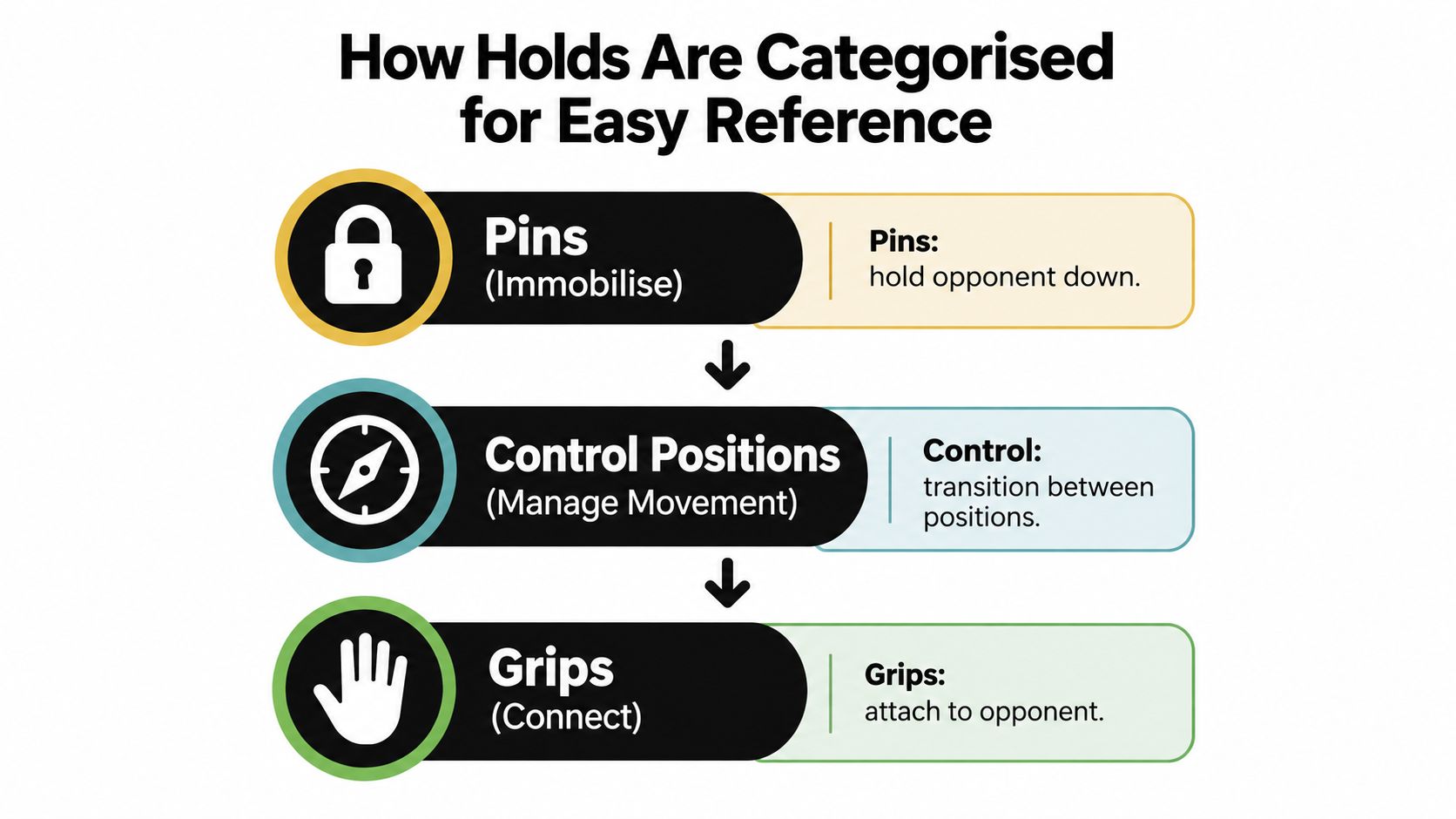
Pins hold someone in place long enough for the position to count and matter. Mount, side control, knee-on-belly, and back control fit here. The goal is to restrict turning, standing, or recovering guard. If your partner can keep moving freely, the pin is not settled yet.
Control positions manage movement without always freezing it. Closed guard, half guard, turtle rides, front headlock control, and many leg entanglements belong in this family. You use them to steer reactions, break posture, create imbalance, and set up the next step.
Grips and connections are the contact points that make the other two families work. In the Gi, that might be a collar grip or sleeve grip. In No-Gi, it is often an underhook, wrist tie, seatbelt, body lock, or head position. A grip by itself is not always a position, but it often decides whether the position survives.
A simple way to remember it is this: pins stop motion, control positions shape motion, and grips attach you to the motion.
How scoring fits the picture
This functional split also matches how competition rewards progress. Under IBJJF rules, athletes score for advancing to stable positions such as takedowns, guard passes, knee-on-belly, mount, and back control, while many grips and transitional controls matter because they lead into those scored moments, not because they score on their own (IBJJF Rules Book).
That scoring logic is useful in the gym. It tells you which holds must become stable first, and which holds are mainly tools for getting there.
Family | Main job | What you are usually trying to get |
|---|---|---|
Pins | Immobilise | Secure points, prevent escapes, apply pressure safely |
Control positions | Direct movement | Sweep, transition, off-balance, expose openings |
Grips | Create connection | Keep attachment, break posture, stop counters |
Students often get confused when a strong grip feels powerful but does not score, or when a fast transition looks dominant but earns nothing because it never settled. The fix is to ask one question: what job is this hold doing right now?
Safety progression matters too
The category also changes how you should learn the hold.
With pins, start with base and weight placement before adding pressure. If you skip that step, beginners tend to squeeze with the arms, drift too high, or get rolled.
With control positions, learn the main direction you are trying to steer first. For example, in closed guard you are often breaking posture. In turtle control you are often blocking stand-ups and turns. Once that direction is clear, transitions make more sense.
With grips, learn when to connect and when to let go. Newer students often cling to grips after the position has changed. That habit slows reactions and can create awkward scrambles, especially in No-Gi where sweat makes late grips unreliable.
At Locals, coaches often teach this as a progression: hold the person, guide the person, then attack the person. It is safer, and it produces cleaner jiu jitsu.
Gi and No-Gi change the tools
The job stays the same in both styles. The tools change.
In Gi, fabric gives you extra anchors, so many grips can hold a position together for longer. Collar and sleeve connections often buy time to settle a pin or slow an escape.
In No-Gi, the same job depends more on wedges and alignment. Head position, shoulder pressure, inside ties, and hip proximity do more of the work because there is no cloth to catch and hold. Advanced students already know this, but beginners often need the reminder that No-Gi control usually feels less like grabbing and more like placing your body in the right lane.
That is why this article groups holds by function instead of by a long submission-style catalogue. The question is not just what the hold is called. The question is what job it is doing, whether it can score, how safely you should build it, and how the answer changes between Gi and No-Gi.
Essential Pinning Holds Every Beginner Should Know
Pins are where many students first feel what real control means. You're not just lying on someone. You're placing your hips, chest, knees, and head so their movement becomes expensive.
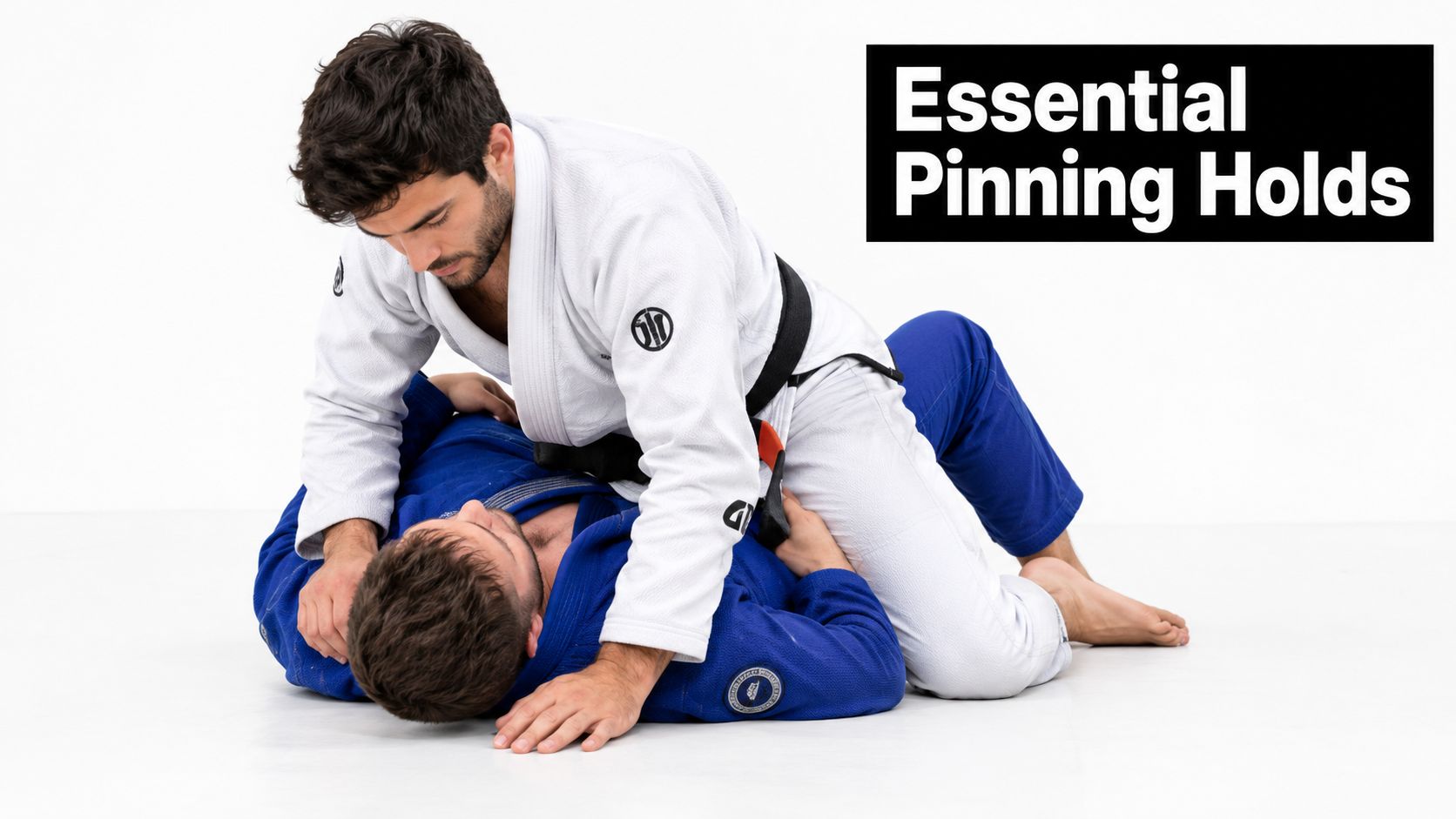
Mount
Mount is one of the clearest examples of a pin. You're on top with your knees around the torso or higher near the armpits, using your hips to keep the person flat or reacting.
Under IBJJF-style scoring, mount is worth 4 points within the Australian rules framework linked above. That matters because mount shows stable control, not just top position.
Common beginner mistakes:
Leaning too far forward: you get rolled.
Squeezing with the knees only: your base gets weak.
Ignoring the hands: the person frames and escapes.
Useful cue: keep your knees active, hips heavy, and hands ready to post.
Side control
Side control is usually the first top pin students learn after a guard pass. Your aim is chest pressure, hip angle, and head control, not hugging the body.
Think about three checks:
Can they turn into you?
Can they recover a knee inside?
Can they get their head free?
If the answer is yes to any of those, your side control isn't settled yet.
A good side control teaches patience. White belts often leave too early for a submission. A more mature round involves pausing, feeling their bridge, then adjusting before moving to mount or north south.
Knee on belly
Knee on belly is more mobile than mount or side control, but it still works as a strong pin when used properly. It creates pressure, exposes elbows, and often forces a reaction.
Students get confused here because it feels transitional. That's true, but it's also a control point. Use your posted foot for balance, keep your chest tall enough to move, and don't dump all your weight through a sharp knee into a smaller training partner.
Coaching cue: Pressure should be heavy enough to control, not careless enough to injure.
North south
North south can feel awkward at first because your orientation flips. You're controlling from around the head and shoulders rather than square to the torso.
The hold works when your hips stay low and your chest blocks turning. It often leads naturally to arm isolation and head control attacks, but the position itself teaches an important lesson. Sometimes the best pin isn't the most dramatic one. It's the one that removes their frames.
Here's a useful demonstration to watch after you've felt the position in class:
Back control with body triangle
Back control is a special pin because you aren't pinning someone to the mat. You're pinning them to you.
The key connection is usually the seatbelt first, then your hooks or body triangle if the ruleset and situation allow. Beginners often rush the body triangle and lose the upper-body control that makes it safe and effective.
Focus on sequence:
secure chest-to-back alignment
hide your choking hand
keep your head close
then tighten lower-body control
When to use each pin
A simple beginner map looks like this:
Pin | Best time to use it | Main danger if done poorly |
|---|---|---|
Mount | After a pass or forced turn | Getting rolled |
Side control | Right after passing guard | Leaving space for re-guard |
Knee on belly | When the opponent is framing hard | Losing balance |
North south | When arms are exposed and frames are weak | Sitting too high |
Back control | After the opponent turns away | Losing chest connection |
At Locals Zetland and Locals Maroubra, these positions usually become clearer once students stop treating them as resting spots. A pin is active. If your partner can move comfortably, you're probably not pinning them yet.
Control Positions That Build Transitions and Submissions
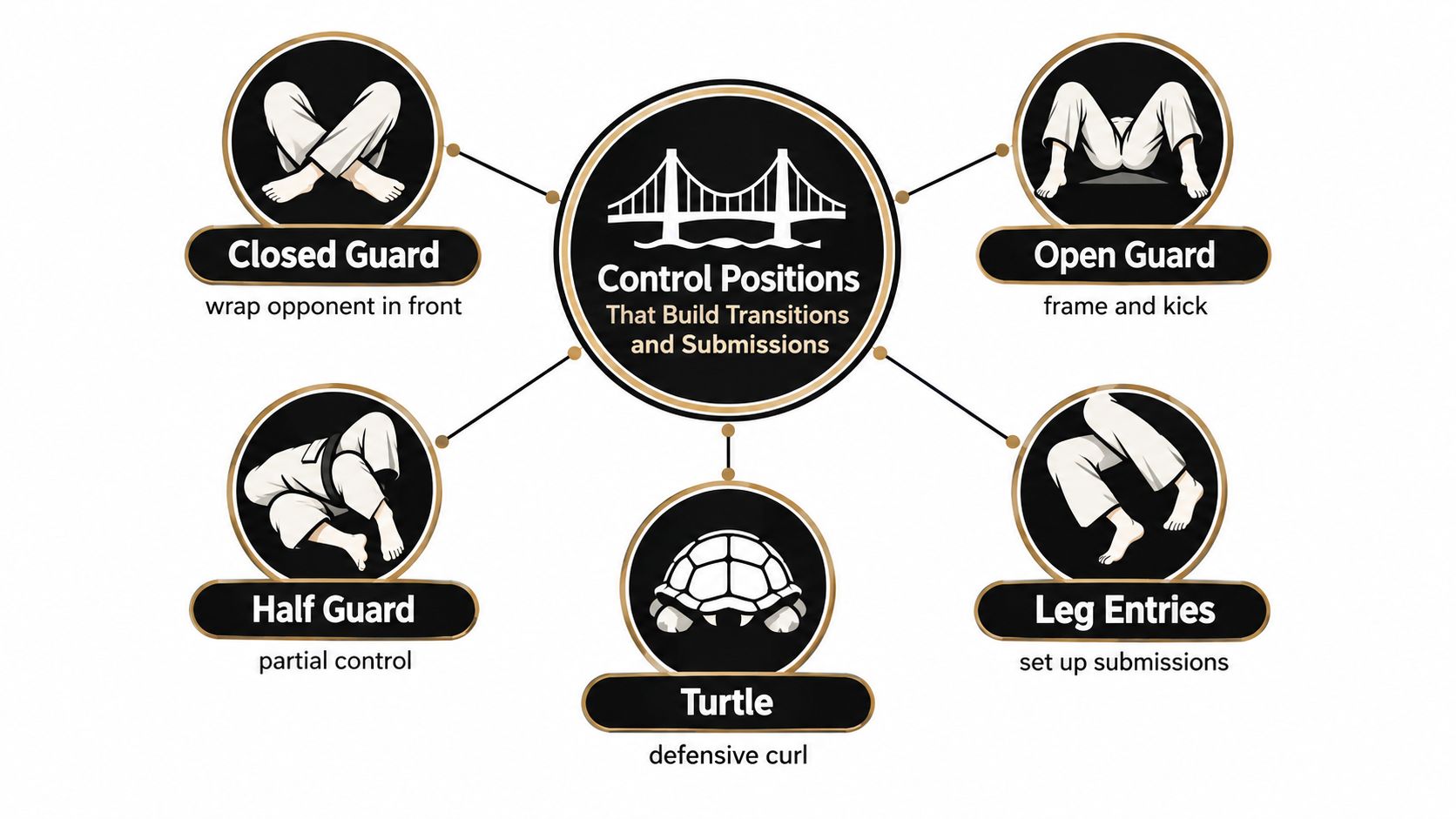
Control positions are less about freezing and more about directing. You use them to set rhythm, distance, and angle. A good control position gives you choices while taking choices away from your partner.
Closed guard
Closed guard is the first bottom control many people learn. Your legs wrap around the torso, but control comes from your hips and upper-body connection.
Beginners often cross their feet and then just hold. Better closed guard uses:
broken posture
angle off the centre line
active knees pulling inward
hands that control a wrist, sleeve, collar, or head position depending on the ruleset
Closed guard is a hold because it limits posture and movement. It becomes a launching point for sweeps, armbars, triangles, and back takes once your angle improves.
Open guard and distance management
Open guard looks looser, but it demands sharper timing. Instead of locking the torso, you use your feet, shins, and frames to manage space.
The biggest confusion for newer students is trying to “win” open guard by hanging on. That usually fails. Open guard works when you re-angle, re-frame, and keep your hips mobile.
For students working on base and posture, this short breakdown on Jiu Jitsu base and structure fits well with open-guard development.
If your legs are active but your hips are flat, your guard usually feels busy without being effective.
Half guard
Half guard sits in the middle. One leg is trapped, one isn't, and both people may feel they're close to improving.
That's why half guard is such a valuable control position. From top, you can flatten, crossface, and free the knee line to pass. From bottom, you can get under the hips, build to an underhook, and come up to a sweep or dogfight-style stand-up.
A few coaching cues matter here:
Bottom player: get onto your side before hunting attacks.
Top player: control the head and hips before trying to rip the leg free.
Everyone: don't confuse stalling with control.
Turtle control
Turtle is often treated as a temporary scramble, but it deserves study as a genuine control area. The person on top is trying to attach without falling off. The person on bottom is trying to stand, roll, or recover guard.
Turtle control usually improves when you stop chasing the neck too early. Start with balance, hip following, and shoulder control. Then attack openings.
For kids and newer adults, turtle training is especially useful because it teaches safe movement under pressure. You learn not to flatten your neck, not to post weakly with straight arms, and not to spin blindly.
Leg entanglement entries as control
Students sometimes think leg entries only matter when a heel hook or straight foot lock is coming. That skips an important step. Many leg entanglements are first and foremost control positions.
They affect posture, balance, and the direction someone can turn. For advanced students, especially in No-Gi, this matters a lot. You may not finish immediately, but you can force a seated opponent to post, rotate, or expose upper-body reactions.
A helpful way to sort these positions:
Control position | Primary purpose | Likely next move |
|---|---|---|
Closed guard | Break posture | Sweep or submission |
Open guard | Manage distance | Off-balance or re-guard |
Half guard | Trap and angle | Sweep or pass |
Turtle control | Follow movement | Back take or breakdown |
Leg entry | Isolate lower body | Submission or stand-up disruption |
These positions make sense once you stop asking, “Is this a finish?” and start asking, “What movement does this remove?”
Grips and Connections for Gi and No-Gi Holds
A hold starts failing long before the final escape. It usually fails at the connection point.
That's why grip work deserves its own category. Good students don't just learn positions. They learn how to arrive attached.
Gi grips
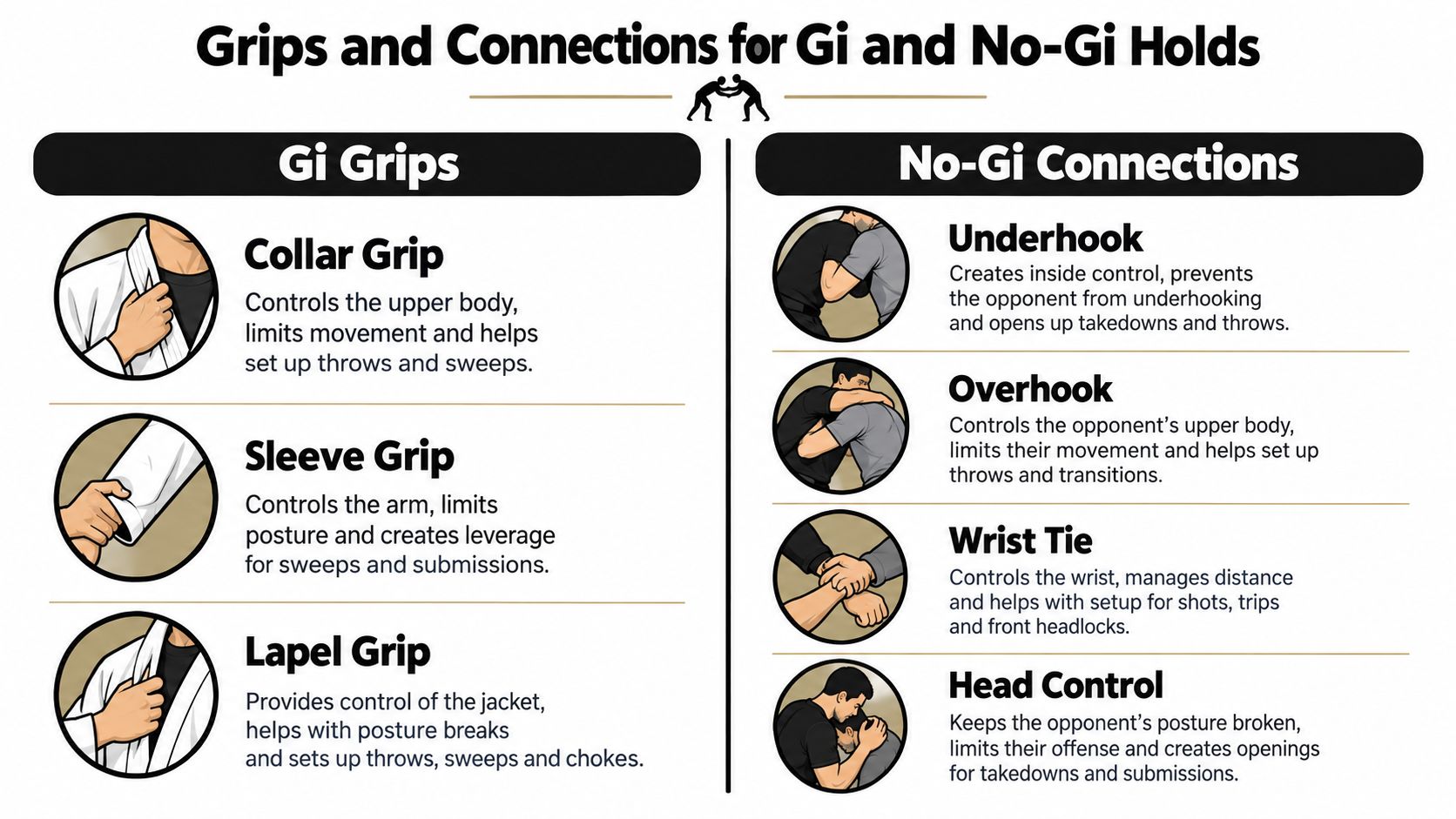
Gi grips let you create friction and structure with the uniform itself. That often slows scrambles and makes positional control easier to study.
The most common examples are:
Collar grip: useful for posture breaking, steering, and choke setups
Sleeve grip: limits posting and hand-fighting options
Lapel grip: adds wrapping and anchoring options, especially in guard exchanges
The trap for beginners is over-gripping. They tense their forearms, hang on too long, and stop moving their hips. The grip should support the position, not replace it.
Another issue is finger strain. Research on stage-specific injury patterns shows advanced athletes report more finger and ankle injuries, while novices report more shoulder and knee issues, according to the SciELO review on BJJ injury patterns. For Gi players, that's a reminder to grip with structure rather than with isolated fingers.
No-Gi connections
No-Gi removes fabric, so body contact has to do more work. You'll see more underhooks, overhooks, wrist ties, collar ties, seatbelts, and head control.
The rhythm changes too. Because grips slip more easily, No-Gi often rewards quick re-connection rather than static attachment.
A practical comparison:
Gi | No-Gi |
|---|---|
Slows movement through cloth grips | Requires tighter body positioning |
Sleeve and collar dominate many exchanges | Underhooks and head position dominate many exchanges |
Easier to anchor from farther away | Usually safer to connect chest-to-chest or elbow-to-rib |
Students crossing between styles often need help here. If that's you, this breakdown of wrestling grips for grappling is a useful companion because it explains the ties that replace fabric handles in No-Gi.
What stays the same in both styles
The connection method changes. The core principles don't.
Elbows close: loose elbows create gaps
Head position matters: your head is part of the hold
Hips follow hands: if your hands connect but your hips lag, control weakens
Relaxation matters: gripping harder than needed burns energy and reduces sensitivity
The best grip is the one that still lets you move.
A newer student usually needs fewer grips, used more cleanly. An advanced student needs better grip switching. That's a useful distinction. Beginners benefit from learning one reliable collar grip, one sleeve grip, one underhook, and one head-control pattern before chasing variety.
Safe Application and Common Mistakes With Holds
Safety isn't a separate topic from Brazilian Jiu Jitsu holds. It's built into how a hold should be taught and applied.
Australian injury research makes that clear. One peer-reviewed review found 185 musculoskeletal injuries across 8,891 competitive athlete exposures, which equals 20.8 injuries per 1,000 matches, and training studies in the same review reported 13.0% to 15.2% of BJJ athletes experiencing at least one injury in a six-month period. The review also noted another broader sports medicine finding that 85.2% of surveyed high-level grapplers had at least one musculoskeletal injury, according to the Australian grappling injury review.
What that means in practice
The lesson isn't to be fearful. It's to be organised.
Holds that involve the neck, elbow, shoulder, knee, and ankle need progressive resistance. Students should learn where the finish begins, how quickly danger rises, and how to release immediately on the tap.
Common errors include:
Cranking instead of controlling: especially on armbars and triangles
Bridging into the cervical spine: often during scrambles or poor back takes
Holding submissions after the tap: never acceptable
Escaping too late with pride instead of judgement: common in adults returning to sport
Training risk and facility standards
Training and competition don't create the same risk profile. A large survey of 1,140 BJJ athletes found 784 athletes, or 68.8%, reported at least one injury causing at least a two-week absence from training over a three-year period, with the knee at 27.1% and shoulder at 14.6% among the most commonly injured sites in the open-access injury survey. That matches what coaches see on the mat. More volume usually means more opportunity for overuse, poor timing, and preventable strain.
Australian combat-sports guidance also identifies choking, spinal damage, and joint locks as specific hazards in grappling-only contests, and WA rules require safety basics including a mouthguard, suitable attire, at least 2.5 cm of foam padding, and a minimum 2.5 m clear safety buffer around the contest area in the WA regulatory proposal.
Tap early when you're caught. Release early when your partner taps. Good training depends on both people.
A mat-side safety checklist
At Locals, a sensible coaching checklist for holds looks like this:
Before drilling: check mat spacing, mouthguard, and whether the movement includes a neck or joint threat
During drilling: increase resistance gradually, not suddenly
During live rounds: stop if a partner can't move safely or is turning the wrong way under pressure
For kids and beginners: prioritise pins, escapes, posture, and verbal communication before hard finishing mechanics
If your hold only works when your partner doesn't know the risk yet, it isn't clean technique. It's just surprise.
How Holds Connect Into Chains and Cross References
A hold becomes far more useful once you stop seeing it as an endpoint. Most effective grappling happens in chains.
One example is simple and common. You pass the guard, settle side control, force a turn, climb to mount, then take the back when the person bridges. None of those moments stands alone. Each one makes the next easier.
A beginner chain
For newer students, a reliable flow might look like this:
Start with a stable grip or connection.
Enter a control position such as closed guard or half guard.
Create an angle or off-balance.
Advance to a pin such as side control or mount.
Only then start threatening the submission.
That order reduces panic. It also reduces wasted effort because you're no longer trying to finish from poor structure.
Students building submission awareness can pair these chains with a clear guide to common Jiu Jitsu submissions so the finishes make sense in context rather than as isolated moves.
Gi and No-Gi versions of the same idea
The chain often stays the same while the connection changes.
In Gi, you might use a collar-and-sleeve setup to break posture from guard, move the hips, attack a sweep, and settle top position with cloth grips helping you stop the scramble.
In No-Gi, the same sequence may rely on wrist control, head position, and an underhook instead. Less fabric means the transitions usually need to be tighter and more immediate.
Competition timing changes your choices
Match length also shapes how you connect holds. Under IBJJF rules, adult match length varies by belt rank, with 5 minutes for white belts, 6 for blue, 7 for purple, 8 for brown, and 10 for black belts, according to the IBJJF match length summary. A white belt often needs simple chains that can be recalled under stress. A black belt can build longer traps because there's more time and usually more positional patience.
The same applies to space. IBJJF mats have a minimum total area of 64 m², divided into a 36 m² combat area and 28 m² safety area, with a maximum of 100 m² total according to the IBJJF rules document. Good chain-building includes spatial awareness. A hold that works in the centre may need adjustment near the edge.
At Locals Zetland, beginners usually improve fastest when they drill only one or two chains per position. Advanced students often benefit more from branching options, where one failed mount entry leads to knee on belly or back control instead of a full reset.
Quick Reference Finder for Brazilian Jiu Jitsu Holds
When you're tired, you won't remember a long lecture. You'll remember a short decision.
Use this finder by asking one question first. Do I need to immobilise, manage movement, or connect? That gives you the category. Then choose the hold that fits your ruleset and current stage.
Quick Finder for Common Brazilian Jiu Jitsu Holds
Hold | Category | Best Use Case | Gi vs No-Gi Notes |
|---|---|---|---|
Mount | Pin | Stabilising top control and opening submissions | Works in both. No-Gi needs tighter hip balance |
Side control | Pin | Settling after a guard pass | Gi grips can slow escapes, No-Gi needs chest pressure |
Knee on belly | Pin | Forcing reactions and creating movement | Slightly easier to stabilise in Gi |
North south | Pin | Removing frames around the head and shoulders | Effective in both if hips stay low |
Back control | Pin | Controlling a turning opponent and attacking safely | Seatbelt is vital in both styles |
Closed guard | Control position | Breaking posture from bottom | Gi offers stronger posture control through cloth grips |
Open guard | Control position | Managing distance and creating angles | No-Gi usually needs faster re-connection |
Half guard | Control position | Sweeping from bottom or flattening from top | Underhook battles matter in both |
Turtle control | Control position | Following a defensive opponent | No-Gi often feels faster and more slippery |
Leg entry | Control position | Isolating lower body for off-balance or attacks | More common as a flowing control in No-Gi |
Collar grip | Grip | Steering posture and setting attacks | Gi only |
Underhook | Grip | Lifting, turning, and climbing to dominant angles | Essential in both, especially No-Gi |
Wrist tie | Grip | Interrupting posts and hand fighting | More prominent in No-Gi |
Head control | Grip | Steering movement and limiting posture | Strong in scrambles and passing |
A simple revision habit
After class, don't try to memorise everything. Pick:
One pin you lost
One control position you didn't understand
One grip that kept slipping
That gives you a focused problem to solve in the next session. If you train that way, Brazilian Jiu Jitsu holds stop looking like a giant list and start feeling like a connected system.
Locals Jiu Jitsu Zetland offers structured training for kids, beginners, advanced students, and No-Gi grapplers, so you can learn these holds in the right order with controlled drilling, positional rounds, and clear coaching. If you want to turn this guide into something you can feel and practise on the mat, visit Locals Jiu Jitsu Zetland.
Comments