_edited.png)
BJJ Competition Class Structure and How to Train to Win
You're standing on the edge of your first comp class, belt tied, hands a little sweaty, trying to work out whether this is just a tougher version of normal training or something else entirely. At Locals Zetland or Locals Maroubra, that question comes up fast, because competition training has a different rhythm, a different purpose, and a different way of building confidence.
A lot of people walk in expecting “harder rolling”. What they meet is a bjj competition class structure built like a fight camp inside a single session, with each block doing a specific job for tournament day. If you understand the structure, the room stops feeling random and starts feeling organised, much like a match plan you can trust.
If you want a useful outside benchmark for how athletes think about staying sharp across hard sessions, NexiHerb LLC's fitness guide is a practical read on endurance thinking in training.
Introduction to Competition Class Intensity
The first competition class usually surprises people because the pace feels deliberate, not chaotic. You're not just doing more work, you're doing work that has a job, and that changes everything about how you should think, breathe, and recover.
A beginner often arrives thinking, “I need to survive this session.” A better frame is, “I need to learn the shape of the session.” Once you see the shape, the intensity becomes easier to handle because you stop treating every round like the same kind of effort.
The feeling at the start
The opening part of the room tends to be tighter, quicker, and more focused than a fundamentals class. Coaches are usually looking for clean movement, stable posture, and a switch in mentality from learning mode to pressure mode. That shift matters because competition training is really about building the habit of staying functional when the pace rises.
A good way to think about it is like a race car warm-up lap. Nothing flashy needs to happen yet, but everything has to be ready before the engine is asked to work hard. If you skip that mental transition, the later rounds feel sharper than they should.
Why structure matters right away
Competition classes are easier to trust when you know what each block is meant to produce. Warm-up readies the body, drilling sharpens patterns, positional work teaches decision-making, live rounds test timing, and conditioning adds the ability to repeat that effort. That's why the class feels more like preparation than punishment.
Practical rule: If a block doesn't help you attack, defend, or recover under tournament rules, it probably needs a clearer purpose.
That's the mindset shift that helps new competitors stop comparing competition class with regular class. One is built to teach technique, the other is built to turn technique into performance.
What Makes a Competition Class Different
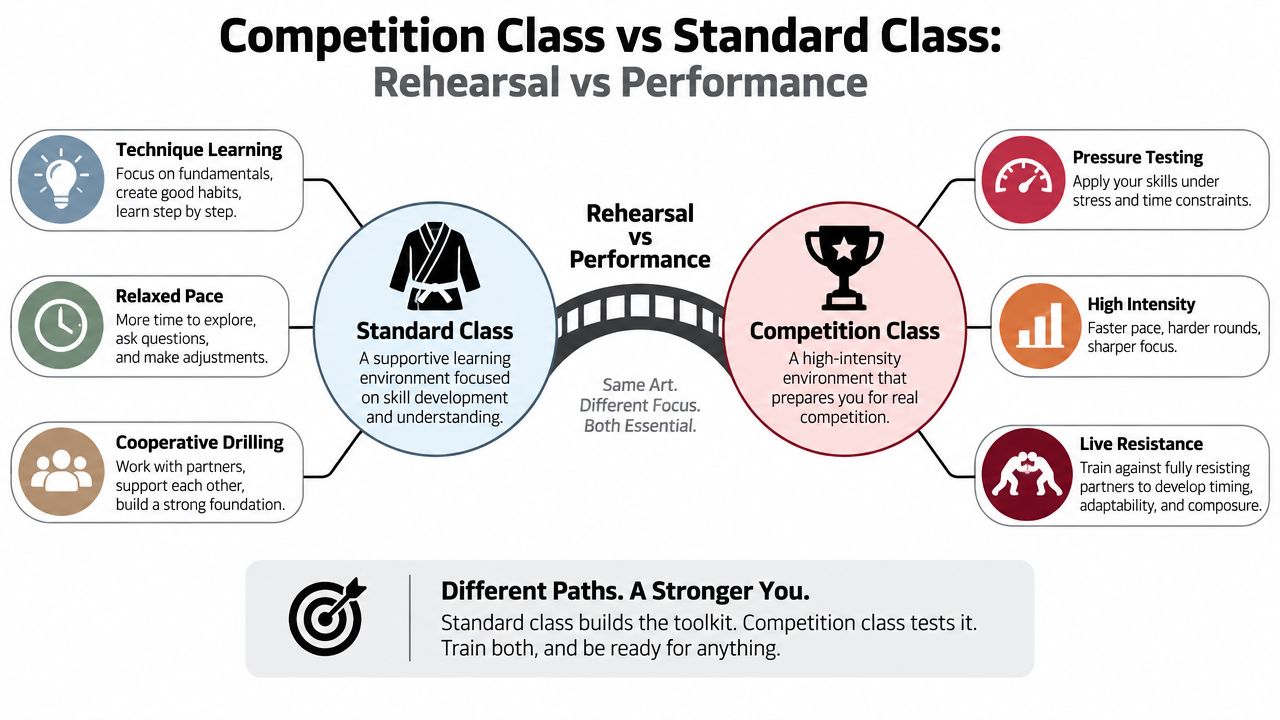
A standard BJJ class is a rehearsal, a competition class is a performance check. Both matter, but they train different parts of the game. Rehearsal gives you the script, performance forces you to deliver it when someone's pushing back.
The clearest way to see the difference is through the choices coaches make. Standard class often gives you more room to learn a movement without consequence. Competition class reduces that slack and asks, “Can you do it when it counts, under pressure, with tired legs and a live opponent?”
Rehearsal versus performance
In a rehearsal, you can stop, reset, ask questions, and repeat the same action with little urgency. In a performance, the clock is moving and the other person is trying to ruin your plan. That's why competition classes focus so heavily on timing, pressure, and rule awareness.
Australian competition culture reflects that long development. The NSW BJJ Federation marked its 25-year celebration in 2025 (source), which shows that organised competition here has grown through a multi-decade structure, not a passing trend.
A competition session should feel controlled, but not comfortable. If it feels comfortable, it probably isn't testing enough of the right things.
What coaches are really building
At a structural level, competition classes train a few linked abilities:
Decision-making under pressure, so you don't freeze when grips break or positions collapse.
Rule-set awareness, so you know what scores, what stalls, and what matters to the referee.
Energy management, so you can stay effective across repeated rounds.
Technical transfer, so techniques move from the drill phase into live resistance.
For a useful framing on how skills behave under pressure, training design with skill taxonomy is a smart lens. It maps well to the jump from closed, repeatable reps into open, live decision-making.
That's why competition class isn't just “hard class”. It's a different teaching system with a different outcome.
How Warm Up and Technical Drilling Set the Tone
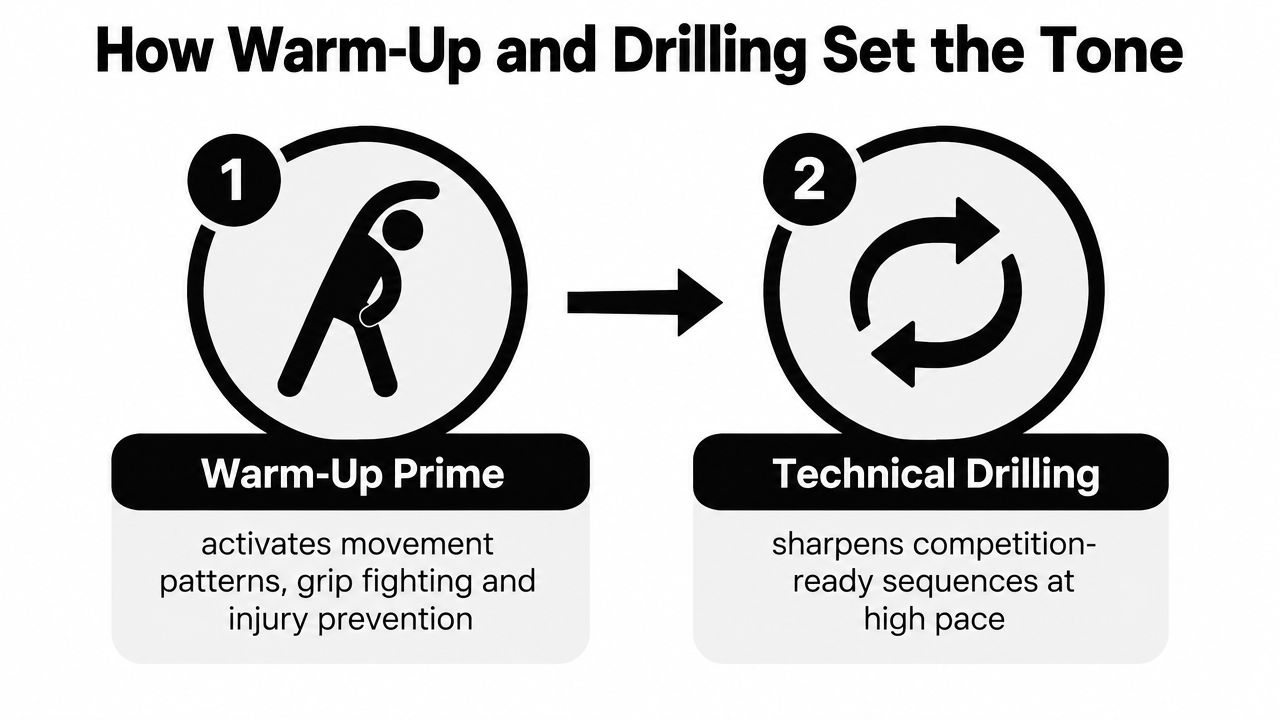
The warm-up in a comp class isn't fitness theatre. It's the first layer of preparation, and it should turn sleepy joints into usable joints without wasting energy. If the body isn't primed, the later rounds become sloppy, and sloppy habits are expensive in a match.
Warm-up as movement prep
Good warm-ups in competition training usually look like a short sequence of movements that echo grappling demands. Shrimping, bridging, technical stand-ups, stance motion, and grip-aware movement all help the body remember the shapes it'll need later. That's not random conditioning, it's rehearsal for the movement vocabulary of the session.
A useful way to judge the warm-up is simple. If it helps you move more cleanly, defend more safely, or react faster once live work begins, it belongs there. If it just makes you tired, it's probably stealing energy from the important blocks.
Drilling with a tournament lens
Technical drilling in comp class should be narrow and useful. Coaches often prioritise high-percentage sequences, then repeat them with enough speed and pressure that they start to feel familiar in motion, not just in theory. That's where chain drilling matters, because one isolated move rarely survives first contact with a real opponent.
Coaching cue: Drill the entry, the reaction, and the follow-up together. A move that only works in a vacuum won't hold up in competition.
The point isn't to collect techniques. The point is to make a few competition-ready actions feel automatic when the round starts getting messy.
A good warm-up and drilling block also sets up the rest of class by reducing uncertainty. The body is awake, the hands know what they're looking for, and the mind has already been pointed at the day's tactical problem.
For a closer look at how one local warm-up flow is framed, see the Locals Zetland warm-up overview.
Positional Sparring and Specific Training Explained
Positional sparring is where competition class starts to feel like problem-solving instead of exercise. The coach gives you a starting point, a task, and a limit, then watches how you think when your options are smaller and the pressure is real. That's why this block develops competitors so efficiently, it strips away noise.
Why the starting position matters
If you always begin from open rolling, the whole match becomes too broad to study cleanly. Start from half guard, back control, or a passing battle, and the lesson gets sharper. You're no longer asking, “What can I do anywhere?”, you're asking, “What can I do here, right now, against resistance?”
That narrower question makes feedback much more useful. Coaches can correct a grip, a frame, a hip angle, or a first reaction instead of trying to fix an entire game in one conversation. Athletes improve faster because the round is built to expose one problem at a time.
Specific training builds decisions
Specific training goes one level further. The coach adds a scenario, a goal, and often a constraint, so the round imitates a real tournament moment. One athlete might need to hold side control, another might need to escape, another might need to score first, and all of that happens under live resistance.
The advantage is repetition with meaning. You get the same kind of decision over and over, but against different bodies, different reactions, and different levels of fatigue. That's how tactical awareness starts to stick.
The best positional rounds don't feel random. They feel like a series of small exams, each one checking whether your habits still work when someone fights back.
The NSW police competition rules used in Australia keep this pressure relevant by limiting adult Brazilian Jiu-Jitsu matches to 5 minutes and using the traditional IBJJF scoring system, 4 points for mount, 4 for back control, 3 for guard pass, 2 for sweep, 2 for takedown, and 2 for knee-on-stomach. A position must be held for 3 seconds before points are awarded (source), which is exactly why positional discipline matters so much in class.
Live Sparring Conditioning and Match Simulation
Live sparring is the last place where training turns into proof. By this point, the room should already have primed movement, cleaned up the main sequence, and stressed the important positions. Now the class asks whether the athlete can keep that work alive when the pace rises and fatigue starts to interfere.
Match simulation versus casual rolling
Casual rolling can drift into habit. Match simulation has a target. The coach may ask athletes to score first, start from a specific position, stay inside a ruleset, or emphasise control before submission. That changes the whole round because you're no longer free-styling for the sake of movement, you're rehearsing tournament behaviour.
The other difference is pacing. In a normal roll, intensity often rises and falls without much intent. In live comp rounds, the coach tends to manage rest, rotation, and effort so the athletes can keep working near their competition pace without tipping into chaos.
Conditioning belongs in the same conversation
Conditioning in competition class should support match output, not replace grappling. That usually means short, hard efforts that mimic the strain of repeated exchanges, not endless exhaustion for its own sake. If the athlete can't keep technical shape while tired, the conditioning block has gone too far or started too early.
Australian class planning also has to account for weight categories, and that makes prep more concrete. In NSW BJJ Federation rules, adult and master Gi and No-Gi divisions use different limits, with No-Gi generally about 2.0 kg lighter in corresponding male divisions. For example, Male Adult/Master Gi Rooster is 57.5 kg, while Male Adult/Master No-Gi Rooster is 55.5 kg (source).
Division Name | Gi Limit | No-Gi Limit | Difference |
|---|---|---|---|
Rooster | 57.5 kg | 55.5 kg | 2.0 kg |
Light Feather | 64.0 kg | 61.5 kg | 2.5 kg |
Feather | 70.0 kg | 67.5 kg | 2.5 kg |
Light | 76.0 kg | 73.5 kg | 2.5 kg |
For athletes who need a structured way to pair strength work with mat training, the Locals Zetland strength and conditioning overview fits neatly into competition prep.
Periodization and Peaking for Tournament Day
A single class only matters if it sits inside a larger plan. That's where periodization comes in, which is just a practical way of saying training changes shape as the tournament gets closer. You build, then sharpen, then reduce noise so the body shows up ready.
Training blocks need different jobs
Early in a camp, the focus is usually broader. Athletes need enough volume to consolidate movement, clean up weak links, and build general confidence in the positions that matter most. As competition gets closer, the work becomes more specific, and the room spends more time on the exact problems likely to show up on tournament day.
That shift matters because fatigue hides good decision-making. If every week feels identical, the body gets tired, but the performance doesn't get clearer. When the blocks are organised properly, each one has a distinct purpose.
Why weight management can't be left late
Queensland competition guidance is strict on weight, with no further allowances beyond the published category limits. If an athlete exceeds the limit when the match is called, they're disqualified, they forfeit the entry fee, and they receive no placing (source). That makes division choice and weigh-in discipline a training issue, not a last-minute admin problem.
Practical rule: Don't plan your tournament around what you hope the scale will say. Plan around the category you can actually make, consistently, without panic.
A lot of athletes also underestimate how much class structure helps with peaking. If your training week already distinguishes between drilling, positional work, live rounds, and conditioning, it becomes easier to taper intelligently rather than guessing what to remove. The structure does part of the planning for you.
For readers mapping that logic into a competition calendar, the Locals competition training guide gives a simple framework for bringing class choice and tournament timing together.
Bringing Your Competition Game Together at Locals
The cleanest way to think about bjj competition class structure is as one connected system. Warm-up prepares the body, drilling gives you usable tools, positional work tests decision-making, live rounds reveal what survives, and periodization makes sure you peak at the right time instead of burning out early.
That system matters even more in Australia, where class and tournament design already split athletes across age, belt, weight, Gi, and No-Gi categories. The Australian Jujitsu Federation lists seven male weight divisions from -56 kg to +94 kg and seven female divisions from -45 kg to +70 kg (source), which makes smart division planning part of serious preparation from the start.
At Locals Zetland and Locals Maroubra, the right approach is the one that keeps the athlete improving without guessing. Bring your rash guard or Gi, water, a clear mind, and a willingness to work through each block with purpose. If you're new to comp training, one good session will already show you that structure beats random intensity.
If you're ready to train with a clear competition path, visit Locals Jiu Jitsu Zetland and see how structured classes support beginners, competitors, and adults who want a smarter way to prepare. You'll get a room that treats each block like part of a real tournament plan, not just hard rounds for the sake of it.
Comments