_edited.png)
Learn Brazilian Jiu Jitsu in Sydney: Beginner's Guide
You're standing outside a Sydney BJJ academy, wondering whether everyone inside already knows how to shrimp, tie a belt and survive a roll. They don't. Every experienced student was once the person checking the timetable twice, worrying about fitness and hoping nobody would notice they didn't know the difference between guard and mount.
Learning Brazilian jiu-jitsu is much easier when you start in the right class, control your training load and measure progress by useful skills rather than spectacular submissions. This guide is for adults trying their first grappling class, parents considering classes for children and returning martial artists who want a sensible path back onto the mats.
Walking Into Your First BJJ Class
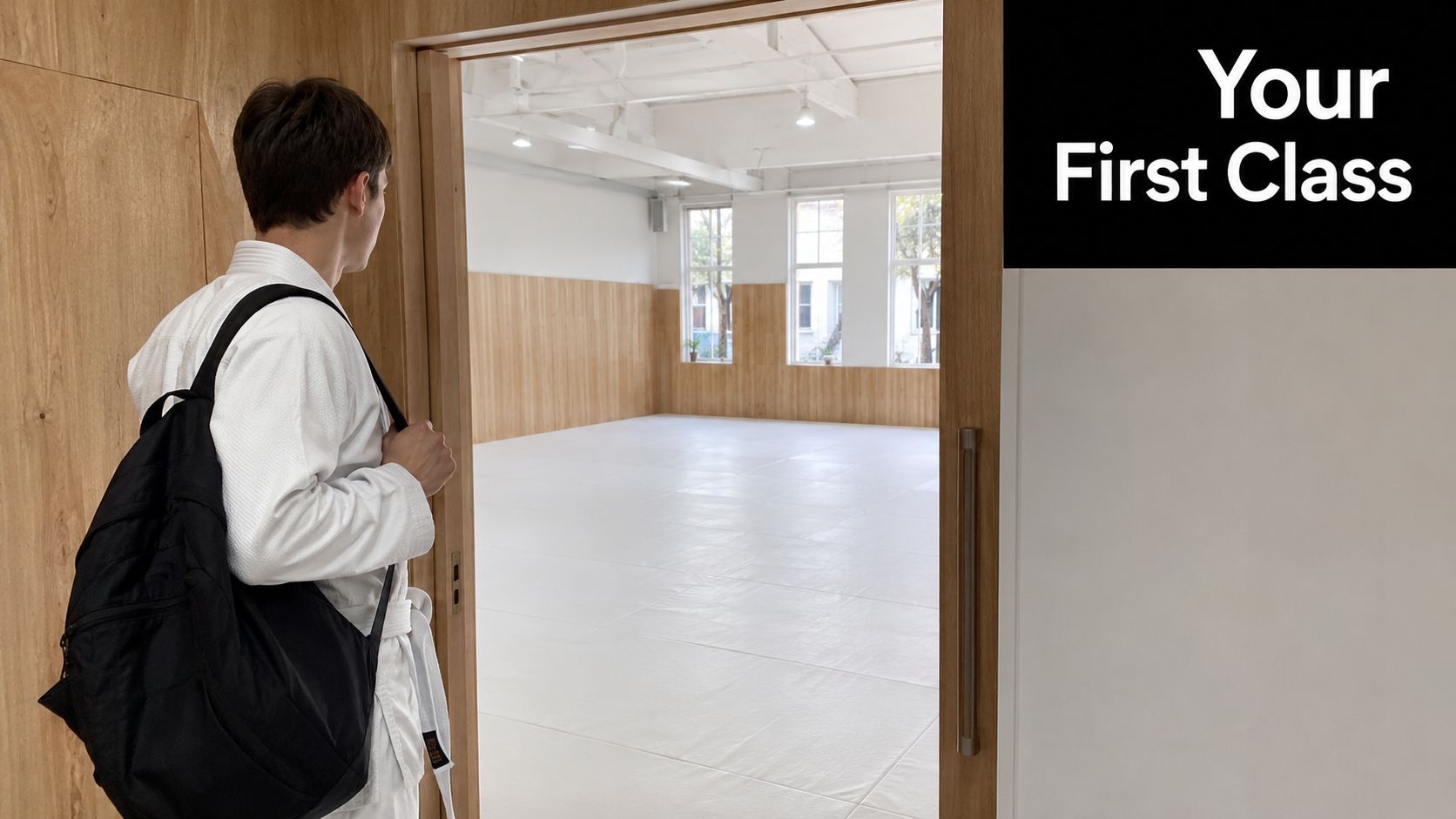
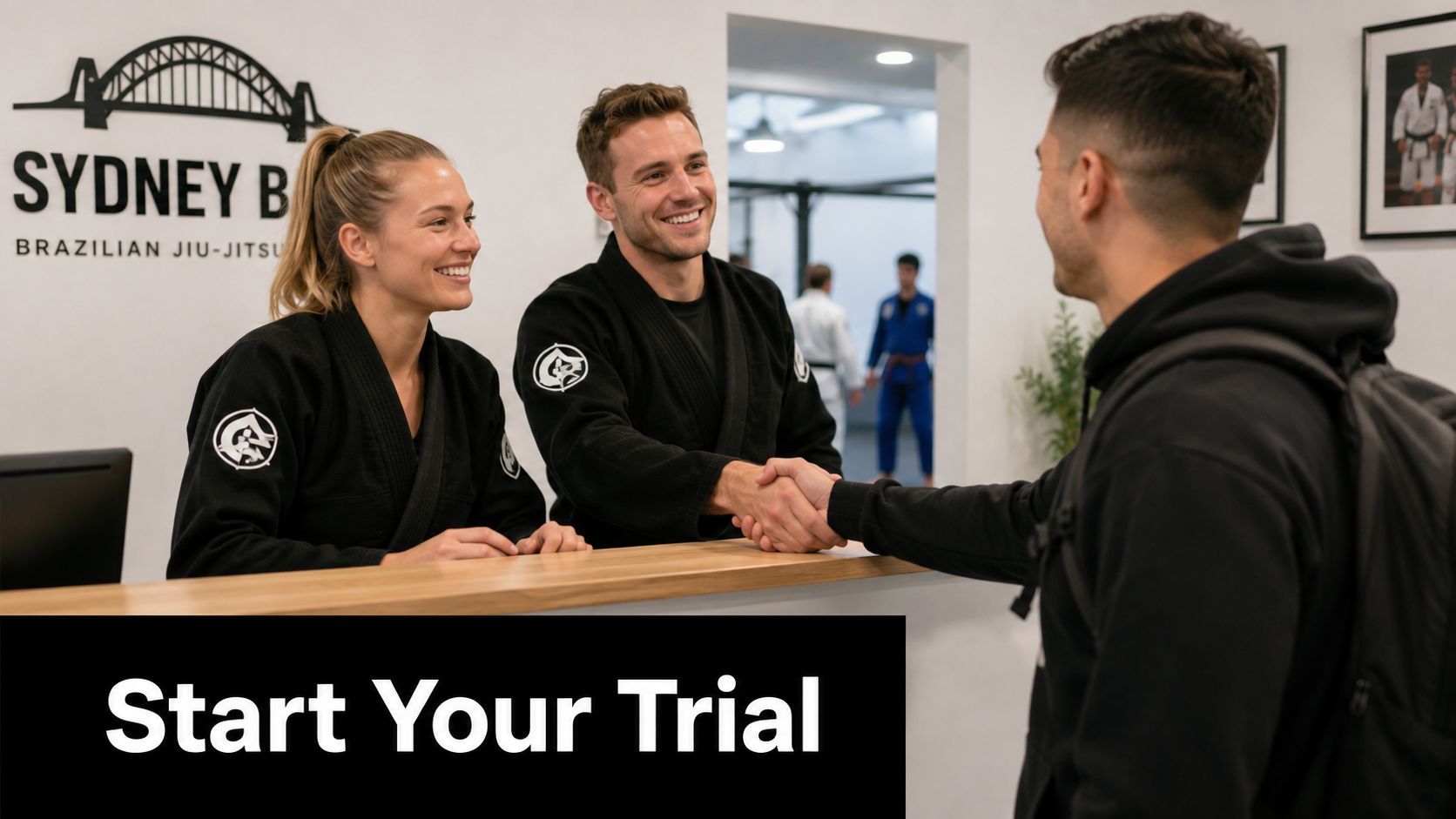
The first thing you'll notice is that a structured class removes most of the guesswork. You'll be welcomed, shown where to change, told what to wear and paired with someone who understands how to work with a beginner. Your job isn't to look tough. Your job is to listen, move carefully and ask questions when a position doesn't make sense.
Australian BJJ is no longer a fringe activity. SBS reported around 40,000 practitioners nationwide, with an estimate that 90% are Australian rather than Brazilian in its coverage of the sport and business (SBS coverage of Brazilian jiu-jitsu in Australia). That matters in Sydney because you're joining an established local training culture, not trying an obscure activity with no clear progression.
Start with the right expectations
Your first class will probably include movement drills, a technique demonstration, partner practice and some form of controlled positional work. You may feel clumsy. That's normal. BJJ asks you to coordinate your hips, hands, breathing and balance while another person is actively changing position.
The first two weeks should feel like orientation, not an examination. Learn how the academy moves, how partners communicate and how to tap before discomfort becomes panic. A coach can make that process far more productive than trying to copy advanced techniques from social media.
Who should start
Adults don't need a wrestling background, unusual flexibility or a particular body type. Parents should look for a children's class with clear boundaries, attentive coaching and activities that develop movement without turning every interaction into rough play. Returning martial artists should resist the urge to skip fundamentals, because grappling uses different timing, distance and balance from striking arts.
Read the Locals Zetland beginners programme before booking. Then contact the academy, explain your experience and ask which class suits your age, goals and schedule.
Coach's rule: Your first win is showing up prepared to learn, not submitting somebody.
Choosing the Right Program at Locals
Picking a class becomes simple when you match the programme to your experience rather than your ambition. The advanced class may look exciting, but a beginner needs time to build frames, base, safe falling and positional awareness before adding complicated combinations.
Use this quick comparison when reviewing the Locals programmes:
Programme | Best fit | What you'll work on |
|---|---|---|
Kids | Children roughly aged 5 to 12 | Games, coordination, confidence and anti-bullying fundamentals |
Beginners Gi | Most adults starting BJJ | Fundamentals, drilling, posture and positional sparring in the gi |
Advanced | Experienced students, generally through invitation or prior experience | Technical depth, combinations and higher-level problem-solving |
No-Gi Beginners | Students from wrestling, MMA or athletic gym backgrounds | Faster transitions, underhooks, head control and grip-free scrambling |
Kids classes
A child's first class should be organised, active and easy to understand. Game-based movement gives younger students a way to practise balance, coordination and safe body positioning without demanding that they absorb adult terminology immediately.
Parents should ask how coaches handle contact, partner changes and emotional overwhelm. A good children's programme develops confidence through repeatable tasks, not through pressure to dominate another child.
Beginners Gi
For most adults, this is the correct starting point. The gi gives you clear grips and slows exchanges enough for a new student to understand posture, frames, guard and control. You'll drill basic movements repeatedly, then apply them in limited positional rounds.
Advanced and No-Gi
Advanced training is for students who already understand the foundations and can train safely at a higher pace. It isn't a shortcut to improvement.
No-Gi Beginners suits people who already feel comfortable with fast movement, wrestling-style pressure or athletic conditioning. It still requires patience. Without collar grips, you'll rely more heavily on underhooks, head position, body control and deliberate hand fighting.
Your First Two Weeks at Locals Zetland or Maroubra
Book the free trial through the Locals website, then arrive 10 to 15 minutes early. That gives the coach time to learn your name, understand your experience and choose a suitable partner. Don't walk in at the exact start time while rushing to put your shoes away. Calm preparation helps you absorb the first instructions.
Bring a clean gi if you're attending Gi class. For No-Gi, wear a clean rashguard or fitted sports top with shorts that don't have exposed hard fittings. Pack a water bottle, keep your nails trimmed and leave shoes off the mat. A mouthguard is optional, but it's a sensible addition once you begin regular positional sparring.
What a normal class looks like
A typical session starts with a guided warm-up. Expect movements such as shrimps, breakfalls and technical stand-ups. These aren't filler exercises. They teach you how to create space, land safely and stand without exposing your back.
The coach will then demonstrate a technique or position. Watch the details that make the movement work, especially frames, hip placement, posture and the direction of pressure. During drilling, rotate partners when instructed and keep the pace slow enough to understand the sequence.
If there's time for positional sparring, you'll start from a defined position with a clear goal. You might work on escaping mount or maintaining side control rather than attempting to win an unrestricted roll.
Check the Locals timetable before travelling so you choose an appropriate beginner session.
Mat etiquette keeps everyone training
Belt colour reflects experience within the academy, but it doesn't make a partner untouchable or a beginner unworthy of respect. Bow in and out as instructed, listen when the coach speaks and don't walk across an active pair.
Tap early and often. A tap can be physical or verbal, and you should release immediately when your partner taps. Tell the coach about injuries or restrictions before class, not after a problem develops.
Core Techniques Every Beginner Should Drill
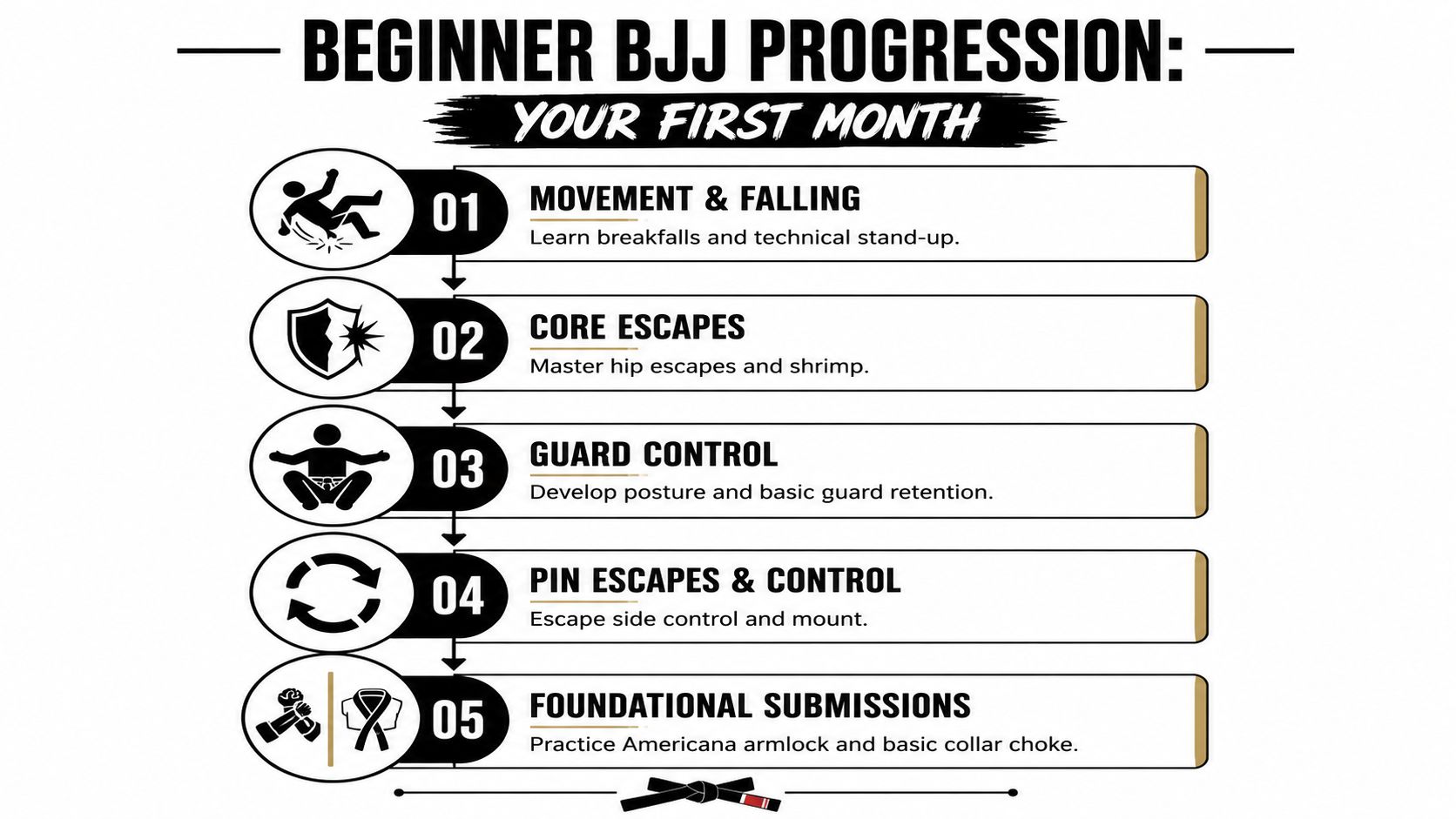
Don't build your first month around collecting submissions. Build it around movement, survival, control and escape. If you can't create space or maintain a safe position, an advanced submission won't help you for long.
Start with the movements that appear in almost every useful exchange:
Hip escape: Turn onto your side, frame against your partner and move your hips away to make space.
Bridge: Drive through your feet to lift your hips and disrupt top pressure.
Technical stand-up: Post safely, protect your head and stand while keeping distance.
Breakfall: Learn to land without throwing an arm out or striking the mat dangerously.
Build positions before submissions
In closed guard, protect your neck, keep your posture organised and control your partner's sleeves or wrists. Move your hips instead of pulling constantly with both arms. From the bottom, practise creating frames and recovering space. From the top, learn to keep your weight balanced rather than leaning so far forward that you lose your base.
Your early escape menu should include side-control escape and mount escape. Your control work should include maintaining side control with stable pressure, sensible head position and awareness of your partner's frames.
Once those positions feel manageable, add straightforward patterns such as a cross-collar choke and an armbar from guard. The point isn't to force them on every partner. The point is to recognise the opening, establish control and transition safely if the first attempt fails.
Practical rule: During positional sparring, choose one task, such as escaping mount, and let that task guide every decision.
No-Gi students use the same principles without collar grips. Work on underhooks, head-and-arm control, two-on-one grips and strong frames. After class, write down three techniques and revisit one at the next session.
A Realistic Six-Month Training Plan
Your first six months should be steady enough to fit around work, family, study and recovery. Australian martial arts participation is heavily organised, with 85% of adult participation reported as organised and a national adult participation estimate of 248,351 in the Australian Sports Commission's State of Play report (Australian Sports Commission martial arts participation report). A coached, scheduled routine suits the way most adults already participate.
Weeks one and two
Train once or twice each week. Concentrate on safety, terminology and two or three movements you can repeat without rushing. Leave at least one recovery day between demanding sessions.
You're learning how your body responds to grips, pressure and unfamiliar positions. Don't add extra conditioning or hard sparring because the first class left you excited.
Months two and three
Aim for two classes each week, including a fundamentals or beginner session where available. Add short, controlled positional rounds and choose a narrow goal, such as escaping side control or maintaining closed guard.
At the end of each month, ask yourself three questions:
Can you explain the position in plain language?
Can you perform the key movement without rushing?
Can you survive positional rounds with different partners?
These questions measure learning more accurately than chasing a particular belt timeline.
Months four to six
Train two or three times weekly if your recovery, work and study allow it. Keep one session centred on technique, retain one fundamentals class and treat a third session as optional drilling or sparring.
Increase volume gradually. If soreness, poor sleep or an irritated injury is affecting your movement, don't add hard rounds. A 2025 systematic review recorded 1,711 of 1,913 reported injuries during training, or 89%, with injury incidence of 5.5 per 1,000 training hours and 55.9 per 1,000 competition matches (systematic review of BJJ injuries). The lesson is direct: control training exposure before worrying about competition intensity.
Progress may slow when you alternate Gi and No-Gi or miss sessions around life commitments. Consistent attendance and sensible recovery will take you further than occasional bursts of extreme effort.
Common Beginner Mistakes and How to Avoid Them
Your first hard roll can feel like a test of toughness. Treating every round that way is the fastest route to poor habits. New students often squeeze, chase submissions and ignore position until they are exhausted. Partners notice that frantic pace and may stop trusting you in training.
Set one technical objective for each positional round. Control the pace, keep breathing and tap immediately when a submission is secure or discomfort feels unsafe. Hiding pain earns nothing.
The mistakes that slow progress
Overtraining: Three intense sessions after a long inactive period can overload your shoulders, knees, other joints and lower back. Increase training gradually, rest between demanding days and tell your coach about medical restrictions before rolling.
Training through warning signs: Sharp pain, dizziness or unusual fatigue means you should stop and speak with the coach. Do not try to prove toughness by continuing.
Clenching every grip: Constant squeezing drains your hands and forearms. Relax when your partner is not attacking, then regrip with a clear purpose.
Jumping into advanced class: Start with Fundamentals or Beginners. You need time to learn frames, base, turns and safe falling before complex combinations and faster rounds.
Copying techniques without context: A dramatic online move cannot replace sound movement or positional understanding. Ask questions, then practise one detail correctly.
Use the Better Health Channel guidance on preventing martial arts injuries when judging training risk. Martial arts can suit children from around age five, and injuries are often limb injuries that range from mild to moderate. That does not make every session safe. Coaching standards, partner behaviour, hygiene and sensible load management still determine whether your training is sustainable.
After class, review one detail and write it down. Return to that movement during your next drill instead of collecting another dozen techniques. Relaxed, consistent practice will take a beginner further than aggressive rounds followed by missed sessions.
Why Learn BJJ and Your Next Step at Locals
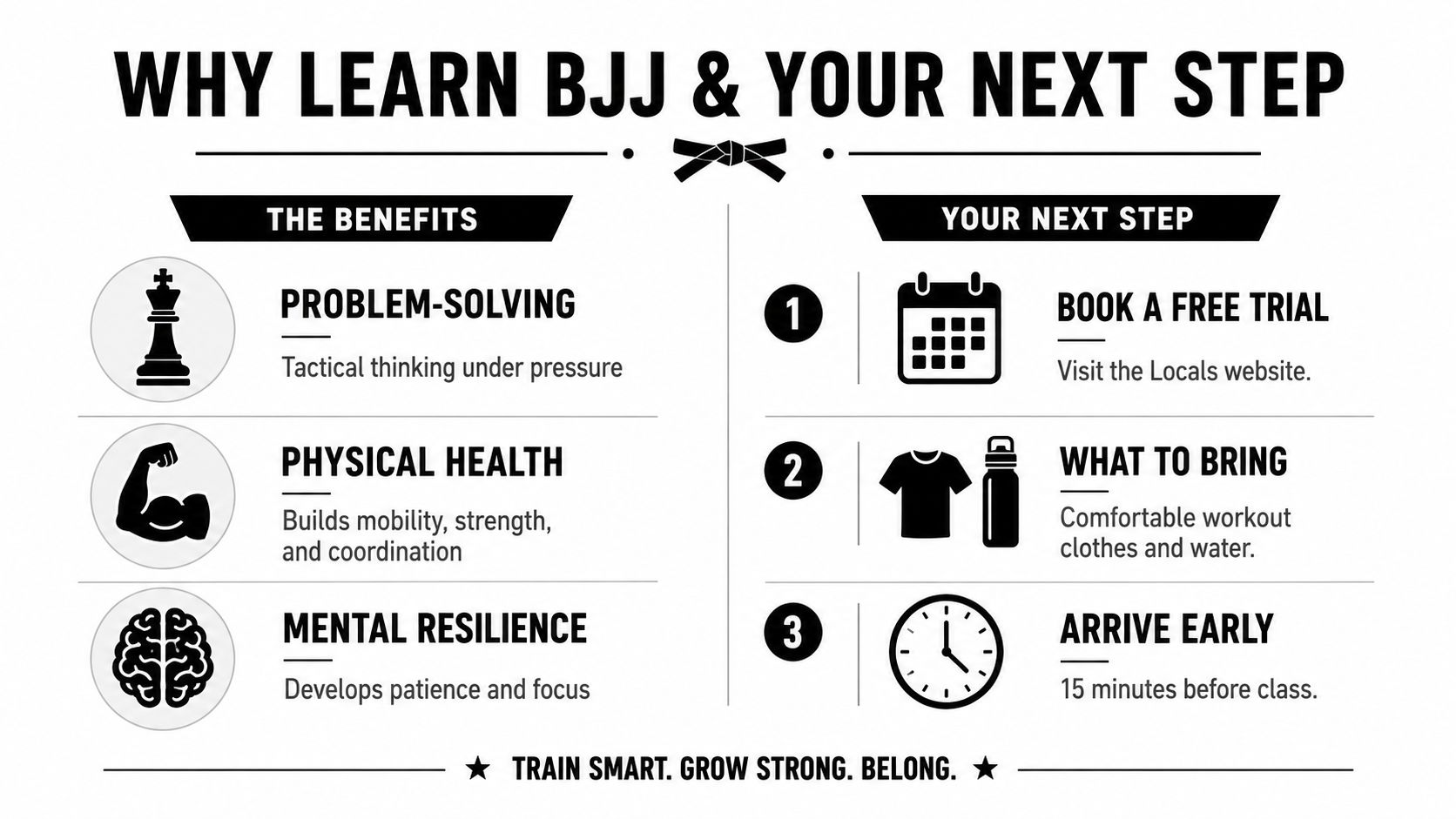
You do not need an athletic background to start BJJ. Each class gives you a physical problem to solve while a partner changes the situation in real time. You learn to manage balance, pressure, frames and timing, building coordination, mobility, strength, fitness and patience through steady practice.
Technique also gives smaller students practical ways to control position against larger partners during supervised training. Keep the limits clear: sport practice cannot guarantee self-defence. Real situations may involve uncertainty, multiple people, hard surfaces, weapons and the need to escape. Choose an academy that explains those risks instead of promising invulnerability.
Women and parents should ask direct questions before booking. Research involving more than 400 female martial artists has reported benefits across different stages of life, while Australian participation in combative sports among women remains low. The useful test is the class itself: look for structured coaching, respectful partners and a gradual introduction to contact training.
What you can expect from a local routine
A regular class builds connection because training partners rely on one another to drill, spar and improve safely. You will develop a working vocabulary for pressure and position, then practise staying calm while a problem feels uncomfortable.
Locals Jiu Jitsu Zetland offers Kids, Beginners, Advanced and No-Gi pathways. The academy serves students in Zetland and nearby inner-south suburbs, including Waterloo, Kensington and Alexandria. Locals also operates a Maroubra academy, giving you another option when travel time and weekly routine determine whether training lasts.
Start with a free trial. Arrive early, wear comfortable sports clothing, bring water and tell the coach that you are new. The coach can guide you through the warm-up, introduce basic positions and match you with a suitable partner.
Keep your first month simple. Train one or two sessions each week, focus on safe movement and record one useful detail after class. Review that detail in your next drill. Consistent, relaxed practice will take you further than hard rounds followed by missed sessions.
Locals Jiu Jitsu Zetland provides beginner BJJ classes, kids and adult coaching, plus No-Gi and advanced pathways as your skills develop. Visit Locals Jiu Jitsu Zetland, book your free trial and begin learning Brazilian jiu-jitsu safely and consistently.
Comments