_edited.png)
BJJ Self Defense Curriculum: A Structured Plan
You've watched a child freeze when another child pushes too close, or you've considered starting Brazilian Jiu-Jitsu but wondered whether sport training really prepares someone for an unpredictable confrontation. Those concerns are reasonable. A BJJ self-defence curriculum should do more than teach submissions during friendly sparring. It should build calm decision-making, safe movement, escape skills, and the confidence to disengage when physical conflict can't be avoided.
The difference lies in structure. Sport jiu-jitsu develops excellent grappling through rules, positions, and resistance. Self-defence training must add standing safety, boundary-setting, takedown awareness, breakfalls, positional restraint, and realistic decision-making. A good programme teaches these skills progressively, without throwing beginners into chaotic rounds before they understand how to protect themselves and their training partners.
Why a Structured Self-Defence Curriculum Matters
A new student often arrives with two worries at once. They're concerned about being unsafe outside the academy, but they're also concerned about being unsafe inside it. A parent may ask whether their child will be pushed too hard. An adult beginner may wonder whether an experienced partner will make every round feel like a fight.
A structured curriculum answers both concerns by replacing guesswork with progression. Rather than moving randomly from one technique to another, the coach builds a sequence. Students learn how to stand, move, protect their head and neck, fall safely, create space, escape pressure, and leave an unsafe position before they're asked to link those skills into more complex grappling.
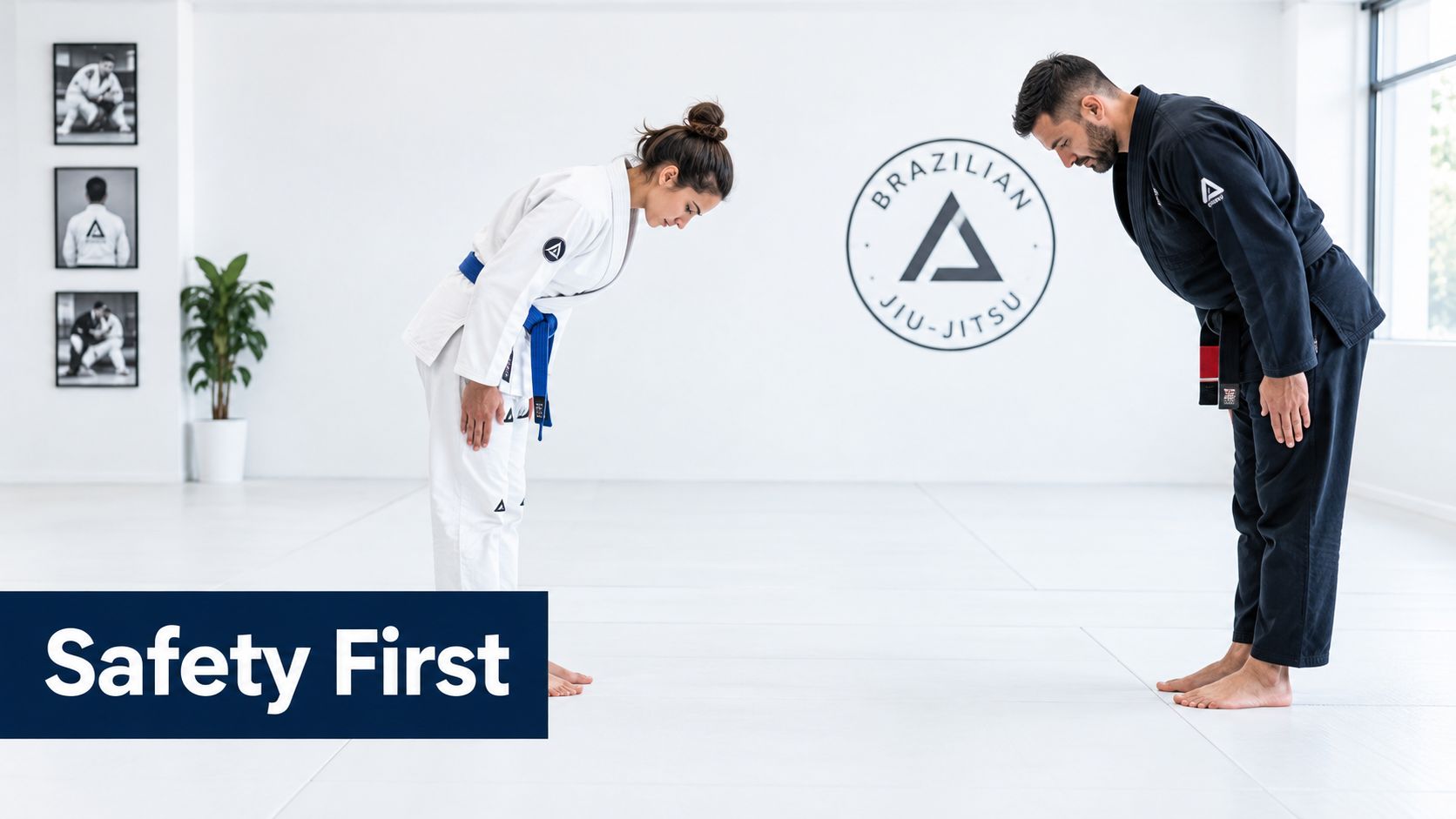
Sydney students at community-focused academies such as Locals Zetland and Locals Maroubra may have different goals, but the teaching principle remains the same. A child may need to manage unwanted contact on a playground. An adult may need to escape a grab, regain their feet, or control distance long enough to reach safety. Neither student benefits from practising only tournament exchanges.
Sport rules are not real-world rules
Sport jiu-jitsu gives students a safe framework for testing technique against resistance. That pressure matters, but a sporting exchange assumes agreed participation, a defined surface, rules, and an opponent who also understands grappling. A self-defence curriculum starts earlier in the decision process, with awareness, verbal boundaries, avoidance, and rapid disengagement.
Australia's need for this broader approach is grounded in national violence prevalence data. The Australian Bureau of Statistics' Personal Safety Survey found that about 8 million Australians aged 15 and over, or 41%, had experienced physical or sexual violence since age 15, as reported in Australian martial-arts and self-defence coverage. That scale supports teaching skills for common real-world threats rather than limiting instruction to sport scenarios.
Practical rule: The purpose of self-defence training isn't to win a fight. It's to recognise danger, protect yourself, create an opportunity to escape, and use only the control necessary to reach safety.
The curriculum should therefore feel like a safety net. Each layer supports the next, so a beginner doesn't need perfect timing or athleticism before they can make a sensible defensive choice.
The Reality of Training Safety and Injury Risks
Live training carries risk, and responsible coaching acknowledges that plainly. Australian sports injury hospitalisation data recorded 602 hospitalised injury cases from combative sports in 2011–12, representing 2% of all hospitalised sports injuries, with 401 cases classified as martial arts. The figures are reported in Australian sports injury hospitalisation data. They show why falling, contact, and resistance must be taught deliberately, not left to chance.
Australian reporting groups judo, jujitsu, karate, kendo, kung fu or wushu, mixed martial arts, muay thai, and taekwondo under martial arts, while separating self-defence training as its own category in national hospital morbidity reporting. That classification makes safety auditing possible. A BJJ programme should be judged not only by how effective its techniques appear, but also by whether its structure limits avoidable stress and teaches students how to manage contact.
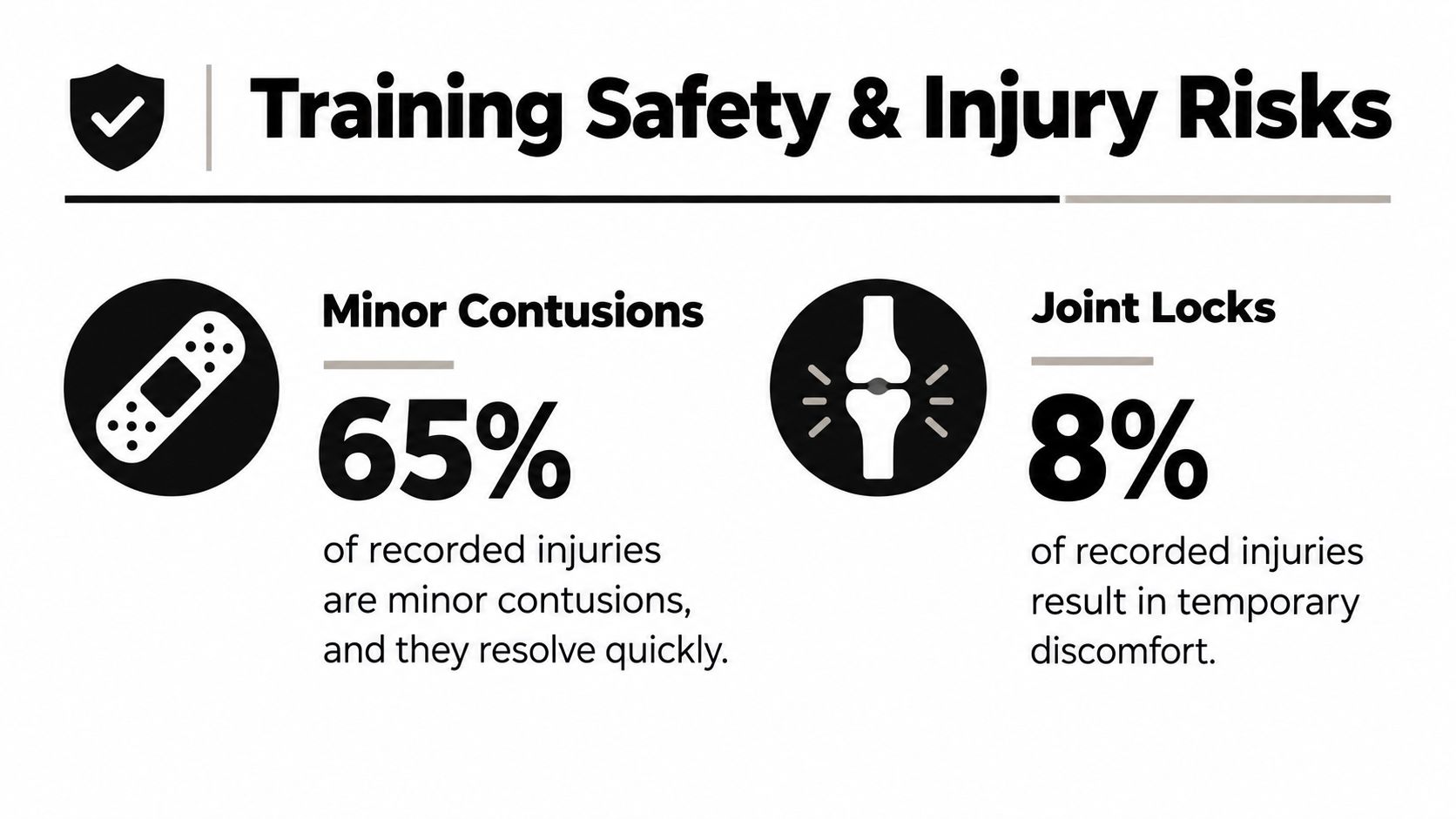
What safer training looks like
The coach controls exposure by changing the task, the starting position, the intensity, and the length of each round. Beginners might begin from a seated or pinned position, practise one escape, and reset after the key movement. That creates useful resistance without turning every drill into an exhausting contest.
A safe class typically includes:
Technical warm-ups: Students rehearse movement patterns before applying them against a partner. The Locals guide to a jiu-jitsu warm-up reflects why preparation matters before live work.
Controlled falling: Breakfalls and safe posting reduce panic when balance changes.
Clear tapping rules: Students learn to tap early, release immediately, and communicate discomfort before a minor problem becomes an injury.
Progressive resistance: Partners increase pressure only when the defender can maintain posture, breathing, and awareness.
Position-specific rounds: Short scenarios teach a defined response instead of rewarding uncontrolled scrambling.
The injury data shouldn't be used to frighten beginners away. It should shape the lesson plan. A self-defence curriculum that teaches restraint, breakfalls, frames, escapes, and controlled contact takes risk seriously while still giving students the pressure-testing needed to retain skills under stress.
Building Confidence Through Kids BJJ Programs
Children need a different pathway from adults. They're still developing coordination, language, emotional regulation, and an understanding of personal boundaries. A kids' BJJ class should never depend on fear or aggression to create confidence. It should help children recognise unsafe behaviour, use their voice, move away, and ask for help before physical skills become necessary.
A useful lesson begins with simple movement. Children learn how to stand with balance, change direction, sit safely, turn their hips, and maintain a stable base. Games can teach these ideas without making a child feel as though they're being tested. The coach can then connect each game to a practical purpose, such as staying upright, protecting space, or escaping from an uncomfortable position.
A child-friendly progression
The first layer is awareness and boundaries. Children practise saying “stop” clearly, keeping enough space to move, and identifying trusted adults. They learn that being polite doesn't mean accepting unwanted contact.
The second layer is safe movement. Standing breakfalls, technical stand-ups, and basic hip movement help children respond when they stumble, fall, or get pushed. The emphasis remains on recovering balance and returning to a safe position, not chasing a submission.
The third layer is escape mechanics. A child may practise framing against a partner's shoulders, turning onto their side, recovering their knees, and moving towards an exit. Coaches can introduce basic throws and takedowns in carefully controlled ways, with a clear focus on body awareness and safe landing.
Why inclusion matters
Parents also want to know whether the room will suit children who are shy, smaller, or inexperienced. The answer depends on class design. Partners should rotate thoughtfully, coaches should explain consent and tapping, and drills should reward control rather than force.
Australian participation data supports the need for inclusive, organised programmes. A Judo NSW summary of AusPlay and State of Play data reported 136,998 women among 248,351 martial-arts participants aged 15 and over, roughly 55% of adult participation, and stated that 85% of adult participation was organised through clubs or academies in the Judo NSW participation summary. That points to a substantial audience seeking coached, venue-based learning.
For children, success means leaving class more capable and more settled. A child who can say no, keep their balance, escape pressure, and seek help has gained practical confidence without being taught that every problem must become a fight.
Navigating the Beginners Pathway
Adult beginners often expect the first lessons to focus on submissions. A well-designed self-defence pathway usually does the opposite. It teaches the skills that keep a person safe when technique breaks down: posture, breathing, frames, base, movement, and the ability to stand up without exposing themselves unnecessarily.
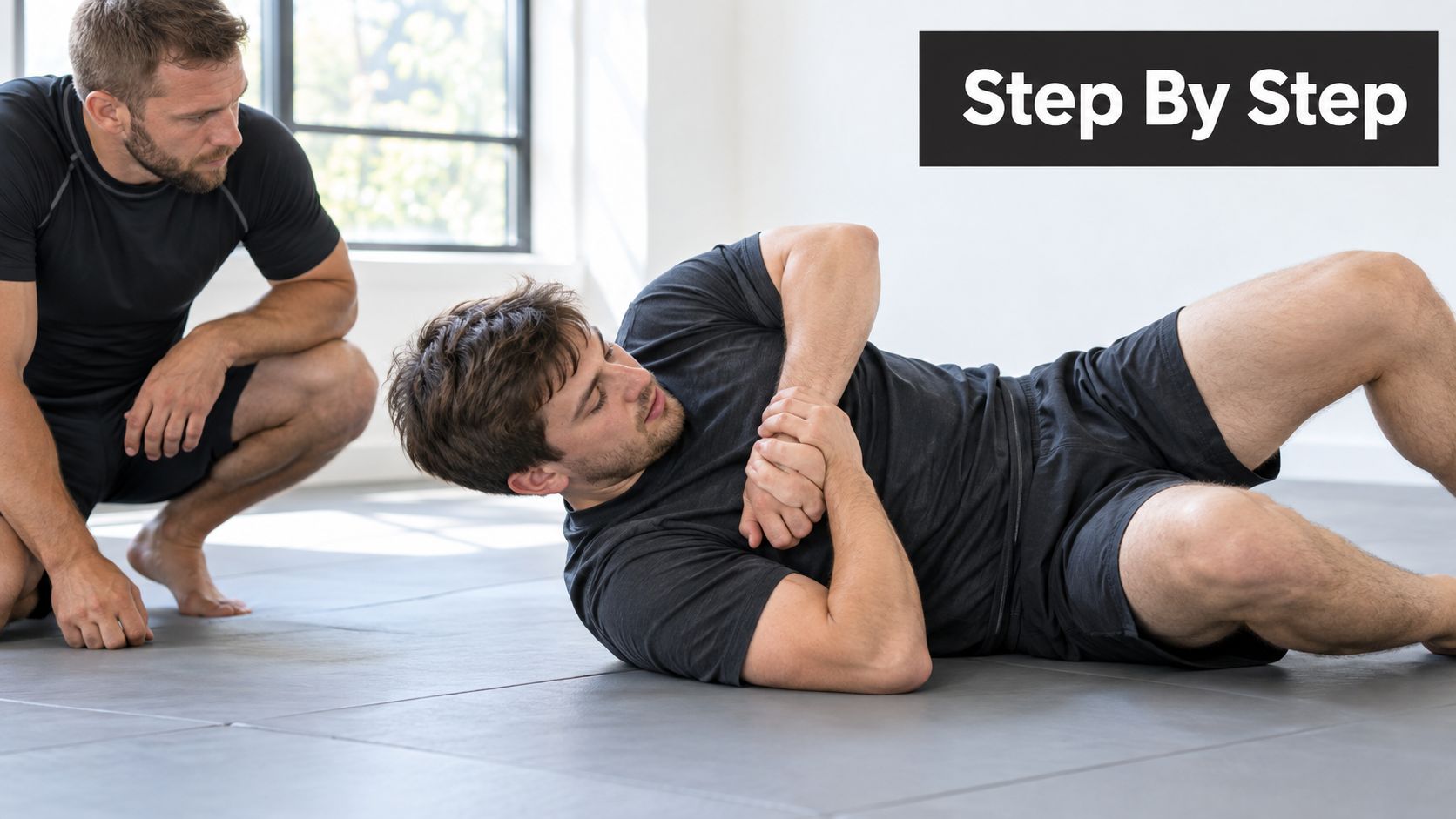
The foundation phase
Early lessons should establish a reliable order of priorities:
Protect yourself first. Students learn head position, elbows close to the body, frames, and breathing under pressure.
Build a stable base. A strong base makes it harder to be moved and easier to create space.
Move before attacking. Hip escapes, bridging, turning to the side, and guard retention help a beginner avoid becoming flat and helpless.
Recover a standing position. Technical stand-ups and wall-assisted movement connect ground survival to disengagement.
Add control later. Submissions and positional attacks make more sense once students can survive, escape, and reset.
The sequence resembles learning to drive. You don't begin by practising emergency manoeuvres at speed. You first learn where the controls are, how to brake, how to steer, and how to stay aware of what surrounds you. In BJJ, those controls are posture, frames, base, hips, and breathing.
Australian combat-sport research reinforces the need to teach lower-body awareness. A Western Australia study collected 250 athlete questionnaire responses, with 97 responses reporting 321 injury-related health problems. It also found that 82 injury-related issues weren't documented by physicians, while lower limbs accounted for 63% of reported problems, according to the Western Australia combat-sport study.
That evidence gives beginners a practical reason to learn safe base, takedown defence, leg positioning, and controlled transitions early. These aren't glamorous techniques, but they're the foundations that help a student train consistently.
The BJJ fundamentals curriculum can help readers understand how foundational positions connect before advanced attacks appear.
A beginner shouldn't be measured by how aggressively they roll. Progress looks like keeping calm under pressure, protecting the neck, creating a frame, recovering a safe position, and making a clean decision to stand or disengage.
Advanced No-Gi and Technical Depth
Once students can defend and move with confidence, they may want faster transitions and more demanding rounds. That's where an advanced no-gi pathway can complement a self-defence foundation. The two approaches share positional principles, but the grips, pace, and tactical choices differ.
Gi training gives students fabric grips that can slow exchanges and make posture easier to manage. No-gi removes those handles, so students rely more heavily on wrist control, underhooks, overhooks, head position, body locks, and pressure through contact. The result is often a quicker exchange in which small changes in balance create immediate openings.
Two useful training lenses
Fundamentals pathway | Advanced no-gi pathway |
|---|---|
Emphasises posture, frames, base, escapes, and safe stand-ups | Emphasises wrestling-based grips, transitions, and submission chains |
Uses controlled resistance to build confidence | Uses faster positional changes and more dynamic rounds |
Suits beginners learning to protect themselves | Suits experienced students seeking technical depth or competition preparation |
Prioritises survival and disengagement | Develops initiative after positional control is established |
Neither pathway replaces the other. Beginners who skip survival mechanics may mistake speed for skill. Advanced students who never revisit basic posture and control can become technically busy while remaining vulnerable to simple positional errors.
Australian injury reporting provides a useful framework for making that distinction. National data classify martial arts broadly, including jujitsu alongside several other combat disciplines, while listing self-defence training separately in hospital morbidity reporting, as described in Australian martial-arts injury classification. A BJJ self-defence curriculum can therefore be evaluated as a deliberate training system, not merely as informal fitness or unstructured rolling.
When intensity becomes useful
Higher intensity has a place when students can communicate, tap, reset, and manage fatigue. Coaches should still vary the round's objective. One round might start from a clinch and require safe separation. Another might begin from bottom position and require an escape before any submission is attempted.
Students interested in no-gi BJJ training should understand that technical depth comes from solving problems, not from making every session maximal. The most effective no-gi practice keeps the self-defence priorities visible: protect the head and neck, maintain balance, control the distance, and finish in a position that allows a safe exit.
Assessment Milestones and Progression
A belt can mark development, but it doesn't answer every self-defence question. A student may know a technique during a demonstration yet lose the movement when a partner applies moderate resistance. Practical assessment closes that gap by asking whether the student can perform the skill calmly, safely, and at the right time.
What coaches should observe
A useful assessment begins with simple, observable tasks:
Breakfall quality: Can the student protect the head, distribute impact, and recover without panicking?
Positional survival: Can they maintain frames, breathing, and a safe posture while pinned?
Escape mechanics: Can they bridge, turn, recover a knee, and create enough space to move?
Standing recovery: Can they use a technical stand-up while keeping awareness of the partner?
Control: Can they hold a stable position without relying on unnecessary force?
Decision-making: Can they recognise when to disengage rather than continue grappling?
The coach should change the partner, angle, and level of resistance gradually. A student who succeeds only with a cooperative partner hasn't yet demonstrated a dependable skill. A student who can perform the same movement while tired, surprised by a reasonable positional change, and reminded to breathe is developing something more useful.
Australian self-defence guidance places particular emphasis on compliance, safety, and assessed instruction. The national training package for basic unarmed self-defence focuses on instructing basic skills against an opponent, as shown in the Australian training package for basic unarmed self-defence. That focus offers a valuable standard for BJJ schools: explain what students must learn, show how they'll practise it, and make safety part of the competency rather than an afterthought.
Parents can use the same framework when asking about children's classes. Instead of asking only which belt a child might earn, ask whether the child can set a boundary, follow a safety instruction, fall correctly, escape a controlled hold, and seek assistance. Those milestones reveal confidence more clearly than a colour around the waist.
Your Journey to Real-World Resilience
A strong curriculum changes what training feels like over time. The nervous beginner first learns how to breathe and protect their position. They then learn to move, escape, stand, and communicate under pressure. With consistent practice, they can add control, transitions, and submissions without losing sight of the original purpose, getting themselves and others to safety.
That progression also explains the structural difference between sport jiu-jitsu and genuine self-defence. Sport training offers a valuable laboratory for timing, resistance, and technical problem-solving. Self-defence adds the earlier decisions that competition rules usually leave outside the match: noticing danger, setting boundaries, protecting against standing contact, avoiding unnecessary escalation, and disengaging as soon as possible.
What students carry beyond the mats
The physical skills matter, but they're only part of the outcome. Students also practise patience, attention, communication, and recovery after mistakes. A partner may pass their guard or secure a dominant position, but the lesson is to identify the next safe action rather than freeze.
The same curriculum can serve different goals:
For children: movement literacy, boundaries, respect, and confidence in supervised contact.
For adult beginners: practical escapes, safe falling, posture, and controlled exposure to pressure.
For women: an inclusive environment that develops confidence without requiring an aggressive persona.
For experienced grapplers: deeper positional understanding, no-gi transitions, and competition preparation.
For fitness-focused students: full-body movement, mobility, mental focus, and a consistent training routine.
A community setting helps those goals coexist. Beginners can learn without being treated as targets, experienced students can refine their timing without overpowering partners, and coaches can adjust resistance to match the lesson. That combination makes training sustainable, which matters more than occasional sessions performed at an intensity a student can't maintain.
Your first class doesn't need to prove that you're tough. It needs to show that you can learn safely, ask questions, tap early, and return for the next lesson. That's how practical resilience is built, one controlled decision at a time.
Locals Jiu Jitsu Zetland offers structured kids, beginner, advanced, and no-gi training for students who want fitness, confidence, competition preparation, or practical self-defence skills. Visit Locals Jiu Jitsu Zetland to learn about the programmes and arrange a free trial in a respectful, safety-focused training environment.
Comments