_edited.png)
Jiu Jitsu vs Karate: Which Martial Art Fits You Best
You're standing outside a Sydney community centre with two trial-class flyers in your hand. One promises karate, the other Brazilian jiu jitsu. Your eight-year-old is beside you, full of energy but short on confidence, and you're trying to work out whether they need structure, practical grappling skills, or just a class they'll enjoy attending every week.
The same decision faces adults. A professional from Waterloo might want evening training that builds fitness and confidence without turning every session into a hard fight. A woman travelling through Green Square Station might care most about staying safe at close range. A competitor may want a clear ruleset and a serious pathway.
There isn't one winner in jiu jitsu vs karate. There's a better fit for your actual goal. This guide compares techniques, class structure, self-defence, competition, safety, and local class selection so you can make that choice without relying on martial-arts mythology. For a broader checklist before you choose between BJJ and Karate, compare not just style names but coaching, contact levels, and the people in the room. You can also use this practical guide to decide what martial art suits you before booking a trial.
A Real Choice Facing Sydney Beginners
The parent in Zetland isn't really asking which art is tougher. They're asking whether their child will become more confident, learn boundaries, and feel comfortable around other children. Karate may appeal because the class looks organised, with lines, formal commands, repetition, and a visible grading path. Brazilian jiu jitsu may appeal because children work with partners, solve movement problems, and learn to remain calm when someone is holding them.
Neither concern is trivial. A child who needs predictable structure may thrive in karate. A child who struggles to speak up under pressure may gain more from controlled grappling, where they practise frames, escapes, and asking a partner to stop. The quality of the coach matters more than the marketing language on the flyer.
The Waterloo professional has a different calculation. They may want a demanding workout, but they also want skills that survive contact with a resisting person. Karate develops distance, timing, footwork, and striking mechanics. Jiu jitsu develops control, positional escapes, grip fighting, and submissions. Those training experiences create different kinds of confidence.
Coach's rule: Choose the art that repeatedly trains the problem you actually want to solve.
Sydney has a substantial audience for both options. The Australian participation estimate for the broad martial-arts category that includes jiu jitsu and karate recorded 248,351 adult participants aged 15 and over, equal to 1.2% of the adult population, with adults training a median of 65 sessions per year, each with a median length of 60 minutes. The same report recorded average annual spending of $557 per participant. These figures describe the shared martial-arts category, not each style separately, but they show that structured combat-sport training has a meaningful place in Australian fitness. The Australian martial-arts participation report provides that national context.
Where Each Art Comes From and What It Teaches
Jiu jitsu has deep Japanese roots, but its Australian public history is older than many beginners realise. Cecil Elliott was teaching the art in Sydney by 1905, after earning his first Dan in Yokohama in 1904, and the first recorded ju-jitsu demonstration in Sydney took place in 1906. Australian grappling organisations also point to long institutional roots, including one organisation's claim that it has taught martial arts in Australia for over 80 years. The historical record is documented through the Australian Jiu Jitsu Association's account of its path.
Modern Brazilian jiu jitsu became especially visible internationally through the Gracie lineage and the growth of no-gi competition. The central lesson is practical rather than theatrical: use mechanical advantage, position, timing, and control before trying to force a submission. A smaller practitioner doesn't need to win a strength contest if they can protect space, escape a bad position, and move to a safer one. That problem-solving habit produces calm under grappling pressure.
Karate developed from Okinawan fighting traditions and later spread through Japanese martial-arts systems. In Sydney, its public growth belongs largely to the 1950s, with clubs and wider interest expanding through the 1960s and 1970s, according to Australian historical material. New South Wales practitioners may encounter lineages including Shotokan, Goju-Ryu, and Shito-Ryu, although each dojo applies its own technical emphasis.
Karate's kihon, kata, and dojo kun build a different kind of competence. Repetition sharpens posture, striking precision, balance, and disciplined attention. A student learns to perform a technique correctly even when tired or distracted, then carries that focus into controlled kumite and everyday conduct.
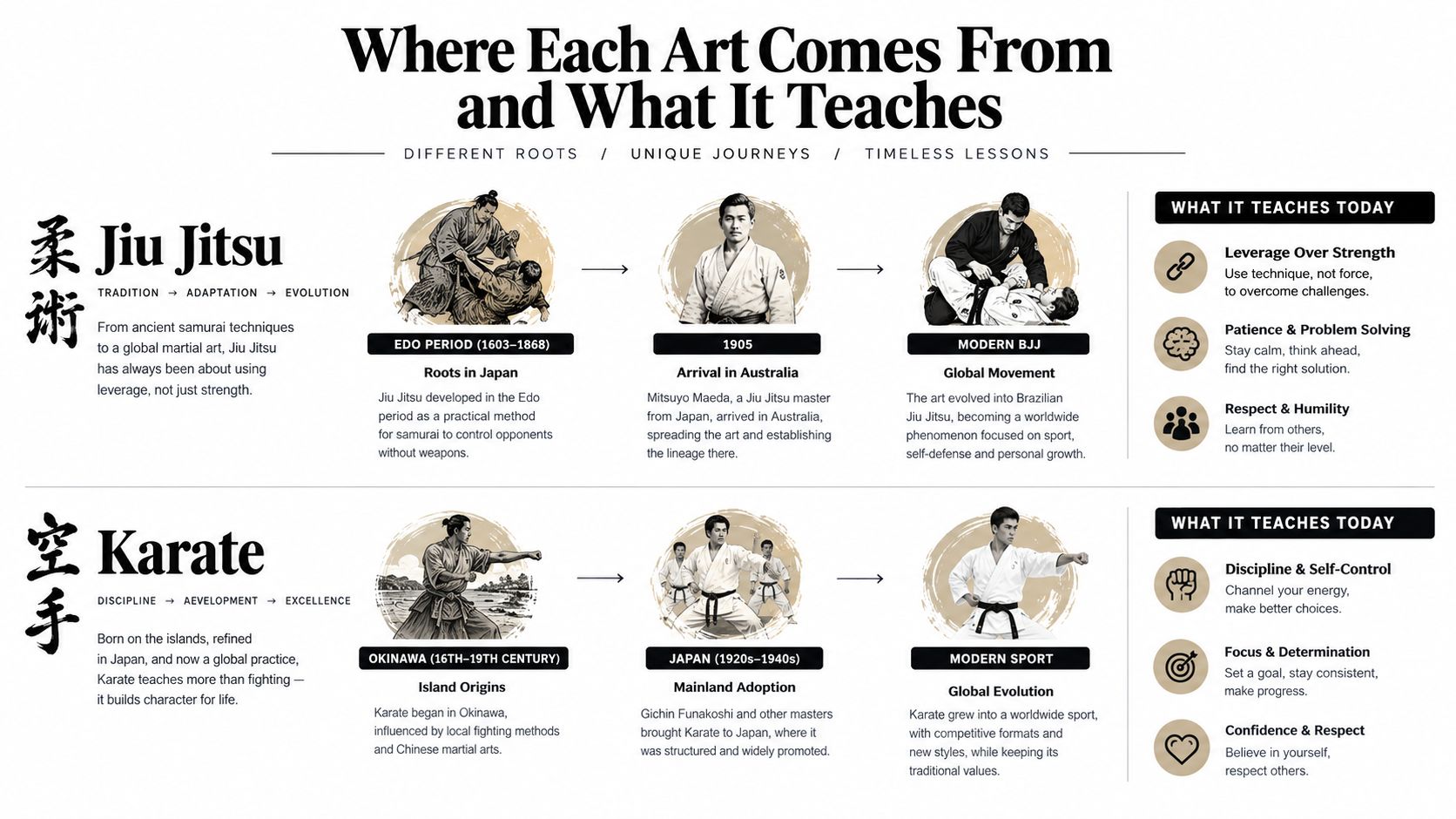
Both arts are legitimate and complete within their own aims. That's why the choice matters. Karate teaches you to manage distance and deliver precise strikes. Jiu jitsu teaches you to manage contact and solve positional problems. The better option depends on which lesson you need repeated.
Techniques You Will Actually Drill on the Mat
Karate beginners spend substantial time building a technical base without a resisting opponent. They may work from zenkutsu-dachi, or front stance, and kokutsu-dachi, or back stance, while drilling oi-zuki and gyaku-zuki punches. Front kicks, roundhouse kicks, blocks, and a basic kata such as Heian Shodan develop coordination and repeatable mechanics.
That solo practice has a purpose. It teaches a student to align their feet, hips, shoulders, hands, and eyes before adding speed or contact. The drawback is equally clear. A beginner can look technically sharp in a line drill and still need time to learn how a moving partner changes distance.
Jiu jitsu starts with a different demand. You'll encounter closed guard, side control, mount, hip escapes, frames, and positional transitions. Submissions such as the americana, kimura, and triangle appear as connected solutions, not isolated tricks. Even when the class begins with a slow drill, the technique usually gets tested against a partner who is trying to prevent it.
Technique | Karate | Jiu Jitsu |
|---|---|---|
Stance and movement | Zenkutsu-dachi, kokutsu-dachi, footwork and distance | Base, posture, hip movement and frames |
Attacking tools | Oi-zuki, gyaku-zuki, front kick, roundhouse | Americana, kimura, triangle and positional submissions |
Defensive work | Blocks, evasive movement and controlled counterattacks | Hip escape, guard recovery, grip fighting and positional escapes |
Structured practice | Kihon and kata, including Heian Shodan | Technique sequences from guard, side control or mount |
Live practice | Controlled kumite with striking rules | Positional sparring and rolling with taps |
The contrast becomes obvious in the nervous system. Karate asks you to recognise range, enter and exit cleanly, and make a strike without losing posture. Jiu jitsu asks you to breathe while compressed, identify the immediate danger, and create movement when the other person is actively resisting.
The arts overlap around clinch work, takedown defence, balance, and awareness. They diverge sharply after contact. Karate prioritises strikes, including kicks to scoring targets. Jiu jitsu prioritises control, joint locks, and chokes, with the expectation that a responsible partner taps before damage occurs. For a closer breakdown of the grappling side, the Brazilian jiu jitsu techniques guide shows how positions connect rather than functioning as a random catalogue.
Training Format and Day-to-Day Class Structure
A karate class usually feels organised from the moment students enter. The group warms up, lines up by rank, repeats kihon, practises kata, and finishes with controlled kumite when the class level allows it. Students generally wear a light gi and train barefoot. Contact is present, but it's intermittent and governed by the school's rules and coaching standards.
A Brazilian jiu jitsu class feels more like a physical puzzle workshop. After movement preparation, students drill a position such as guard, side control, or mount, then apply it in positional sparring before moving into live rolls. The traditional gi is heavier and designed for gripping. No-gi sessions use a rashguard and shorts, with more emphasis on wrestling-style grips, body control, and transitions.
Element | Karate Class | BJJ Class |
|---|---|---|
Opening work | Warm-up and movement preparation | Movement drills and a short warm-up |
Technical block | Kihon, combinations and kata | Position-specific technique and transitions |
Partner work | Controlled kumite, depending on level | Positional sparring and live rolling |
Clothing | Lightweight gi, usually no shoes | Heavier gi or no-gi rashguard and shorts |
Contact pattern | Intermittent, striking-based | Constant partner contact, controlled through taps |
Main physical demand | Footwork, speed, balance and repeated striking | Grip strength, mobility, pressure management and full-body effort |
For an adult chasing fitness, jiu jitsu usually delivers more continuous physical engagement. You're carrying, framing, pushing, pulling, recovering, and making decisions while tired. Karate is a strong choice for someone who enjoys explosive movement, technical repetition, and the satisfaction of refining clean combinations.
For a parent choosing for a child, karate offers an especially clear structure. Rank, etiquette, repetition, and formal class transitions can help a child who needs routine. Jiu jitsu suits a child who learns through interaction and enjoys solving a changing problem with a partner.
The correct question isn't which class looks harder from the doorway. Ask which format your student will attend consistently and absorb without fear.
Self-Defence in Real Sydney Scenarios
Self-defence starts before technique. Leaving an argument, creating distance, using your voice, and moving towards safety are better outcomes than proving a martial-arts point. A style becomes useful when its training habits remain available under stress.
Scenario one, distance at a Zetland bar
A verbal confrontation escalates near a bar. Karate has the clearer standing-distance advantage. Footwork, posture, timing, and trained strikes can help a student maintain space long enough to disengage. Open-hand striking and movement may be more appropriate than trying to exchange punches, but no technique guarantees a safe outcome.
Scenario two, contact on wet pavement
You slip and a larger person lands on top of you. Jiu jitsu is the better fit for this problem. Frames, guard recovery, hip escapes, positional control, and choke defence address the immediate danger of being pinned. The objective is not to win a glamorous fight. It's to protect your head, create space, stand up, and leave.
Scenario three, a wrist grab or bear hug
Jiu jitsu again has the more direct training transfer. Grip breaking, base, hip movement, underhooks, and escape mechanics give you a way to work from contact rather than freezing when someone grabs you. Karate may help with posture and striking responses, but a student who hasn't drilled close-range control can struggle when the exchange becomes tangled.
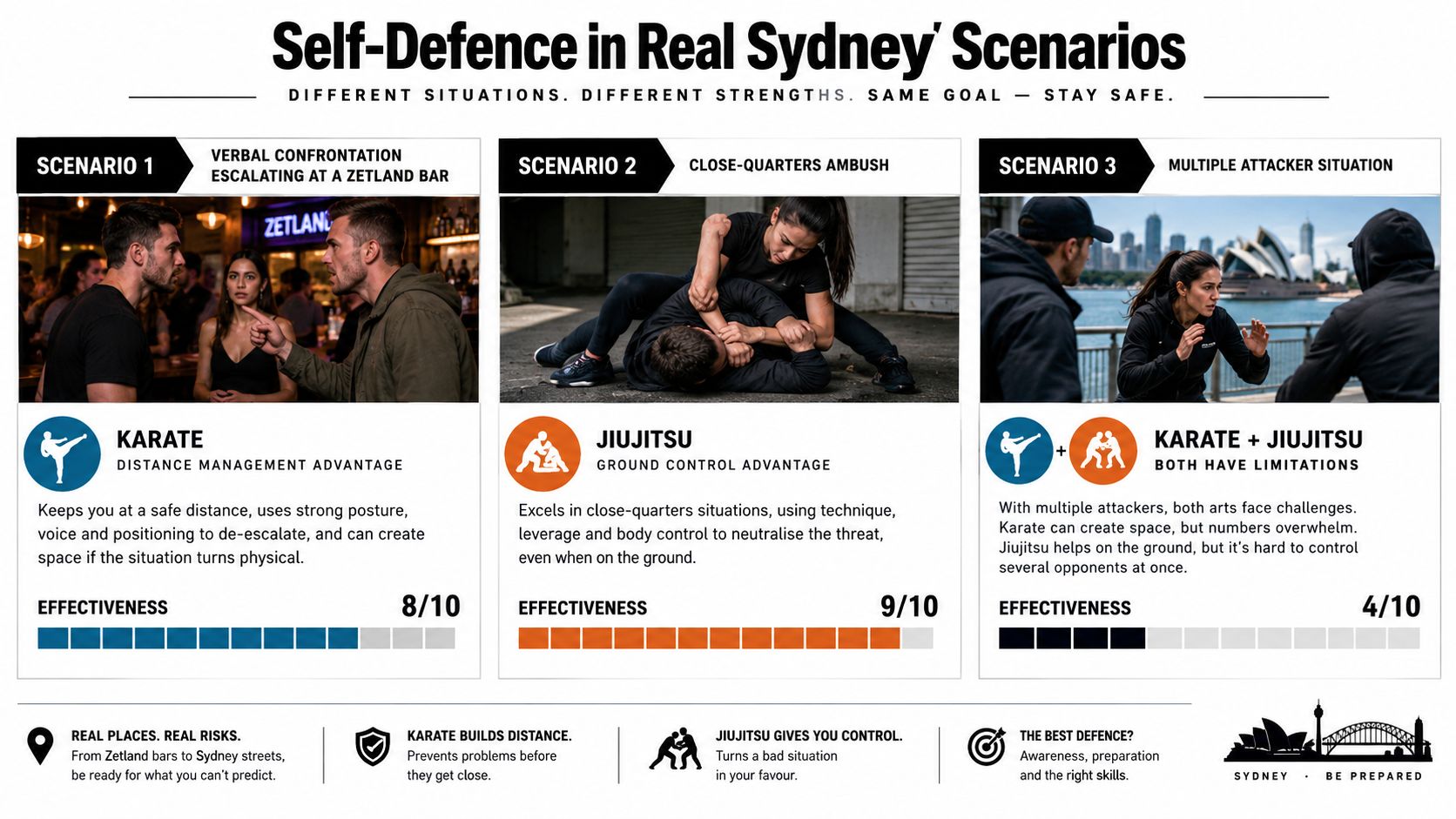
Safety reality: Neither art solves the multiple-attacker problem. The priority remains awareness, escape, and getting help.
For women travelling through Green Square Station late at night, the recommendation depends on the feared situation. Choose karate if you want more standing-distance work. Choose jiu jitsu if close contact, grabbing, or being taken down concerns you most. Combining both gives the broadest skill set, but combining them isn't required to start training. The Brazilian jiu jitsu self-defence guide explains the grappling approach in more detail.
Competition Pathways and How Matches Are Scored
Competition exposes the priorities of each art. Karate asks competitors to show controlled, visible techniques at range. Australian kumite rules require judges to score only what they see. If a judge can't confirm that a technique reached a valid target, they signal “Mienai”, and no point is awarded. The 2024 Australian karate rules set out that judging principle.
Australian karate scoring commonly uses three values: IPPON for 3 points, WAZA-ARI for 2 points, and YUKO for 1 point. Head kicks carry the highest value, while punches and other kicks score lower values according to the target and technique. The karate scoring reference provides the relevant value levels.
Brazilian jiu jitsu rewards positional progress. In the NSW Police Games rules, mount and back control score 4 points, a guard pass scores 3 points, and a sweep, takedown, or knee-on-stomach scores 2 points. Each position must be held and controlled for 3 seconds before the points count. These rules are published on the NSW Police Games Brazilian jiu jitsu event page.
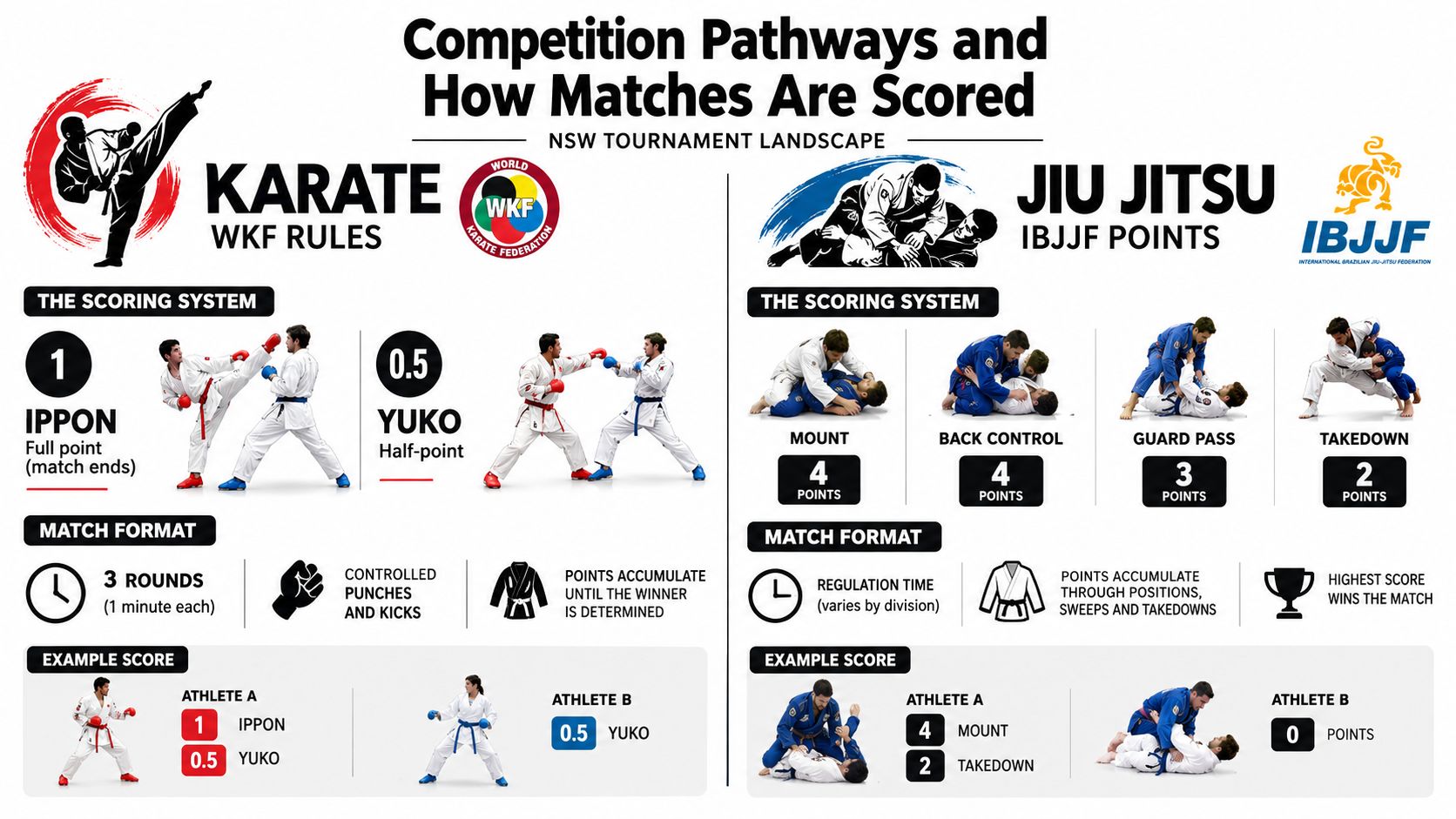
Karate competition suits athletes who enjoy speed, precision, distance management, and performing under judging pressure. Jiu jitsu suits athletes who want continuous problem-solving, positional battles, and submission threats. The physical fatigue differs too. Karate limits contact through its ruleset, while jiu jitsu concentrates effort through gripping, pressure, scrambling, and repeated attempts to control another body.
A common assumption says the safer competition is automatically the better beginner option. That's too simple. Rules, coaching, age category, contact intensity, and the athlete's behaviour all shape the experience. Pick the ruleset that matches the type of challenge you enjoy.
Safety, Injury Risk and What the AU Data Shows
The Australian safety picture doesn't support lazy claims that one art is harmless. Victoria's Better Health Channel notes that martial-arts injury risk is low compared with other contact sports, while also reporting that karate and kickboxing account for about half of martial-arts injuries in Victoria. That figure describes recorded injuries in that state's surveillance context, not the universal risk of every karate class, but it matters when parents compare striking-heavy and grappling-heavy programs. The Australian discussion is covered in research on jiu jitsu as a lived body.
The reason is straightforward. Striking classes expose students to impact, particularly when sparring intensity rises. Jiu jitsu removes strikes but introduces gripping, takedowns, joint pressure, awkward falls, and repetitive stress on fingers, elbows, knees, and shoulders. A tap-out culture helps, but it only works when students recognise danger and partners release immediately.
Body Area | Karate, striking | Brazilian Jiu Jitsu, grappling |
|---|---|---|
Head and face | More relevant where striking contact is permitted | Less central because strikes aren't part of standard rolling |
Hands and fingers | Hand impact and blocking can stress the area | Gripping and fingers caught in the gi can create strain |
Elbows and knees | Impact and movement can affect joints | Joint locks, scrambles and takedowns create more direct joint stress |
Skin | Floor contact and equipment can irritate skin | Mat friction and close contact can cause abrasions |
Main control question | How does the coach manage contact and targeting? | How does the coach teach tapping, falling and submission release? |
Parent's test: Watch how a coach stops unsafe behaviour, not how confidently the coach describes safety.
Parents should ask about first-aid procedures, coach-to-student supervision, partner matching, and progressive contact. Older adults and students returning from injury should ask whether they can begin with technical drilling and controlled positional work. The training environment determines more than the art's label.
For local options, Locals Zetland suits families and adults who want a structured start across karate and jiu jitsu, while Locals Maroubra is relevant to practitioners seeking a more competition-focused training environment. Parents should choose a kids class that controls intensity carefully. Women seeking practical confidence may prefer beginner jiu jitsu fundamentals, while striking-focused students should select karate with disciplined kumite rules. No martial art is injury-free. The type of risk should influence your choice, not scare you away from training.
How to Choose the Right Class at Locals Zetland
Start with the student, not the uniform.
Parents of children aged 4 to 12 should prioritise a class that builds coordination, confidence, listening, and safe partner behaviour. A structured karate program at Locals Zetland is a sensible starting point for children who enjoy repetition, movement, grading goals, and clear boundaries. Jiu jitsu fundamentals may suit a child who learns through physical problem-solving and needs to practise staying calm when another child applies controlled pressure.
Adult beginners focused on fitness should lean towards Brazilian jiu jitsu fundamentals if they want continuous partner work and a full-body challenge. Women interested in self-defence may benefit from starting with positional escapes, grip fighting, and controlled close-contact drills. No-gi grapplers should ask about sessions that integrate wrestling-based grips, transitions, and submissions.
What your first month should contain
A good karate introduction includes basic stances, punches, kicks, kata, partner drills, and an explanation of how grading works. You should leave knowing what the coach wants you to improve, not just which belt comes next.
A good jiu jitsu introduction includes movement, positional escapes, submissions taught responsibly, and situational sparring. You should learn how to tap, how to release a partner, and how to communicate when a drill needs to slow down.
Questions to ask before you commit
Coaching: What experience and certifications does the coach hold, and who supervises beginners?
Class size: How are new students paired, and how does the coach manage different ages and abilities?
Contact: When does sparring begin, and how does the program increase intensity?
Equipment: Do you need a karate gi, a BJJ gi, or no-gi clothing for the trial?
Progression: How are karate gradings or jiu jitsu fundamentals assessed?
Trial fit: Can you attend a free introductory session before choosing a membership?
The advantage of a local academy that teaches both disciplines is that the comparison becomes practical rather than ideological. You can observe how your child responds to structure, or how your own body handles grappling, before making a long-term decision.
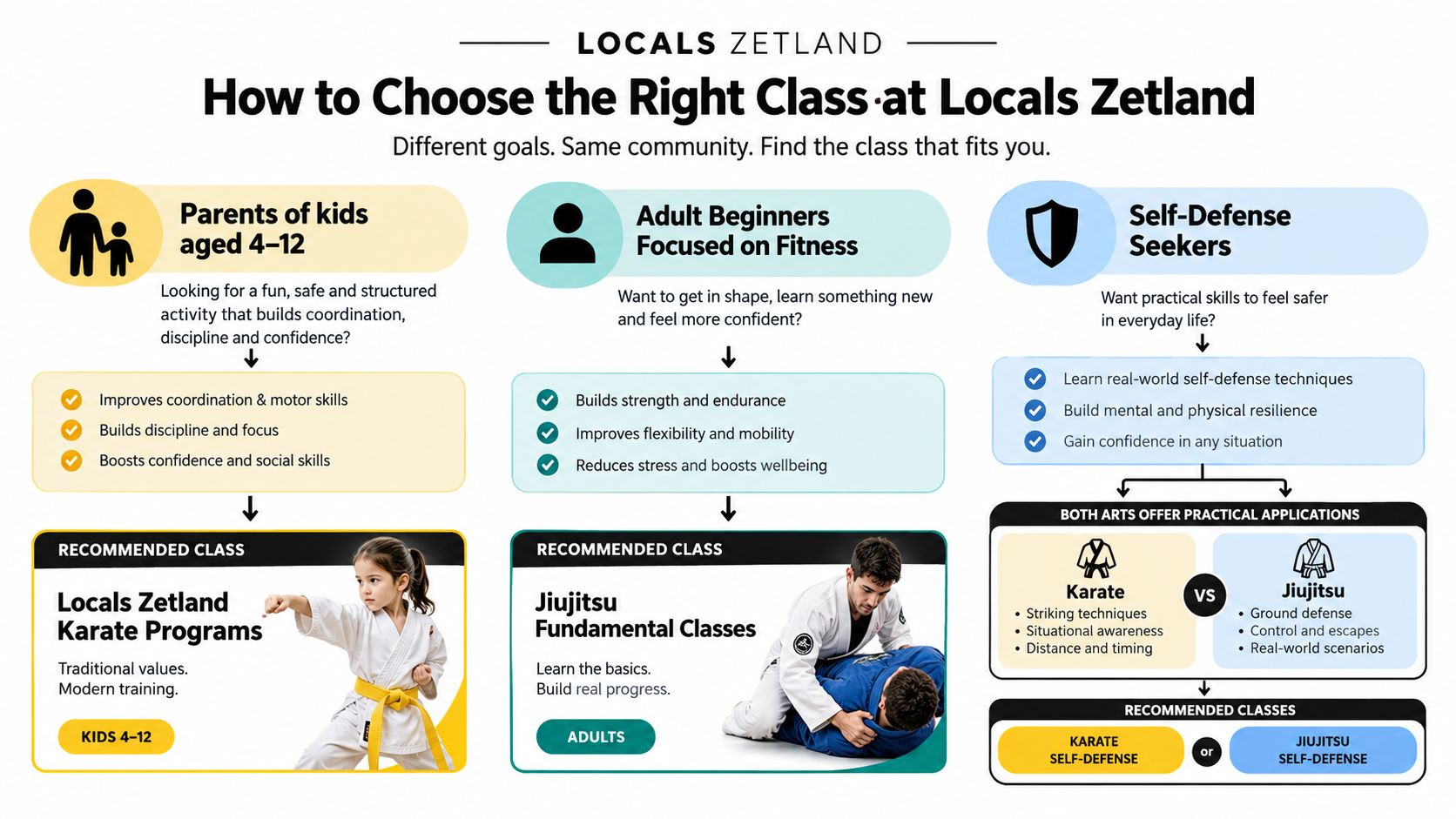
If your goal is standing-distance confidence and disciplined striking, choose karate. If your goal is grappling fitness, close-contact self-defence, or no-gi training, choose jiu jitsu. If you're still unsure, take both trials and judge the class by coaching quality, student behaviour, and whether you want to return next week.
Locals Jiu Jitsu Zetland offers beginner, advanced, kids, and no-gi Brazilian jiu jitsu classes, with structured coaching for fitness, self-defence, and competition goals. Visit Locals Jiu Jitsu Zetland to book a free trial and test whether its training style fits your goals.
Comments