_edited.png)
What Is Bjj Workout
A BJJ workout is a structured martial-arts class combining warm-ups, technical drilling, positional training, controlled sparring and conditioning, rather than a random fitness circuit. In Australia, martial arts involve 248,351 adults aged 15 and over, with 85% of participation organised, so Brazilian jiu-jitsu usually follows a coached, progressive class format rather than informal backyard grappling (Australian Sports Commission data).
You might be standing outside a Sydney academy, wondering whether the first class means being thrown around by strangers until you're exhausted. That's a common fear, especially if you've never trained before or you're joining for fitness rather than competition.
A typical BJJ session is more orderly than it looks from the outside. You'll warm up, learn one technique, practise it with a partner, work from a controlled position and, depending on your experience, take part in light rolling. A coach manages the pace, pairs students sensibly and explains how to tap before anyone expects you to train hard.
By the end of this guide, you'll understand what happens in each phase, how much of the class is technique compared with sparring, what the workout does for your body and how to begin safely at a local academy in Sydney.
Introduction
Brazilian jiu-jitsu, usually shortened to BJJ, is a grappling martial art built around body mechanics, positioning, escapes, control and submissions. Most training happens without strikes, so the learning process depends on solving physical problems with a resisting partner.
That resistance is what makes BJJ a workout, but it isn't the whole workout. A coach doesn't just send beginners into hard rounds and hope they figure things out. The class develops in layers, much like learning to drive: first you learn the controls, then practise simple movements, then handle more complicated situations with supervision.
Australia already has a substantial BJJ community. SBS reported around 40,000 practitioners nationwide, and noted that 90% were Australian rather than Brazilian, using data from the Brazil-Australia Chamber of Commerce (SBS coverage of BJJ in Australia). That established culture helps explain why Sydney classes commonly include beginner pathways, kids' programs, women's self-defence options, advanced training and no-gi sessions.
A useful first-class expectation: you're there to learn how to move and make decisions, not to prove how tough you are.
Your first session may feel unfamiliar because you're using your hips, hands, feet and breathing in ways that ordinary gym exercises don't reproduce. You'll probably get tired, but you'll also have a clear task to focus on, which makes the effort feel purposeful.
What a BJJ Workout Actually Involves
You arrive at your first class expecting a hard workout, then find yourself learning how to move around another person's pressure. A BJJ workout is a grappling class built around creating space, controlling positions, escaping pressure and applying submissions safely. The physical challenge comes from making those choices while a partner responds.
The class has two related parts. Drilling is vocabulary, because you repeat a movement until its order and shape become familiar. Positional sparring is conversation, because you use that movement from a defined situation while your partner offers measured resistance. Rolling is fluency under pressure, because neither person follows a script.
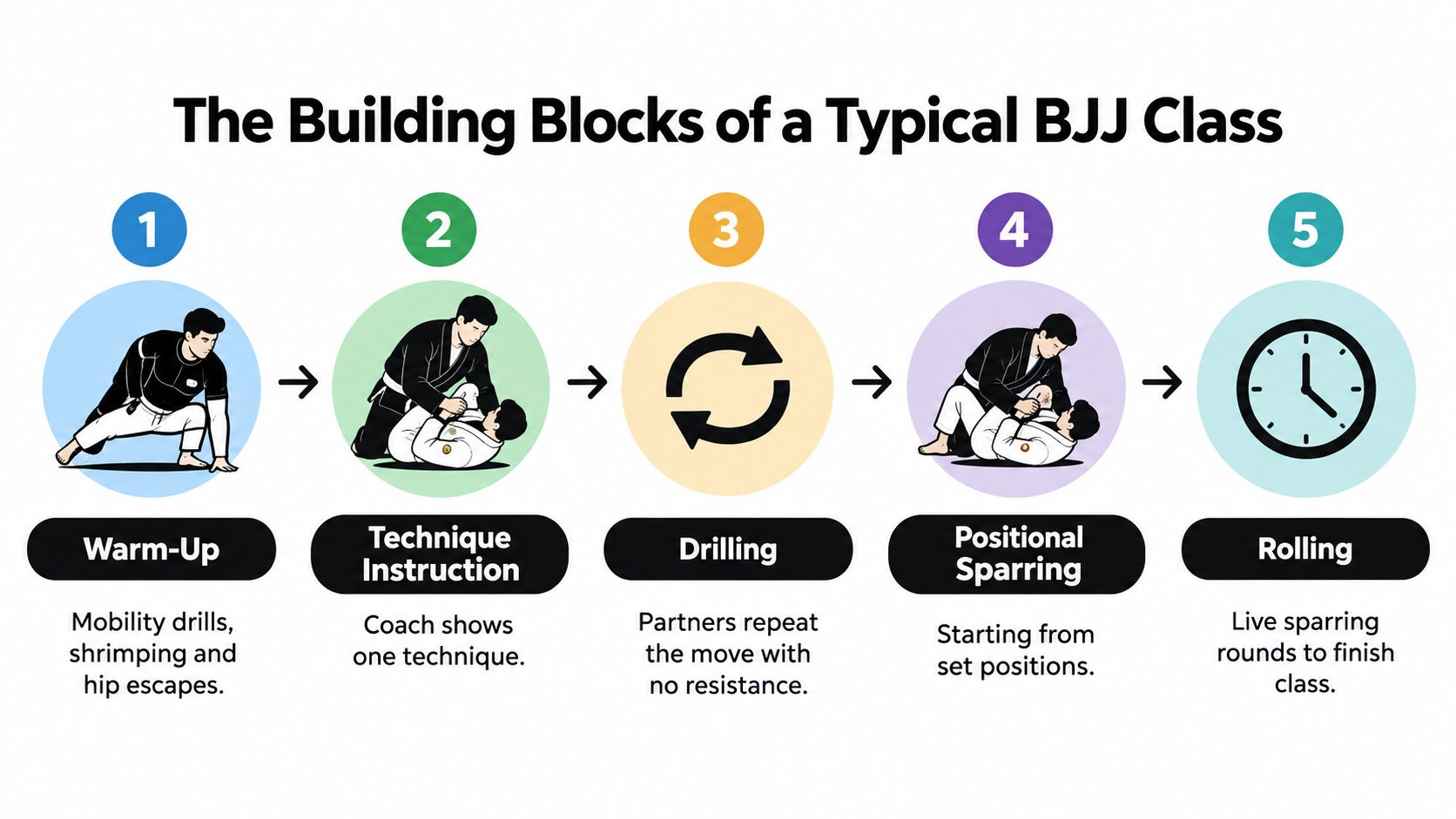
A coach usually builds the session in stages:
You prepare your joints and practise basic mat movements.
The coach demonstrates a technique and explains its key details.
You repeat the movement with a partner, usually with limited resistance.
You start from a defined position and work toward a specific outcome.
You may finish with live rounds suited to your experience and readiness.
Beginners do not need to start with hard rolling. Controlled drilling and positional rounds work like training wheels on a bicycle. They limit the number of problems you must solve at once, while still teaching you how to respond to resistance. That structure also reflects the organised way martial arts are commonly practised in Australia, where 85% of participation is organised rather than informal, according to the Australian Sports Commission data.
Compared with a conventional gym session, BJJ adds decision-making to every repetition. You are not only lifting, running or completing a fixed circuit. You are trying to keep balance while another person changes position, so the effort stays physical and mentally engaging.
Some students add separate strength or recovery work around mat training. A guide such as build a CrossFit supplement stack can help you compare supplementary exercise and nutrition options. Those choices should support coaching, sleep and sensible workload management, not replace them.
The Building Blocks of a Typical BJJ Class
The exact lesson changes from class to class, but the building blocks remain recognisable. A beginner might learn a side-control escape, practise the movement slowly, begin underneath side control and then attempt the escape while a partner offers measured resistance.
Warm-up and movement
The warm-up prepares your body for the positions used later. You may perform mobility work, bridges, hip escapes, technical stand-ups, forward or backward rolls and other bodyweight movements.
A hip escape, often called a shrimp, teaches you to move your hips away from pressure while creating space with your feet and arms. That isn't filler. It's a movement you'll use when escaping side control, recovering guard or making room to stand.
Technique instruction and drilling
The coach demonstrates one technique in manageable steps. You might learn where to place your elbow, how to frame against a partner's shoulder and when to move your hips before repeating the sequence with a partner.
At first, your partner provides little resistance. This lets you learn the order and shape of the movement without trying to solve every problem at once. The coach watches your posture, hand placement, breathing and whether you're trying to use strength where technique would work better.
Positional sparring
Positional training gives the lesson a clear boundary. One person might begin in side control while the other tries to escape; the person on top may aim to hold the position or move to a stronger one.
This phase is valuable because it limits the number of decisions. Instead of starting anywhere, you begin with a particular problem and repeat it from both sides. You get resistance, but the task remains understandable.
Rolling and conditioning
Rolling is live grappling with agreed safety rules. Beginners may observe, drill or take very light rounds before joining full sparring. The coach can also use a short conditioning finisher involving bodyweight movements, mobility or controlled effort.
BJJ matches involve brief, explosive bursts separated by lower-intensity phases. One training analysis describes work periods of about 3 to 5 seconds and a high-to-low effort ratio ranging from roughly 1:8 to 1:5 (BJJ training analysis). That's why you may feel repeated surges rather than one steady cardio effort.
Class phase | What you do | Purpose |
|---|---|---|
Warm-up | Mobility, bridging, hip escapes and bodyweight movement | Prepare joints and rehearse mat movement |
Technique | Watch a coach demonstrate a specific skill | Understand the positions and sequence |
Drilling | Repeat the technique with a partner | Build coordination and confidence |
Positional sparring | Start from a defined position and work towards an outcome | Apply the skill against controlled resistance |
Rolling or conditioning | Complete live rounds or a supervised finisher | Develop decision-making, work capacity and composure |
For a more detailed look at beginner skills, the Locals Zetland fundamentals curriculum provides an example of how a structured pathway can organise core movements and strategies.
Sparring and Rolling Without Getting Hurt
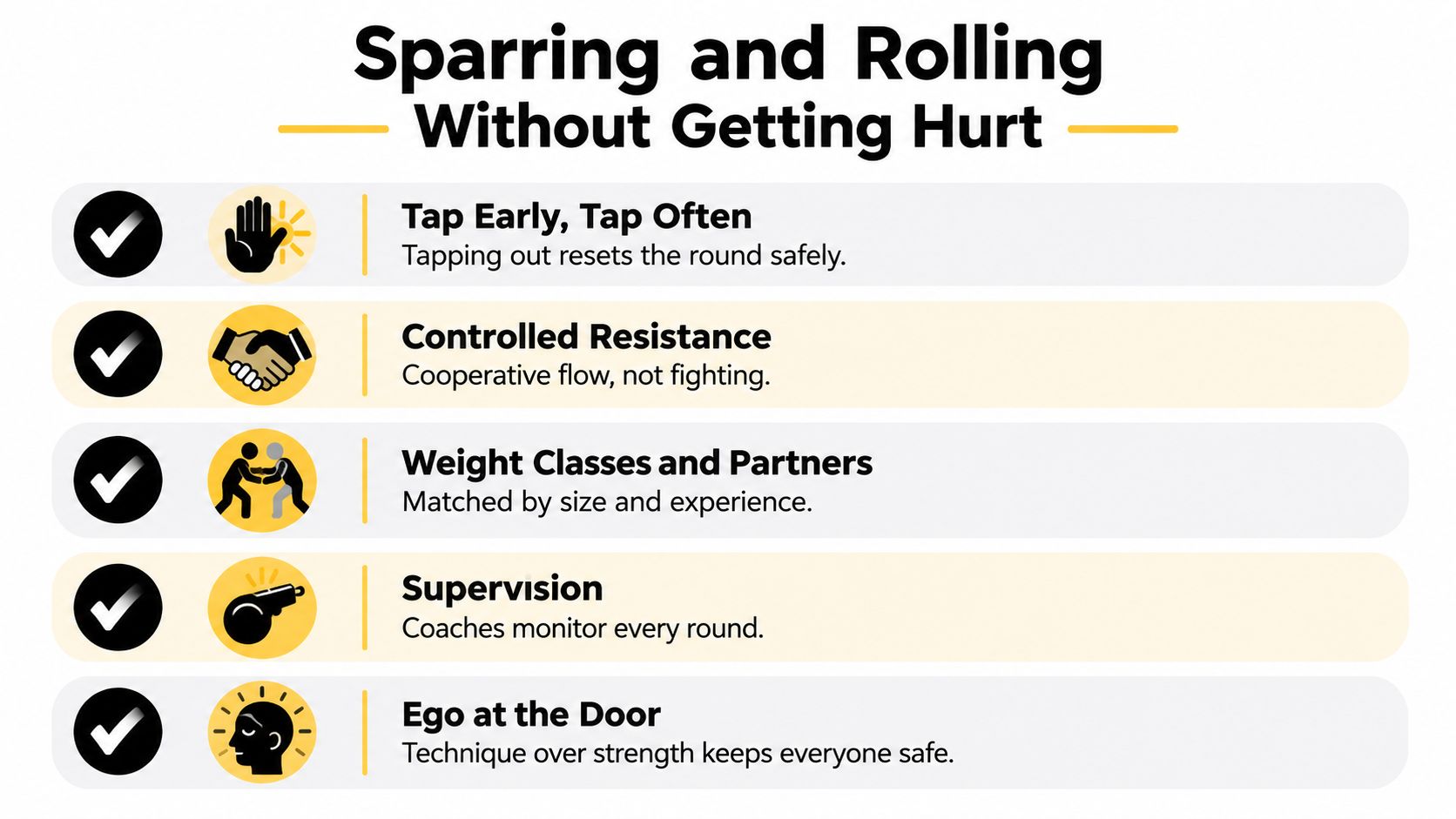
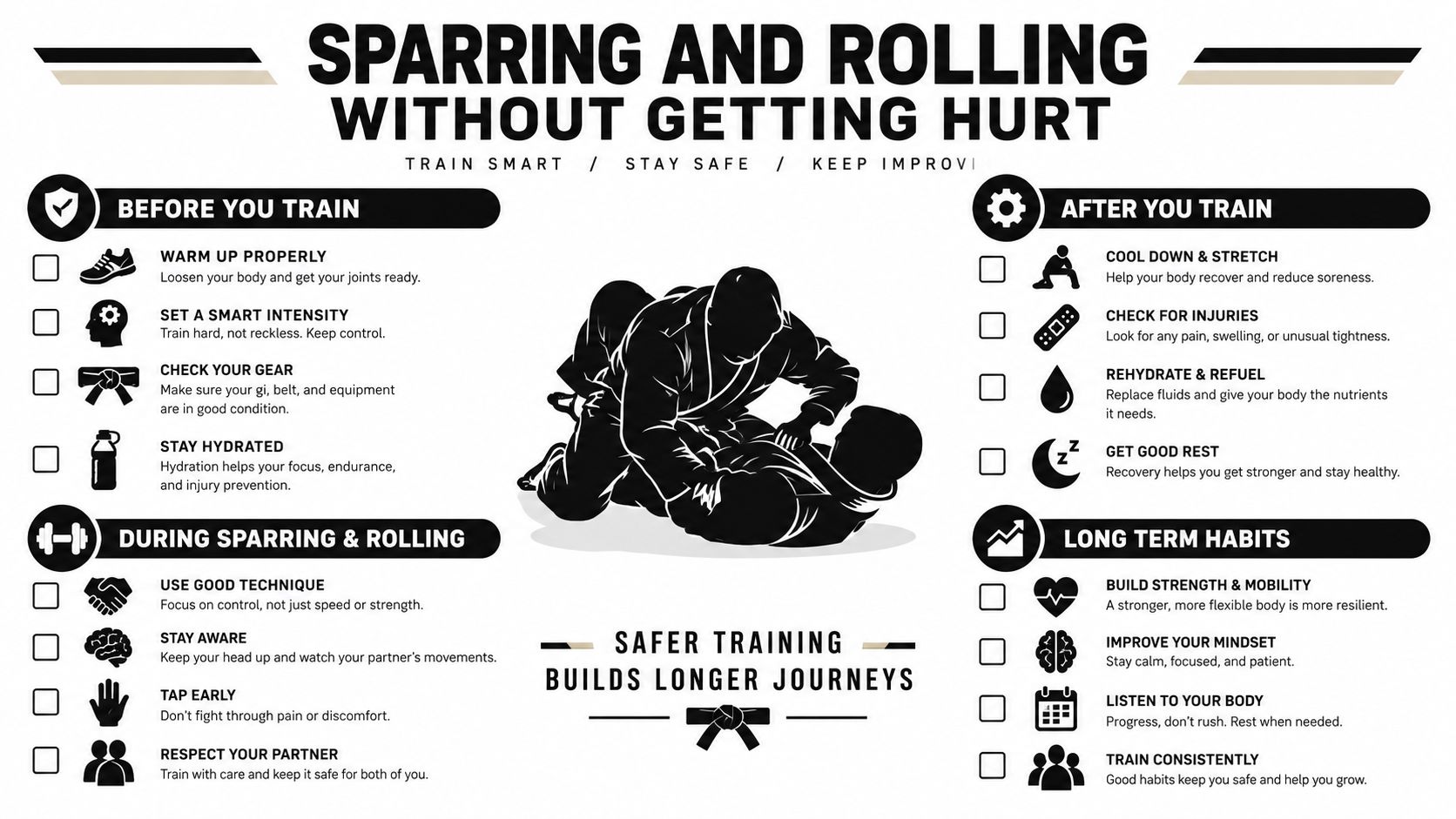
Rolling sounds intimidating because people often imagine a fight. In a well-managed class, it's closer to a problem-solving game with physical resistance. You start in a position, try to improve it or escape, and tap when a submission is applied or the pressure becomes unsafe.
The tap is a safety reset. You can tap with your hand, say “tap” clearly or use another agreed signal. Your partner releases immediately, you acknowledge what happened and restart. There's no benefit in waiting until a joint or neck is under unnecessary pressure.
The reason beginners should progress through drilling and positional rounds before hard rolling is supported by injury data. A large BJJ cohort found that 77.6% of injuries occurred during sparring, while the knee accounted for 27.1% and the shoulder 14.6% of affected sites (BJJ injury survey). A 2025 systematic review similarly reported that 89% of reported injuries happened during training, with 79% of training injuries occurring during sparring; the knee represented 25% of injuries and the shoulder 13% (2025 systematic review).
Those figures don't mean beginners should panic. They explain why responsible coaching controls the part of training where people are tired, competitive and making fast decisions against resistance.
Safety rule: tap early, communicate clearly and treat every round as practice rather than a test of pride.
Australian injury surveillance also places martial arts among the common sports categories associated with hospitalised facial fractures, shoulder dislocations and cervical spine injuries (Australian injury study). That makes neck endurance, scapular control, safe falling and hip-led escapes useful parts of a sensible programme.
For a new adult, one or two sessions per week is a realistic starting point. Leave at least one recovery day between demanding sessions, and increase intensity only after your body is adapting. You can also review practical sports injury prevention for athletes advice, while remembering that a BJJ coach must tailor training to your experience and current condition.
A good warm-up and cool-down routine supports that approach. The Locals Zetland warm-up and cool-down guide offers a local reference for preparing to train and easing out of a session.
The Real Fitness Benefits of BJJ Training
BJJ combines physical work with constant problem-solving. You may push from your feet, brace through your trunk, pull with your back, grip fabric or wrists and move your hips repeatedly within the same exchange.
For an Australian comparison, one local exercise energy chart lists vigorous martial arts at 10.3 METs, corresponding to approximately 1,508 kJ in 30 minutes and 3,017 kJ in 60 minutes (Australian exercise energy chart). Individual energy use varies with body size, pace, rest and how much of the class involves live work, but the figures show why a BJJ session can function as vigorous conditioning rather than gentle technical practice.
Grip endurance is another distinctive demand. A review of athlete profiles found mean grip endurance ranging from 54 to 62 seconds among national and international competitors (grip strength review). Beginners don't need to match that level. They'll gradually develop the ability to hold useful grips, relax their hands when force isn't needed and keep working without clenching continuously.
The benefits reach beyond the muscles:
Mobility: Hip escapes, bridges, guard work and technical stand-ups teach movement through positions that ordinary machines rarely reproduce.
Mental resilience: You practise staying calm while uncomfortable, choosing a response and trying again after an unsuccessful attempt.
Practical confidence: Repeatedly learning to escape pressure can make physical problem-solving feel less mysterious.
Community: Partner training creates regular interaction, accountability and a shared learning experience across different ages, backgrounds and experience levels.
Women seeking confidence and self-defence can benefit from learning escapes, frames and positional control in a supervised environment. Children can develop listening, coordination and discipline through age-appropriate classes. Fitness-focused adults get a changing physical challenge, which can make regular attendance easier than repeating an isolated routine.
Your First Class at Locals Jiu Jitsu Zetland
A first evening at Locals Zetland can be simple. Arrive early enough to introduce yourself, tell the coach you're new and mention any injuries, movement limitations or concerns. You won't need to understand every BJJ term before you step on the mat.
The coach can explain the class format, introduce you to a suitable partner and show you the basic signals for stopping a drill or round. You'll likely begin with fundamentals such as posture, hip movement, defensive escapes and safe transitions. The focus is on understanding what your body should do before adding speed or resistance.
The beginners pathway covers fundamentals, movement and strategy in a progressive way. During the first few weeks, one or two sessions weekly gives you time to remember the techniques, recover between demanding classes and notice how your body responds. You don't need to arrive already fit. You need to listen, breathe, tap when necessary and ask questions when a position feels unclear.
You can read more about the programme through the Brazilian jiu-jitsu classes at Locals Zetland. If you live on the eastern side of Sydney, Locals Maroubra offers the same kind of welcoming entry point for people who want to learn in a local setting.
Book a free trial, wear comfortable training clothes and let the coach guide the first session. The aim isn't to survive a hard workout on day one. It's to meet a respectful team, learn a useful movement and decide whether the academy feels like a home-away-from-home training environment.
Locals Jiu Jitsu Zetland offers structured BJJ pathways for beginners, adults, advanced students and no-gi grapplers, with coaching that connects technique, fitness and self-defence. Visit Locals Jiu Jitsu Zetland to book a free trial and experience what a safe, progressive BJJ workout feels like.
Comments