_edited.png)
Brazilian Jiu-Jitsu vs Judo: How to Choose in Sydney
Most advice on Brazilian jiu-jitsu vs judo starts with the wrong question. It asks which art is “better”, as if a style can make the decision for you. In Sydney, that argument misses what determines whether a beginner stays: your goal, your body, your timetable, your tolerance for impact, and the culture of the club you can reach consistently.
Judo gives you explosive standing work, throws, breakfalls and a clear Olympic pathway. Brazilian jiu-jitsu gives you prolonged ground exchanges, positional problem-solving and a technical ladder that rewards patience. Neither wins on paper. The right choice is the one you'll train safely and regularly.
Why the Brazilian Jiu-Jitsu vs Judo Question Matters in Sydney
Sydney families aren't choosing between abstract martial arts. They're choosing between real class times, real coaches, real travel distances and training partners who shape the experience every week. A style that looks perfect online is a poor choice if the timetable clashes with school pickup or the club culture makes a beginner feel out of place.
Judo suits people who want to learn standing balance, gripping and explosive entries. You'll practise falling safely, then build towards throws such as seoi-nage, ouchi-gari and uchi-mata. The sport also offers an established Olympic competition pathway, which matters to children and adults who like clear rules and measurable progression.
BJJ suits people who enjoy solving problems from difficult positions. You'll spend more time learning guard, escapes, passing, control and submissions, then testing those skills in live rolling. The pace can feel more deliberate, but the mental workload is demanding because your partner is constantly changing angles, pressure and threats.
My coaching rule: choose the training environment you can attend consistently, not the style you think sounds toughest.
Sydney's inner east and eastern suburbs offer meaningful options in both grappling traditions. For a beginner, convenience and culture often matter more than the theoretical ceiling of either art. A welcoming class with controlled sparring will teach you more than an impressive syllabus you rarely attend.
Use this quick filter before booking:
Choose judo if you want standing control, throws, breakfall training and an Olympic sport.
Choose BJJ if you prefer ground exchanges, submission strategy and a longer positional game.
Try both if you're unsure, especially if you have a previous shoulder, knee or neck injury.
Judge the club by how coaches manage beginners, not by how advanced the senior students look.
The practical comparison is simple. Judo asks whether you can break balance and finish a throw. BJJ asks whether you can stay composed, escape, advance position and submit or control. Your preferred question isn't “which art is superior?” It's “which set of problems do I want to practise every week?”
Origins and Australian History of Both Arts
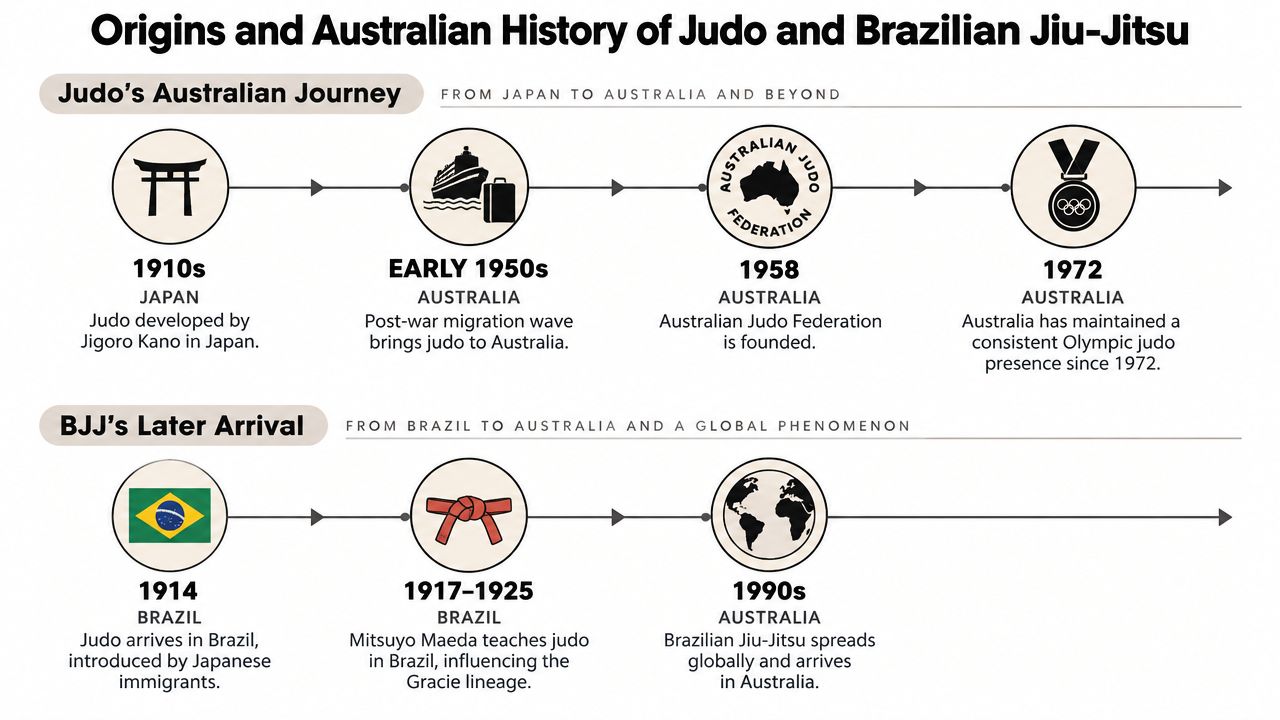
Brazilian jiu-jitsu and judo share a technical family tree, yet Australian clubs adopted their organised forms at different times. Brazil's grappling lineage developed from Japanese judo groundwork in the early 1900s. Australia's documented timeline begins with a ju-jitsu demonstration in Sydney in 1906. The Australian judo history timeline records the first Judo Federation of Australia meeting in Sydney in 1952.
That history gives Sydney beginners useful context. Australia had a 46-year span between the 1906 demonstration and the 1952 federation milestone. BJJ then developed a visible local academy network in the late 1980s and early 1990s, roughly 35 to 40 years later. John Will and Peter de Been were among the pioneers who helped establish Australian BJJ schools during that expansion.
Why the difference still matters
Judo is the older organised grappling structure in Australia. Its clubs grew around dojos, federation administration, formal grading and competition rules. Australia has competed in every Olympic judo competition since 1964, with milestones including Ted Boronovskis at the 1964 Tokyo Games and Maria Pekli at Sydney 2000, as detailed in the Locals history of Australian Olympic judo competitors.
BJJ arrived later as a distinct academy network, spreading through private clubs, coaching lineages and word of mouth. That later arrival explains the different feel. BJJ clubs often operate with more flexibility and commercial variety, while judo clubs commonly retain a stronger institutional structure.
Participation shows how far BJJ has grown. An SBS report estimated about 40,000 BJJ practitioners in Australia SBS report, with roughly 90% Australian participants, or around 36,000 locals, according to the Locals analysis of Australian BJJ participation numbers. The broader Australian martial arts participation base has also been reported at about 248,351 adults, with 85% organised participation, in the Locals overview of Australian martial arts participation figures.
For Sydney families and adults, history should guide expectations rather than settle the choice. Judo offers the older organised Olympic pathway. BJJ is the newer ground-fighting discipline with a substantial national participation base. Choose the club whose coaching culture, schedule and training environment fit your routine.
Techniques and Where Each Art Spends Its Time
The biggest training difference isn't the uniform or the belt. It's where the class spends its live rounds.
A judo session usually starts with ukemi, the breakfall system that teaches you to land safely. From there, coaches develop grip fighting, posture, footwork and throw entries. Tachiwaza, or standing throwing, carries the identity of the sport, while ne-waza covers pins, turnovers, chokes and armlocks after the exchange reaches the mat.
BJJ usually gives the ground a much larger share of the class. Students drill guard positions, passing, sweeps, escapes, mount, back control and submissions before rolling through those positions against resistance. Takedowns matter, particularly in no-gi and competition squads, but many recreational classes treat them as a shorter part of the session.
Training Focus | Judo | BJJ |
|---|---|---|
Main range | Standing grip exchange | Ground control and transitions |
Core skills | Ukemi, gripping, off-balancing and throws | Guard, passing, escapes and submissions |
Typical live work | Randori with emphasis on standing exchanges | Positional sparring and longer rolling rounds |
Signature examples | Seoi-nage, ouchi-gari and tomoe-nage | De La Riva, berimbolo, cross-collar chokes and triangle setups |
Ground role | Fast turnovers, pins and submissions | Extended positional problem-solving |
Judo's throw entries demand timing. Seoi-nage turns an opponent's posture and momentum into a shoulder throw. Ouchi-gari attacks the inside of the leg while the opponent's weight is being directed. Tomoe-nage uses a sacrifice entry to redirect the opponent over the practitioner's legs.
BJJ's signature positions create a different kind of technical conversation. De La Riva uses hooks and angles to manage distance. The berimbolo develops inversion and back exposure. Cross-collar chokes and triangle setups teach students to combine posture control, limb isolation and pressure.
The decision most beginners need to make
If you want to stay upright and create a decisive takedown, judo gives you more repetition in that range. If you want to become comfortable underneath pressure and learn how to escape from bad positions, BJJ gives you more time there.
Adults who want to add standing skills to BJJ should study BJJ takedowns at Locals Zetland, while recognising that takedown competence takes focused practice. A short warm-up segment won't create the same feel as regular judo randori.
My recommendation is blunt. Don't choose BJJ because you think it avoids athletic work, and don't choose judo because you think every class is an endless throw-fest. Good coaching scales intensity, teaches the mechanics first and uses live work to reinforce the lesson. The important distinction is the proportion of time each art gives to standing exchanges versus sustained ground work.
Scoring, Rules and Competition Format in Australia
Competition rules shape how athletes train and what they pursue under pressure. Judo rewards a clean, controlled throw, a decisive hold or an opponent's penalty. BJJ rewards positional progress, sustained control and a submission opportunity.
In judo, ippon ends the contest as a full-point victory. Waza-ari records a lesser scoring action, and two waza-ari can decide a contest under the relevant ruleset. A pin, or osaekomi, runs on a clock. If neither athlete wins in regulation, the match can continue into golden score.
The penalty ladder matters for anyone entering a Sydney tournament. Under the AKJA Australian judo contest rules (2017), the first Shido is a free warning, the second gives the opponent 5 points, the third gives 7 points, and the fourth is Hansoku make. That ends the contest with an Ippon win for the opponent, worth 10 points.
Aspect | Judo (JFA/FIJ) | BJJ (IBJJF/ADAA) |
|---|---|---|
Main scoring idea | Decisive throw, pin or penalty outcome | Positional advancement and submission |
Common scoring examples | Ippon and waza-ari | Takedown, sweep or knee-on-belly, 2 points |
Control requirement | Controlled execution and recognised hold | Scoring positions require 3 seconds of control |
Penalties or tie-breakers | Shido escalation and golden score | Advantages can decide a tied points score |
Match structure | Standing exchanges with groundwork governed by contest rules | Gi and no-gi formats with division-specific rules |
BJJ uses smaller scoring steps. The NSW BJJ Federation points guide awards 2 points for a takedown, sweep or knee-on-belly, 3 points for a guard pass, and 4 points for mount or back control with hooks. The athlete must hold each scoring position for 3 seconds.
That format rewards a chain of advances rather than one decisive moment. A competitor can win by submission or build a points lead through controlled positional changes. Judo competitors usually seek a scoring throw, pin, submission or penalty loss.
Beginners do not need to memorise every rule before their first class. Start with the BJJ rules for beginners at Locals Zetland to learn what the referee rewards, how to tap, how to reset and how penalties affect risk-taking. Coaches at Locals Zetland and Locals Maroubra should then explain the rules used at the specific event, since gi, no-gi and ADAA-sanctioned Sydney competitions can differ in detail.
Injury Risk, Training Load and Safety for Beginners
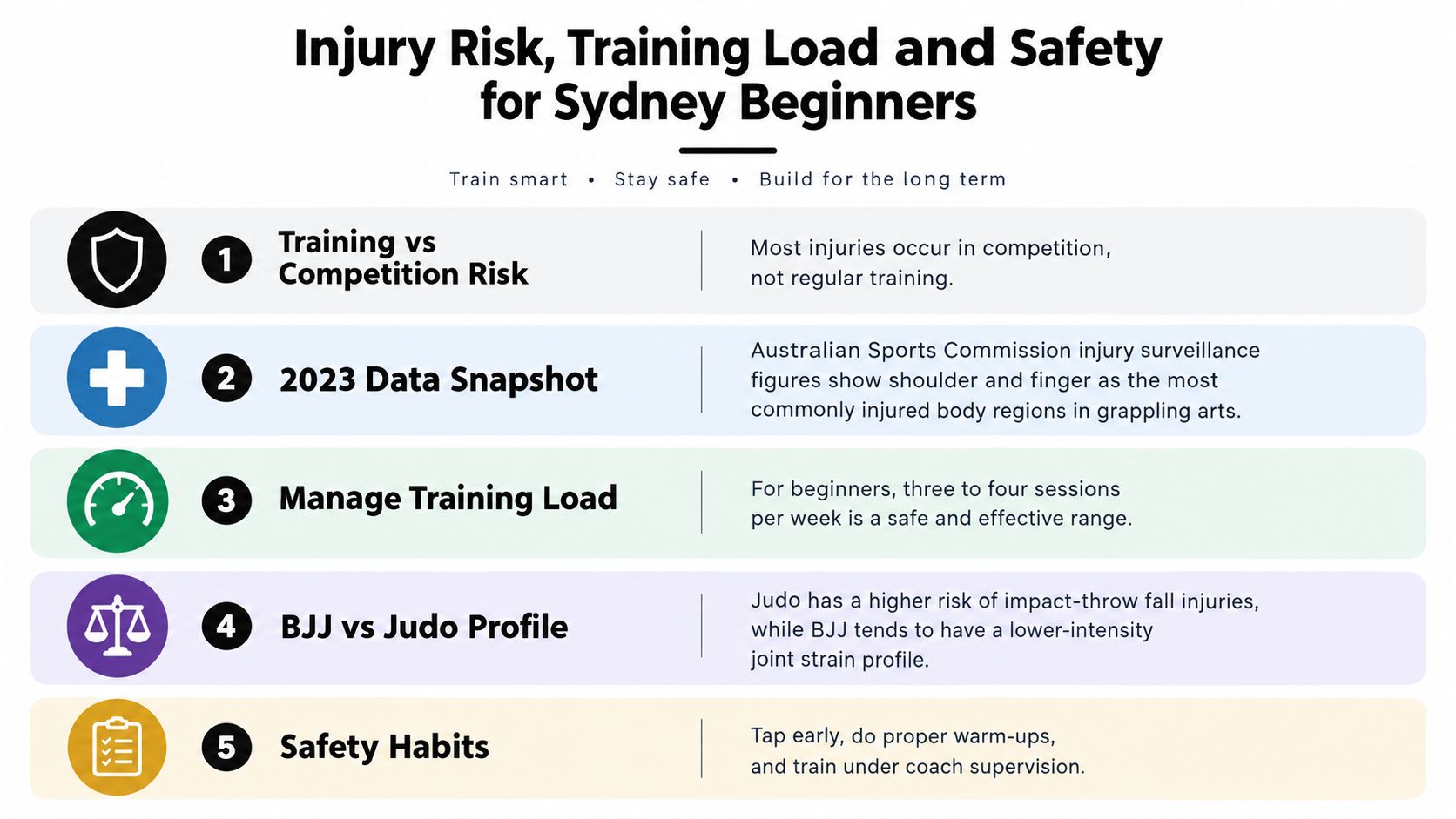
Neither art deserves a lazy “safe” or “dangerous” label. The useful comparison is what creates the load, when injuries happen and how the coach controls exposure.
Judo places more stress on impact management. Breakfalls, throw entries, gripping and lower-limb rotation all matter. An Australian Olympic combat-sports feasibility study reported that judo athletes in its cohort experienced more severe but less frequent injuries than boxers, with the knee and thigh prominent as injury sites. Across the combat athletes studied, the report documented 116 injuries over 12 weeks, equal to 0.88 injuries per week, as discussed in this Australian martial arts injury review.
Australian judo guidance also reports an overall injury incidence of 5.8% per bout, blood contact risk around 3% per bout, fracture risk of 0.38% per bout, dislocation risk of 0.15% per bout, and concussion at about 8% of all injuries, according to the Oceania Judo guidance document.
Training is where club culture matters most
BJJ shifts the risk profile. The common problems are cumulative joint and finger stress from grips, submissions, guard work and repeated scrambles. A 2025 BJJ injury review found 89% of reported injuries occurred during training, and 79% of those training injuries occurred during sparring, as reported in this Australian BJJ training article.
That finding should change how you judge a class. Technical drilling, controlled positional sparring and full rolling can all be useful, but the coach must scale the intensity and pair beginners intelligently.
For a new student, follow these rules:
Tap early: Don't wait for pain to become a lesson. Tap clearly and reset.
Learn ukemi properly: In judo, breakfalls are foundational skill, not a warm-up detail.
Control the round: Ask partners to keep the pace technical while you're learning.
Protect hygiene: Don't train with open cuts, skin infections or uncovered wounds.
Return gradually: After time away or an injury, rebuild intensity rather than testing yourself immediately.
Avoid adolescent weight cuts: Young athletes should not be pressured to manipulate weight for a division.
A good club makes safety visible. Coaches watch the room, stop reckless movement and teach students how to protect partners. That standard matters more than winning the argument about which art has fewer injuries.
Who Each Art Suits Best for Kids, Adults and Women
The best choice changes with age, confidence and the kind of challenge a student enjoys. Don't force every family member into the same class just because they share a surname or suburb.
Children need structure before intensity
For children aged 5 to 8, judo is often the stronger starting point. The formal belt pathway, etiquette and ukemi give young students a clear framework for learning coordination and confidence. The structured environment also helps coaches teach children how to fall, move and partner safely before introducing harder exchanges.
The Locals guide to jiu-jitsu for kids is useful for parents comparing a playful BJJ pathway with judo's more formal dojo structure. Neither choice should be based on toughness. Watch whether the class keeps children engaged, gives them manageable tasks and corrects behaviour without humiliating them.
For ages 9 to 14, the decision becomes more personal:
Energetic and throw-oriented: Judo often fits children who enjoy movement, gripping and the challenge of being thrown safely.
Thoughtful and positional: BJJ gi classes can suit smaller or quieter children who prefer solving ground positions.
Socially cautious: Start with the class where the coach introduces partners carefully and explains contact clearly.
Competition-minded: Ask how the club separates technical development from competition preparation.
Adults and women should test the actual room
Adult beginners who want visible self-defence skills, structured grading and an Olympic sport pathway should start with judo. Expect more impact from falling and more emphasis on standing timing.
Adults who want a longer technical ladder, extended ground work or a practice they can adapt as their body changes often prefer BJJ. The art still demands strength and mobility, but a careful coach can adjust positions, pace and sparring intensity.
Women frequently value BJJ's ability to build confidence through positional control before submissions. Gi and no-gi formats can both work, and a supportive class should offer respectful partner matching rather than assuming every student wants maximum intensity.
Book introductory sessions in both arts before committing. Tell the coach about any shoulder, knee or neck history on day one, then judge the class by how clearly the coach responds.
The right first class should leave you challenged, informed and keen to return, not battered for the sake of a story.
Which Art Fits Locals Zetland and Locals Maroubra Students
For readers in Zetland, Waterloo, Kensington and Alexandria, the practical decision often comes down to whether you want a BJJ-centred weekly routine or a broader family setting with access to both arts. For the eastern beaches, including Maroubra, the best approach is to sample the available formats rather than assume the suburb decides the style.
Locals Zetland leans towards the inner-south adult and after-school kids market with structured gi and no-gi BJJ, fundamentals blocks and a competition squad pathway for students who want one. That suits time-poor professionals in Zetland and Waterloo who want rolling-based fitness, technical progression and a class format that can fit around work.
Locals Maroubra offers both BJJ and judo in a coastal family setting. That makes it a sensible starting point for older teens and adults returning to sport, because they can compare standing throws with ground-based training before choosing a primary path.
Factor | Locals Zetland | Locals Maroubra |
|---|---|---|
Strongest fit | Inner-south adults and after-school BJJ students | Families and students wanting BJJ and judo exposure |
Training choice | Structured gi, no-gi and fundamentals pathways | BJJ and judo in a coastal family environment |
Competition option | BJJ competition squad pathway for interested students | A useful setting to sample both arts before specialising |
Suburb match | Zetland, Waterloo, Alexandria and nearby areas | Maroubra and the broader eastern beaches |
First-session approach | Coach-led fundamentals and positional practice | Compare both grappling ranges with guidance |
Parents in Kensington and Alexandria with children under 10 often prefer judo's formal grading and mat discipline. That preference makes sense when a child responds well to routine, etiquette and clear physical boundaries. If your child is anxious about falling or contact, don't decide from a brochure. Attend a class and watch how the coach introduces those experiences.
Older teens and adults around Maroubra should try both arts for two weeks before deciding. A judo session will show you whether you enjoy gripping, throwing and breakfall work. A BJJ session will show whether you like prolonged positional exchanges, escapes and rolling.
The practical first step is straightforward:
Book a free trial at Locals Zetland or Locals Maroubra.
Wear comfortable sports clothes and bring water.
Arrive ten minutes early so the coach can understand your goals and injury history.
Expect a coached warm-up, technique drilling and live positional practice.
Compare the experience after two weeks, not after one exciting or exhausting class.
The best art isn't the one that wins an internet debate. It's the one that matches your goal, body and weekly schedule, with coaches who keep beginners progressing safely.
Locals Jiu Jitsu Zetland offers structured Brazilian jiu-jitsu pathways, including fundamentals, kids' training, advanced development and no-gi grappling, which makes it a practical option for Sydney readers comparing BJJ with judo. Visit Locals Jiu Jitsu Zetland to arrange a free trial, experience the class culture and decide from the mat rather than from theory.
Comments