_edited.png)
BJJ White Belt Guide for Sydney Beginners
You're standing outside your first Brazilian Jiu-Jitsu class, wondering whether everyone inside already knows what they're doing. Through the door, you can see people grappling, moving between positions, and tying belts you don't recognise. Your stomach tightens because you're not sure what to wear, whether you'll be fit enough, or what happens if someone much stronger pins you down.
That reaction is normal. A BJJ white belt isn't expected to look experienced. You're entering a structured learning stage where mistakes, pauses, tapping, and repeated questions are part of the process. During your first twelve weeks, your main job isn't to win rounds. It's to learn how to move safely, breathe under pressure, protect your joints, and become a dependable training partner.
Stepping Onto the Mat as a BJJ White Belt
The first class often feels more complicated from the outside than it really is. You might watch a pair move from guard to mount and assume you're expected to understand every detail immediately. In reality, the coach will break the lesson into manageable pieces, demonstrate the movement, and give you time to practise with a partner.
At Locals Jiu Jitsu, a beginner isn't treated like a smaller version of an experienced student. The class is organised around learning, not performance. You'll be shown where to stand, how to greet your partner, how to move around the mat, and when to stop if something feels unsafe.
Your first win is staying calm enough to learn.
A white belt represents a beginning, not a judgement about your ability. You'll probably forget the sequence, place a hand in the wrong position, or freeze when your partner applies pressure. That doesn't mean you're failing. It means your body hasn't developed the movement vocabulary yet.
Your early priorities are simple:
Protect your head and neck: Keep your chin in a sensible position and listen when the coach explains safe posture.
Learn to tap: Use your hand or voice as soon as a submission is applied and you can't escape safely.
Ask for clarification: Partners would rather pause and reset than guess what you're trying to do.
Use controlled effort: Strength has a place, but frantic movement makes it harder for both people to stay safe.
Return to the basics: Frames, posture, base, breathing, and escapes matter more than collecting complicated techniques.
Before your first visit, check what to wear to your first Jiu-Jitsu class. Remove anything that can scratch or catch, arrive with clean clothing, and tell the coach about injuries or concerns before class begins.
The first month should feel like a gradual introduction. You'll learn how bodies connect, how force shifts a position, and how to create space without muscling through every problem. Some sessions will feel productive, while others will leave you confused. Both are normal parts of becoming comfortable on the mats.
Understanding the Fundamentals Class Structure
You arrive a few minutes early, see pairs already moving, and wonder whether you are expected to know the routine. A fundamentals class follows a clear sequence, so you can focus on the coach's instructions instead of guessing what happens next.
The class begins with preparation
Most sessions open with a warm-up and mobility work. You might practise bridging, shrimping, technical stand-ups, or changing your base. These movements prepare your joints and teach practical skills: moving your hips, creating space, and standing without exposing your back.
The warm-up also lets the coach observe the group. If a movement causes discomfort or seems difficult, say so early. The coach can adjust the pace, demonstrate another option, or pair you with someone who can work at a suitable speed.
Technique comes before resistance
The coach then introduces one position or a short sequence. For a new student, that could mean maintaining side control, escaping mount, recovering guard, managing posture inside guard, or framing against pressure. You watch the demonstration, ask questions, and practise the steps slowly with a partner.
Sydney beginner classes commonly place white belts and complete beginners in fundamentals programmes built around positions, escapes, posture, base, and introductory submissions. Drilling comes before strong resistance, giving new students a more controlled way to learn timing and body position. The progression is described in this overview of Jiu-Jitsu classes. The full progression is outlined in the Jiu-Jitsu fundamentals curriculum.
Drilling teaches your body what your mind has heard
During drilling, one person performs the movement while the other offers a cooperative response. The purpose is to build coordination, not to surprise your partner or test the technique at full intensity. Notice where your hands, elbows, knees, and hips belong, then repeat the sequence until it feels less unfamiliar.
Change roles regularly and match your partner's pace. Rushing because another pair is moving faster can lead to poor positions, missed instructions, or accidental pressure on a joint. A careful repetition teaches more than several frantic ones.
The curriculum may include positional sparring, too. You start in a defined position with a narrow task, such as escaping side control or maintaining guard, rather than beginning on your feet and trying to submit each other. This adds realistic resistance while keeping the problem small enough for the coach to supervise.
Controlled resistance is the bridge between drilling and live rolling.
If sparring is part of the class, the coach should explain the starting position, intensity, and stopping procedure. Tell your partner that you are new, request a slower round, and sit out if you feel unprepared or unwell. A suitable partner will help you practise the task instead of turning the round into a contest.
Here's a short visual resource to help you recognise common movements and class concepts:
After class, check how your body feels before leaving. Ordinary fatigue and muscle effort are expected. Report sharp joint pain, dizziness, unusual swelling, or pain that increases when you move to the coach rather than trying to train through it.
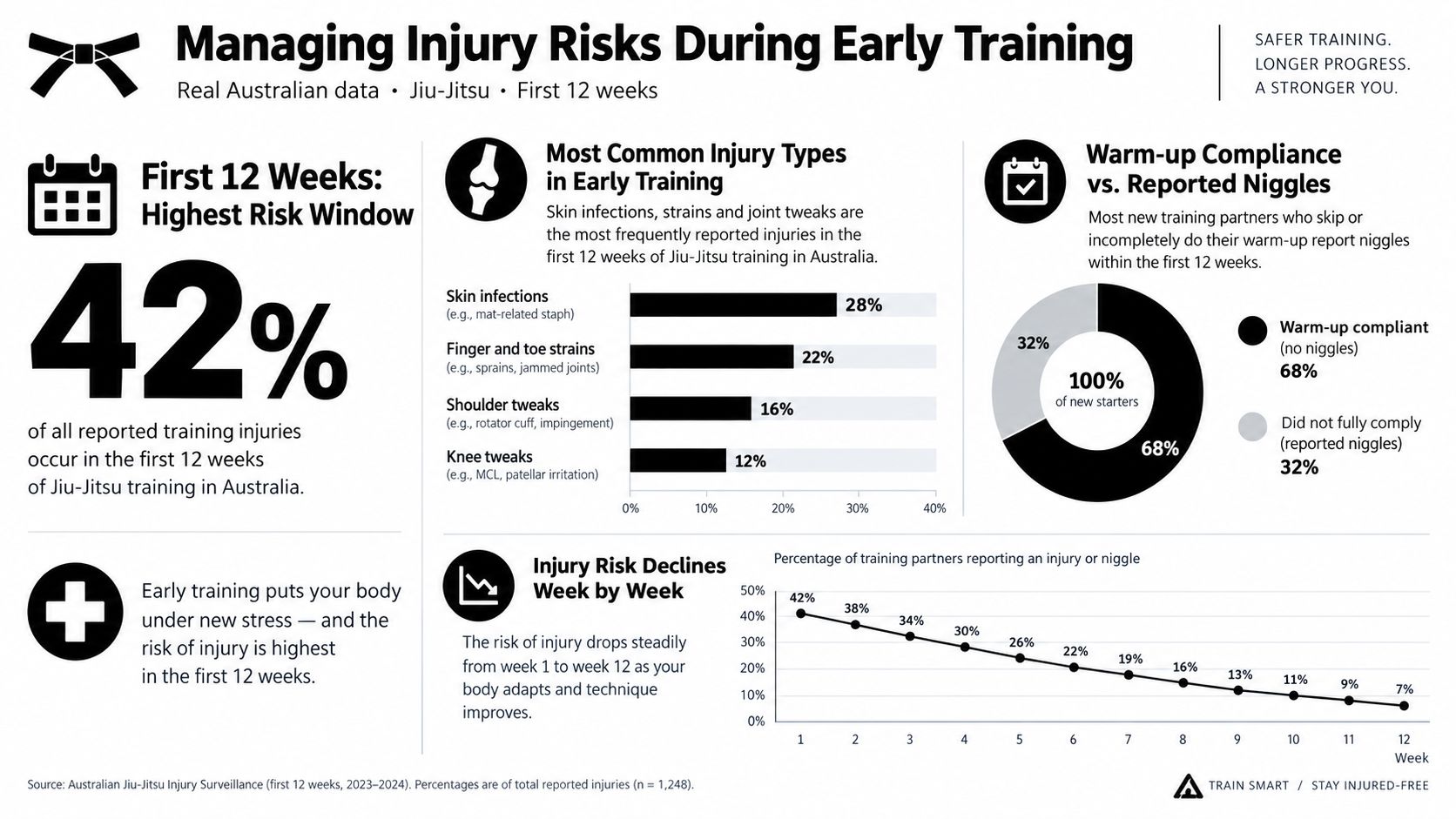
Managing Injury Risks During Early Training
The most useful safety question for a beginner isn't whether Jiu-Jitsu is completely risk-free. No physical activity can promise that. The better question is where avoidable risk appears and what you can do before it becomes a problem.
Australian sports data provides useful context, although it doesn't offer a complete community-sport injury register. The Australian Sports Commission notes that Australia doesn't have a community-sport injury collection, while the Australian Institute of Health and Welfare reports about 56,000 sports injuries led to hospital stays in 2021–22, and combat sports had an estimated 16% injury rate among participants in 2022. These figures are discussed in the National Sports Injury Database resource.
For a white belt, the lesson is practical. You're learning to fall, frame, escape, and tap at the same time as you're learning to manage another person's weight. That makes structured instruction and controlled sparring more sensible than jumping into unstructured, high-intensity rolling.
Live rolling needs boundaries
One injury review cited in Australian BJJ training discussions reports that 89% of injuries occur during training, with 79% of those training injuries happening during sparring. The figures appear in this Australian comparison of Brazilian Jiu-Jitsu and judo.
The implication is clear: the highest-risk exposure for a beginner is often live rolling, not slow technique drilling. That doesn't mean you must avoid every form of sparring. It means the format, partner, pace, and supervision matter.
Choose a partner who:
Matches your communication style: They respond when you ask them to slow down or reset.
Controls their movement: They don't throw their weight suddenly or yank limbs during transitions.
Understands your experience: Tell them you're a white belt and explain whether you're comfortable with positional work.
Respects the tap immediately: Once you tap or say “tap”, they release without delay.
Keeps the round technical: A useful partner creates problems without treating you like an opponent in a final.
If a partner repeatedly ignores your request for lower intensity, stop the round and speak to the coach. You're not being difficult. You're protecting both people from a preventable mistake.
Learn the difference between pressure and pain
Jiu-Jitsu often feels uncomfortable. Someone may compress your ribs, place weight across your chest, or make it difficult to breathe normally. Those sensations can be challenging without indicating an injury.
Joint pain is different. A sharp sensation, a sudden twist, a painful knee or shoulder angle, or pressure that increases rapidly deserves immediate attention. Don't wait to see whether you can tolerate it. Tap before the position becomes dangerous.
Your first defensive response should usually be to create structure. Use frames with your forearms, keep your elbows close, protect your neck, and move your hips deliberately. Explosive escapes can work occasionally, but they become risky when you haven't learned where your body needs to go.
The essential sequence is:
Recognise the position.
Breathe instead of holding your breath.
Build a frame or create space.
Move your hips and recover a safer position.
Tap early if the submission is secure.
That sequence may feel slow at first. Slow movement gives you more information and gives your partner more time to respond safely.
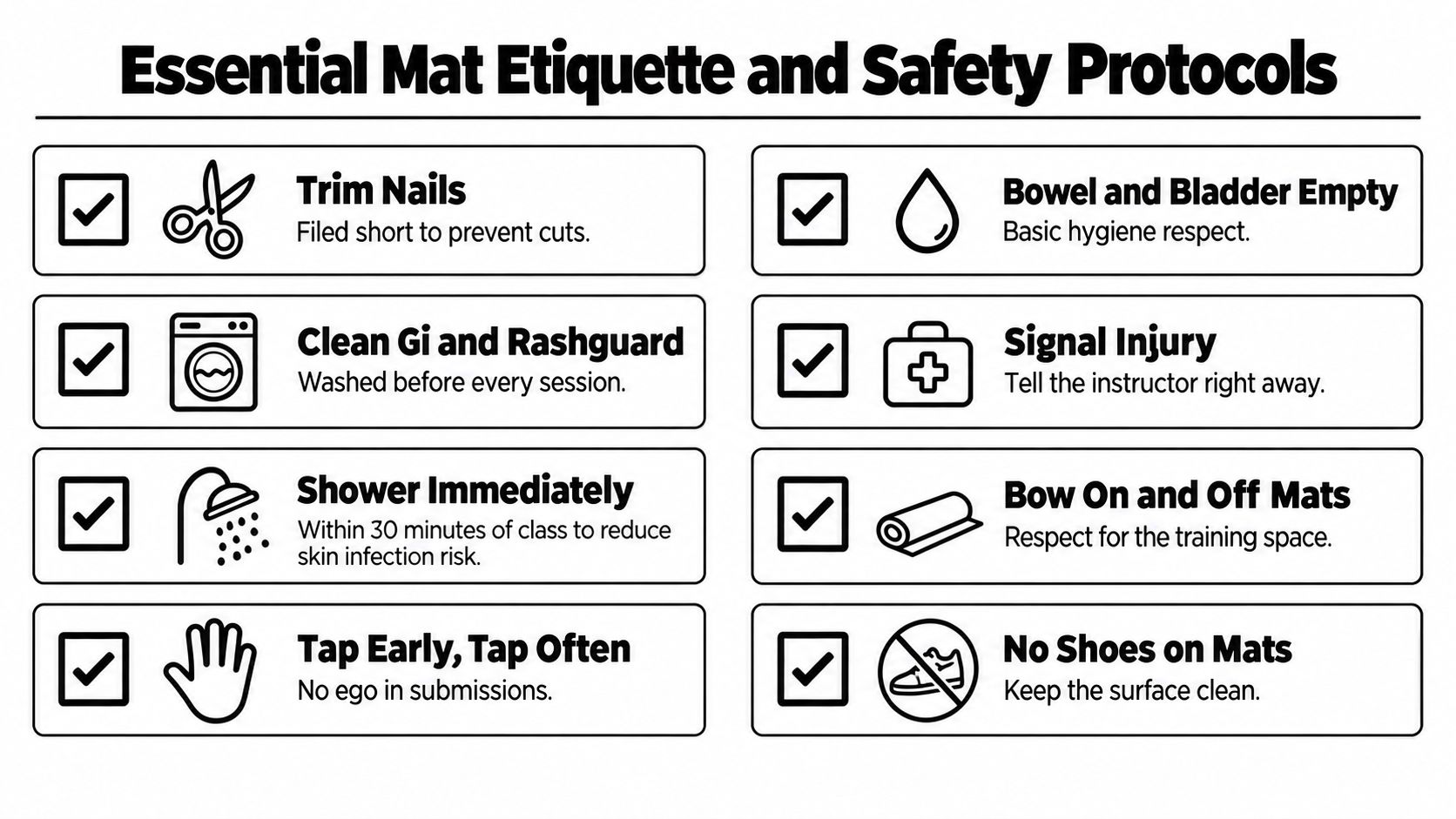
Essential Mat Etiquette and Safety Protocols
Mat etiquette isn't decoration around the training. It prevents cuts, contamination, distractions, and misunderstandings. A white belt who follows these rules quickly becomes someone others trust as a training partner.
Prepare before you step on
Check your hands and feet before class. Keep fingernails and toenails short and smooth, because long or sharp nails can cut a partner during a frame, grip, or scramble. Wear clean training clothes, and wash them after each session.
Remove watches, rings, necklaces, earrings, and other jewellery before entering the mat area. A small metal item can catch on clothing, scratch skin, or injure a finger when two people move under pressure. Sydney guidance for white belts also stresses keeping outdoor shoes off the training surface and following academy hygiene rules to reduce avoidable injury and infection risks, as explained in this guide to Brazilian Jiu-Jitsu.
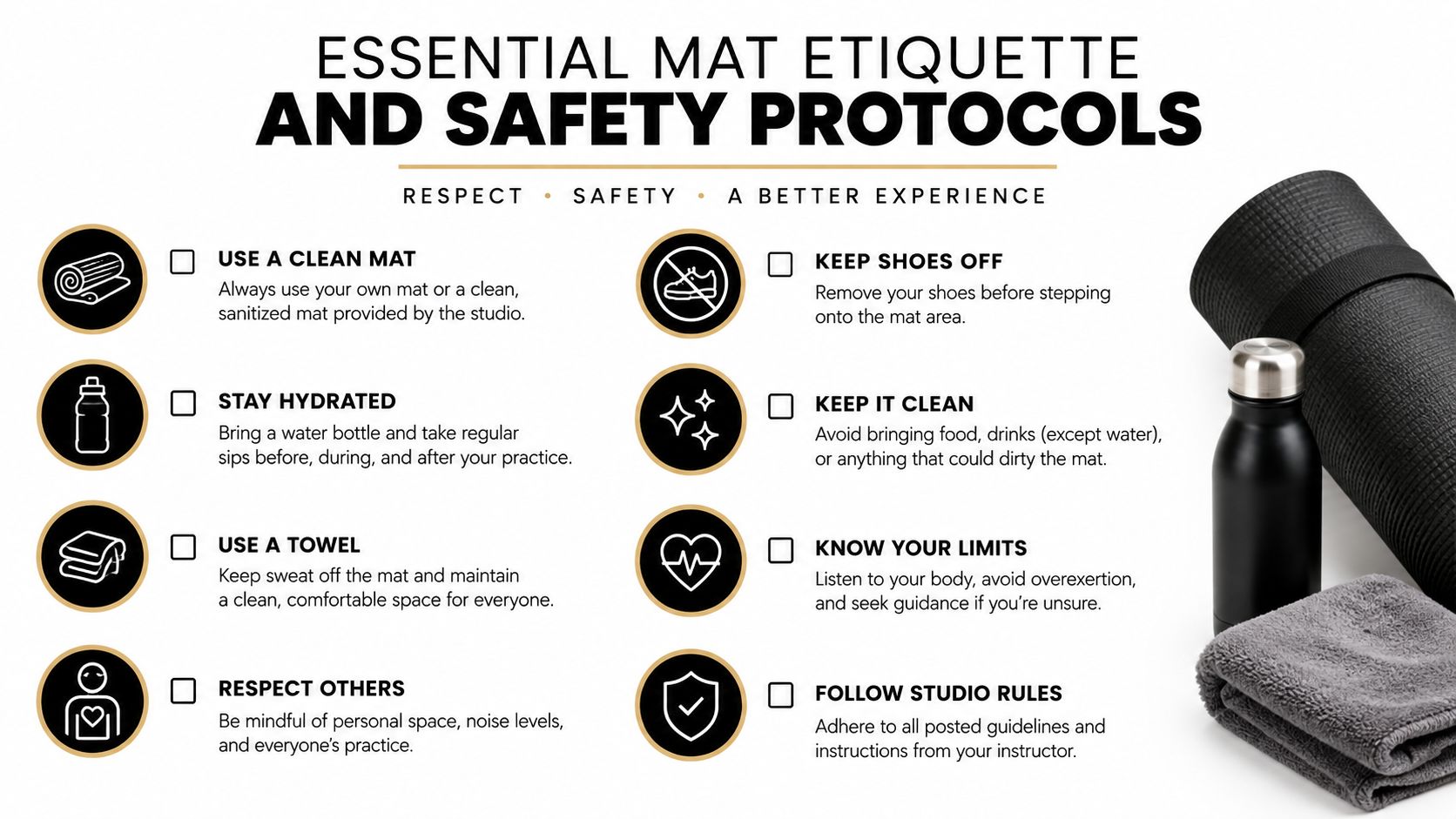
Communicate before and during every round
Introduce yourself to your partner. Say that you're new, mention any physical limitation, and agree to keep the pace controlled. If you need to stop, say “stop” clearly, tap the mat, or tap your partner. Don't rely on a subtle gesture that may be hidden by clothing or body position.
Breathe calmly, especially when you're pinned. Holding your breath raises panic and makes you more likely to thrash. A calm exhale helps you assess where your frames are and whether you can move safely.
A tap is information, not an admission of weakness.
When you finish a round, release your partner and reset the space. Don't walk across another pair, place your hands on someone's face, or continue a movement after your partner has asked you to stop. If you're unsure about mat entry, bowing, or where to wait, copy the class routine or ask the coach.
Keep these habits consistent:
Clean your body and equipment: Arrive fresh, use clean training clothing, and follow the academy's washing expectations.
Cover skin issues: Tell the coach about anything that may affect a partner's health.
Leave food and drink away from the mat: Keep the training surface clear.
Respect the space: Walk around active pairs and keep shoes off the mats.
Report injuries: Tell the instructor immediately rather than hiding a problem and worsening it.
Good etiquette also makes the room less intimidating. When everyone communicates clearly, a new student can focus on learning rather than guessing what is socially or physically acceptable.
Overcoming Common White Belt Pitfalls and Ego
Many beginners believe progress means resisting every submission. That idea sounds tough, but it creates poor decisions. If you refuse to tap because you don't want to “lose”, your partner may need to apply more pressure, and you may miss the chance to understand what led to the position.
Tapping ends a submission attempt so you can reset. It gives you a useful question to ask: What happened before the submission became unavoidable? Perhaps your elbow moved too far from your ribs, you stopped framing, or you tried to bench-press someone's body instead of moving your hips.
Replace winning with specific targets
A new student needs goals that can be measured by behaviour, not by the number of rounds won. During one session, success might mean recognising mount earlier. During another, it might mean maintaining your breathing while trapped underneath side control.
Try choosing one focus for each class:
Position awareness: Identify whether you're in guard, side control, mount, or back control.
Defensive structure: Keep elbows connected and build frames before attempting an escape.
Breathing: Exhale during effort instead of holding your breath.
Early communication: Tell your partner when the pace is too high.
Post-round learning: Remember one mistake and one adjustment.
Your partner's body size, experience, and style will affect every round. Comparing your performance with another beginner's performance creates noise. Compare today's decision with your previous decision instead.
Strength should support technique
Using effort isn't wrong. A bridge needs force, and a frame needs enough firmness to create space. The problem begins when you use maximum effort in every direction at once. That approach burns energy, makes your movement unpredictable, and can place your joints in poor positions.
When adrenaline rises, make the task smaller. Keep your hands near defensive frames, find a safe breathing rhythm, and listen for the coach's instruction. If you're exhausted, tell your partner and ask to slow down. You don't need to prove that you can continue at the same pace.
White belts are beginners, and calm breathing, controlled movement, and immediate tapping are central safety habits in an art built around grappling and submissions without strikes. A Sydney-area explanation of why white belts should stay calm notes that few injuries occur when partners tap before damage is done, as described in this white-belt safety guide.
The round isn't ruined when you tap. It becomes useful when you learn why you tapped.
The first twelve weeks will include awkward moments. You'll forget techniques, lose balance, and occasionally panic. That's not evidence that you don't belong. It's the normal material from which skill is built.
Navigating the Australian Jiu Jitsu Pathway
Your white-belt experience is connected to a wider Australian training and competition community. You don't need to compete, but understanding that pathway can help you see why fundamentals matter. The escapes and positional habits you practise in a beginner class aren't isolated exercises. They form the base for later training, whether your aim is fitness, self-defence, recreation, or competition.
Australian ranking and competition systems list substantial white-belt divisions across states and weight classes. The NSW federation's 2026 white-belt kids rankings and a national tournament database tracking results across 163 tournaments show how the beginner belt is built into the country's competitive pathway, according to Australian BJJ rankings data.
That doesn't mean you should rush into a tournament. Competition adds rules, time pressure, unfamiliar opponents, and a different emotional environment. Some students enjoy that challenge after developing a reliable foundation. Others train for health, confidence, or community and never enter an event.
Your next stage is built from repeatable habits
A useful pathway looks less like a straight climb and more like a series of returning loops:
Learn a position.
Drill a movement.
Apply it against controlled resistance.
Notice where it breaks down.
Ask a coach or partner for guidance.
Practise the adjustment.
You'll revisit the same positions many times. That repetition is intentional. A movement needs to remain available when you're tired, surprised, or under pressure, not only when the coach demonstrates it slowly.
White belts form the broad foundation of the local sport, which is why beginner programmes matter so much to Sydney academies. Large beginner divisions also mean you won't be the only person learning the basics. The room includes people at different points in the same long process.
Keep competition optional
If competition interests you, ask the coach what skills and behaviours they expect before entering. You'll need to understand the relevant rules, manage training intensity, and prepare without neglecting recovery. If it doesn't interest you, your training remains valid. Consistent attendance, safe partnership, and technical improvement are worthwhile goals on their own.
The most valuable long-term mindset is patience. A belt colour can mark a stage, but your daily habits determine whether you can use what you've learned.
Starting Your Journey at Locals Jiu Jitsu
A safe first month has a clear shape. Attend fundamentals classes, tell the coach that you're new, drill patiently, choose partners who communicate, and tap before a joint reaches a dangerous position. Keep your nails short, remove jewellery, wear clean training clothes, and treat hygiene as part of being a responsible teammate.
Locals Zetland and Locals Maroubra offer entry points for people who want to learn in a structured setting. Adults can begin with foundational positions, movement, strategy, and submissions, while parents can ask about age-appropriate kids' training. Women looking for confidence and practical self-defence can also start by discussing comfort, partner matching, and class expectations with the coaching team.
You don't need to arrive fit, flexible, or technically prepared. You need to arrive ready to listen and willing to start slowly. If you're exploring ways to connect with Sydney's fitness community outside the academy, Sydney fitness influencer marketing is another relevant local resource, but your first training decision should be based on coaching, safety, and whether the environment feels respectful.
For a broader look at beginner options, read the guide to Jiu-Jitsu in Sydney CBD. Then contact the academy, explain your experience level, and ask what a first session involves.
Locals Jiu Jitsu Zetland offers structured beginner training that introduces positions, movement, submissions, and safe partner work without expecting you to perform like an experienced grappler. Book a free trial at Locals Jiu Jitsu Zetland, arrive with clean training clothes and trimmed nails, and take your first step towards becoming a calm, capable BJJ white belt.
Comments