_edited.png)
BJJ Workout Routine: Complete Guide for All Levels
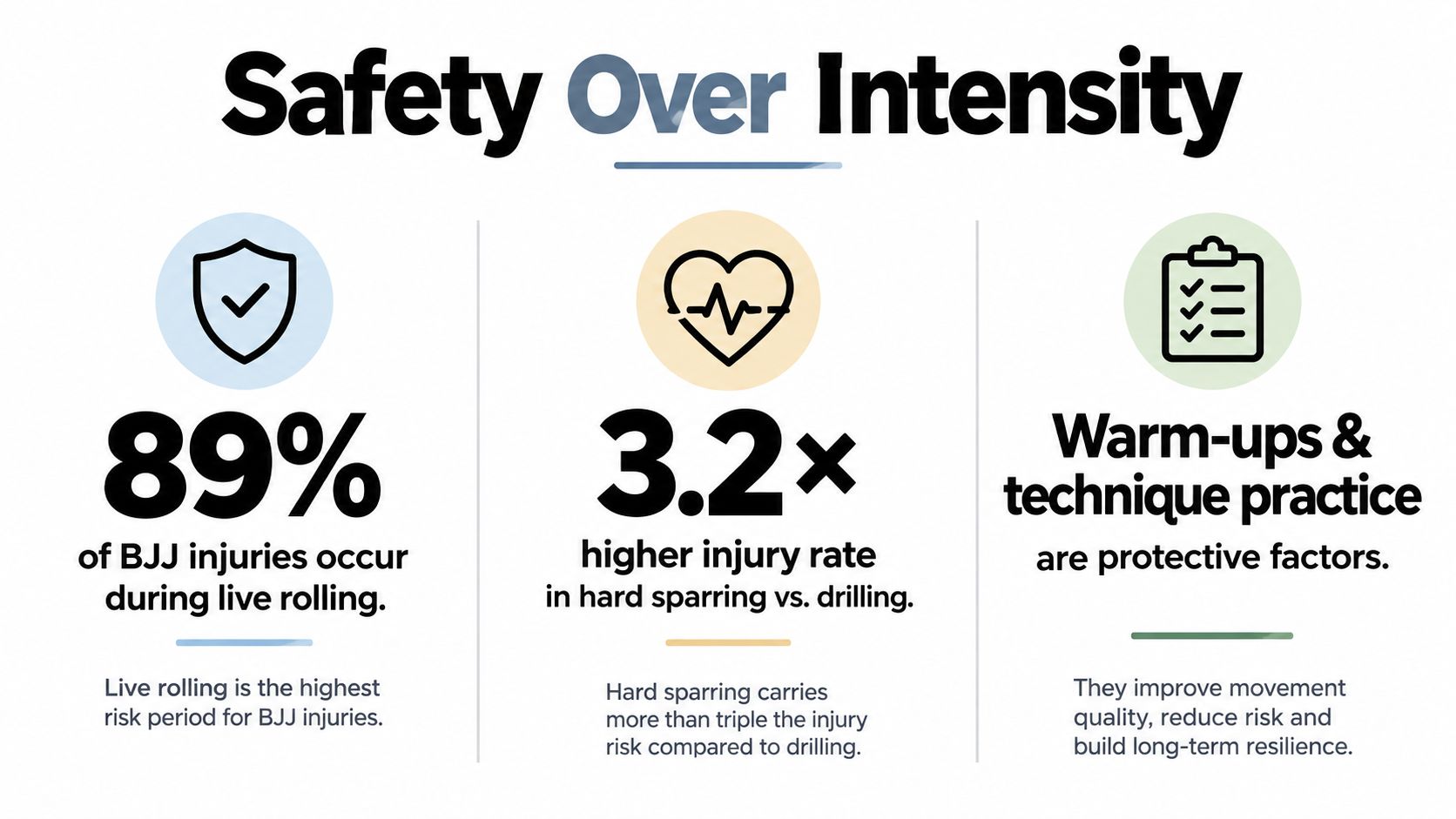
89% of Brazilian jiu-jitsu injuries occur during training rather than competition, so a sustainable BJJ workout routine must control intensity instead of treating every round like a fight. The most useful routine combines mobility, technical drilling, positional sparring, limited live rounds, strength, and recovery.
The popular advice is simple: roll more, roll harder, and fitness will follow. That approach overlooks the phase where most beginners lose technical quality, make poor decisions, and expose joints to unnecessary force. A good coach doesn't measure progress by how exhausted you feel after class. Progress shows up when you can repeat sound movement under pressure, recover between sessions, and return to the mats consistently.
For Australian practitioners, this structured approach fits the way martial arts are commonly delivered. Australian Sports Commission reporting cited by SBS Portuguese describes about 248,351 adults aged 15 and over participating in martial arts, with 85% taking part in organised settings. BJJ in Australia is therefore usually learned through coached classes, not improvised conditioning sessions.
Why Your BJJ Workout Routine Should Prioritize Safety Over Intensity
More rolling isn't automatically faster improvement. Hard rounds create useful adaptation, but only when your body and technique can handle the load. If every session becomes a test of toughness, fatigue starts making technical decisions for you. You reach for strength instead of frames, twist through bad positions instead of resetting, and scramble without enough control to protect your neck, shoulders, knees, or fingers.
The injury figures explain why this matters. A 2025 systematic review recorded 1,711 of 1,913 documented BJJ injuries during training, with an estimated incidence of 5.5 injuries per 1,000 training hours, compared with 55.9 per 1,000 competition matches, as reported by Locals Zetland. Competition is more intense per match, but training accounts for the larger practical exposure because athletes spend far more time practising than competing.
Fatigue changes the quality of your movement
A technically clean escape requires attention. You need to frame, create space, manage your hips, and choose the correct exit. Under excessive fatigue, that sequence becomes a frantic bridge, a loose elbow, or a late reaction to a submission. The problem isn't that hard work has no value. The problem is placing the hardest work before you have earned it through preparation and repetition.
A responsible routine uses intensity as a variable. Some rounds should be exploratory and light. Others can be more demanding, but the coach and partners should still control the pace. Tapping early, sitting out when your movement deteriorates, and stopping a round when pain appears aren't signs of weakness. They're tools for preserving training quality.
Coaching rule: If you can't perform the technique with reasonable control, reduce the resistance before adding more rounds.
Warm-ups and cool-downs support that decision-making process by preparing joints, raising body temperature, and giving you a deliberate transition out of hard work. Use this BJJ warm-up and cool-down guide to build those transitions into class rather than treating them as optional extras.
Sleep also affects how well you tolerate training. If nasal congestion disrupts your rest, learning about how nasal strips aid recovery may help you assess whether a simple sleep-support habit is appropriate. It won't replace sensible programming, but recovery quality belongs in the same conversation as round volume.
The Core Structure of an Effective BJJ Workout Routine
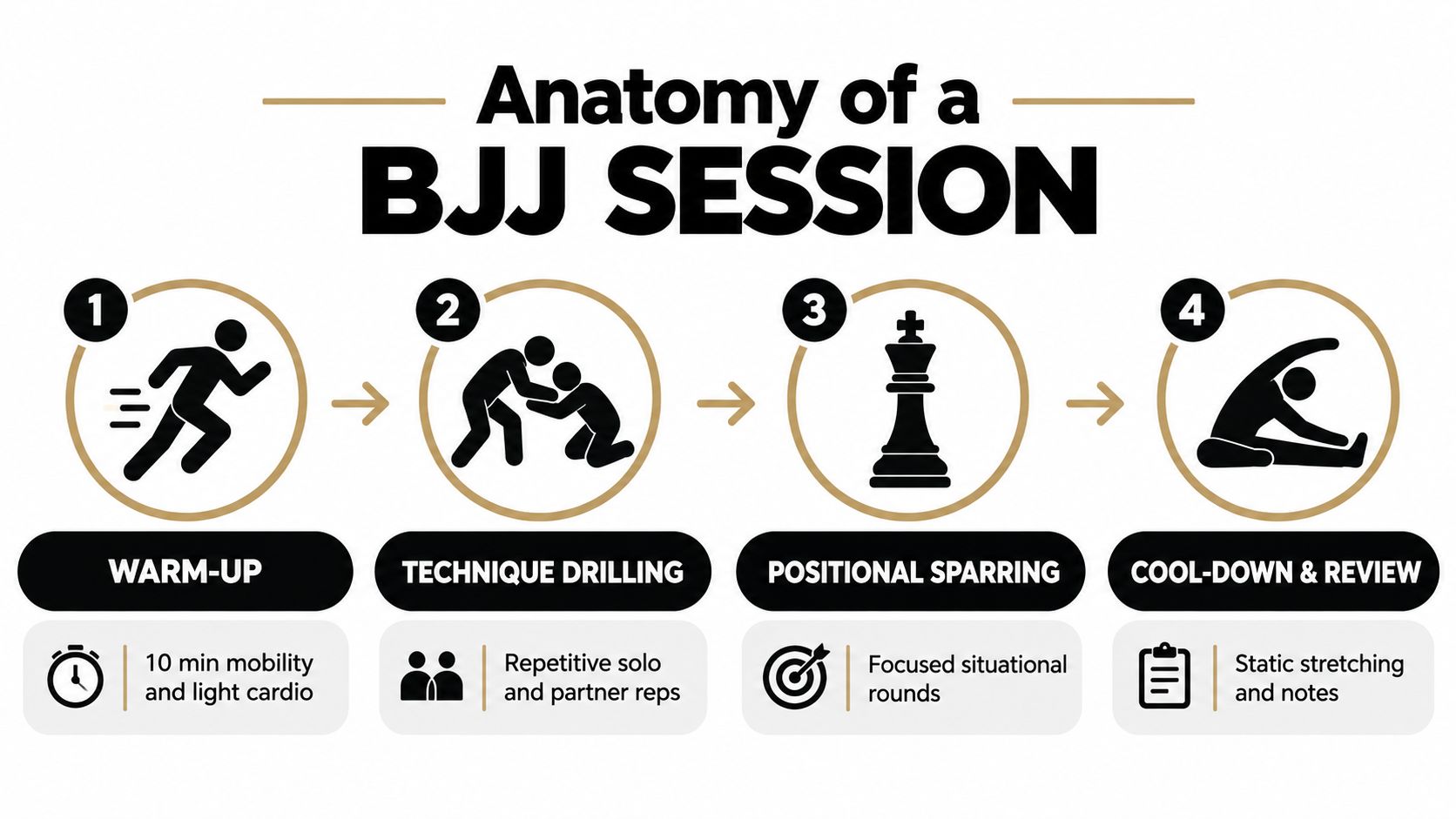
A useful session follows a sequence. You prepare the body first, learn while relatively fresh, add resistance through a narrow positional problem, and only then decide whether live rolling will improve the session or degrade it.
Start with movement, not maximum effort
1. Joint mobility and movement preparation, 10 to 15 minutes. Begin with controlled movement for the neck, shoulders, wrists, spine, hips, knees, and ankles. Add hip switches, bridges, technical stand-ups, level changes, and gentle sprawls if they match the class focus. The aim is to rehearse positions you'll use, not to exhaust yourself before instruction begins.
2. Technical drilling, 20 to 30 minutes. Work at low fatigue. Practise the entry, grips, frames, hip position, and finish rather than rushing through repetitions. Use 3 to 5 controlled repetitions per side when appropriate, then add realistic resistance gradually. Repetition should make the movement clearer, not merely faster.
Add resistance in a narrow channel
3. Positional sparring, 15 to 20 minutes. Start from one defined position, such as closed guard, side control, or a single-leg finish. Give each partner a clear objective. The bottom player might recover guard, while the top player tries to pass. This keeps the round instructional and prevents the session from becoming an unstructured contest.
4. Live rounds, 2 to 5 rounds. Only add these after technique quality has remained stable. A global injury study found 5.5 injuries per 1,000 training hours, with 89% of injuries during training and 79% of those training injuries occurring in sparring, supporting a beginner bias towards drilling and positional work, as detailed in the published BJJ injury study.
Before class, decide what success means. It might be maintaining inside position, escaping without exposing an elbow, or using a particular guard entry. A narrow objective produces better learning than trying to win every exchange.
5. Posterior-chain and grip work. Finish with modest strength work when recovery allows. Bridges, hip hinges, rows, carries, and grip variations can support grappling demands, but they shouldn't turn every class into a second high-intensity workout. The Locals Zetland guide to Jiu-Jitsu strength training provides a useful framework for combining mat work with complementary training.
Nutrition supports the workload, but it doesn't need to become complicated. If you're trying to understand macro ratios for training, start by considering your total training demand, regular meals, hydration, and how you feel during sessions rather than copying a plan designed for someone else.
Tailoring Your BJJ Workout Routine for Kids and Adults
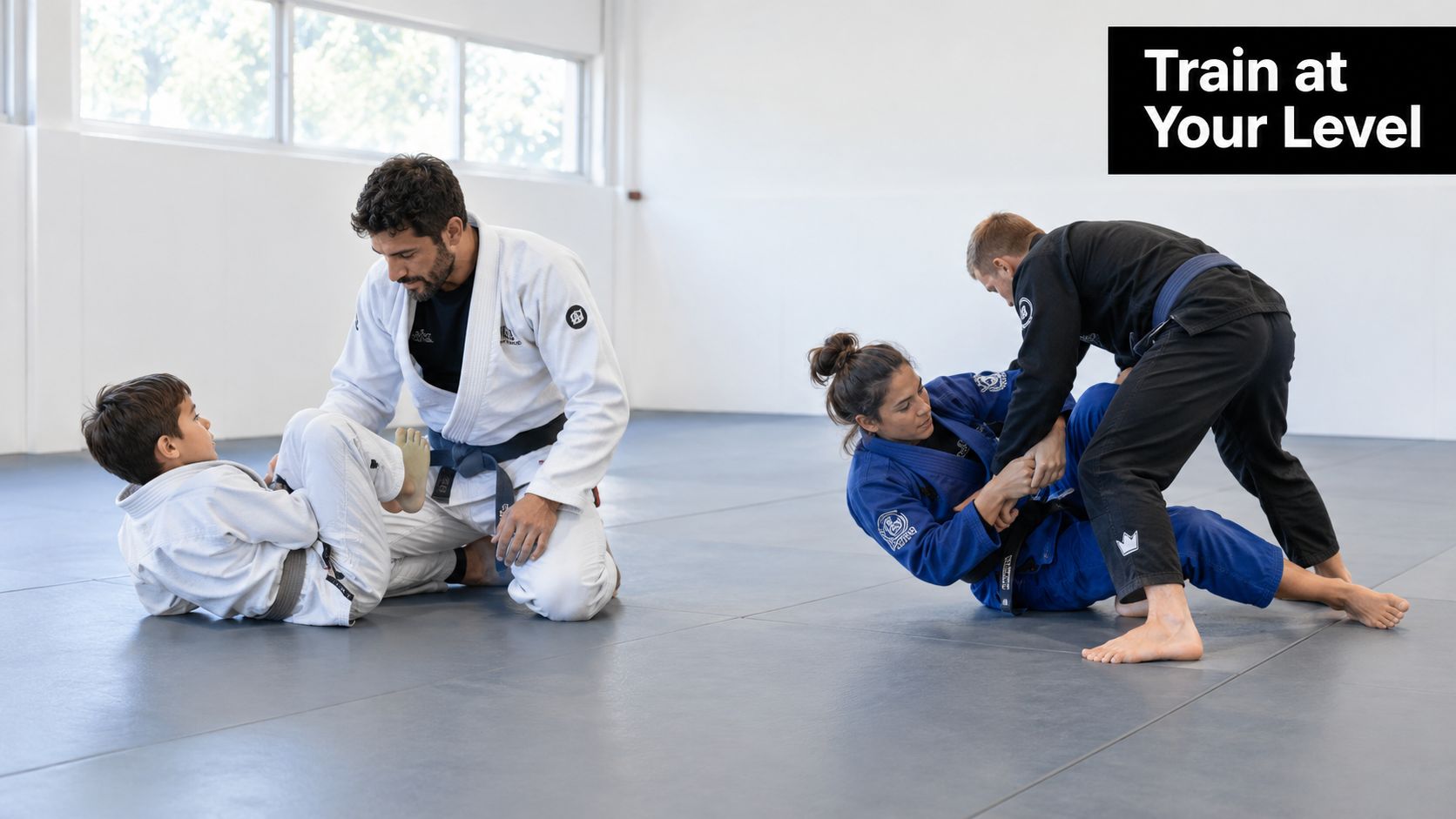
Children and adults need different training priorities, not just different-sized uniforms. Age, coordination, attention, recovery, and risk awareness all shape a sustainable BJJ workout routine. Children learn effectively through structured games that develop balance, base, posture, safe falling, movement, and positional awareness. Adults often benefit from slower technical explanations, focused drilling, and a clear plan for managing training alongside work and family.
Organised coaching makes that adjustment possible. Australian participation data indicates that martial arts participation is largely organised, giving coaches room to scale drills, partner choices, and intensity rather than asking every student to train identically. A coach can reduce live work for a fatigued adult or turn a child's movement lesson into a controlled game without lowering technical standards.
Children need engagement before conditioning
A children's class should reward curiosity and sound movement. Balance games, bounded grip fighting, hip movement, and safe positional escapes build useful habits without turning practice into adult endurance training. Coaches should stop chaotic exchanges early, explain tapping in simple language, and keep submissions controlled.
Parents should choose a programme where the instructor can distinguish purposeful play from unsafe roughhousing. The Locals kids' Jiu-Jitsu drills resource shows how movement and technical learning can be adapted for children.
Adults need honest pacing and options. Someone returning after years away may need fewer live rounds and more time practising breathing, framing, and safe movement. A woman returning after pregnancy, an older beginner, or anyone managing a previous injury should discuss modifications with the coach instead of matching a younger partner's pace. Training quality matters more than proving toughness.
No-Gi also changes the demands on a routine. Without fabric grips, athletes rely more on wrist control, underhooks, head position, hand fighting, and wrestling-based transitions. The answer is not constant maximal effort. Prepare for faster positional changes while keeping the shoulders, neck, hips, and hands organised. That approach supports technical progress and reduces the chance that unnecessary intensity turns ordinary practice into an avoidable injury.
Progressing From Drilling to Sparring Safely
Beginners often make the same mistake. They learn a technique, feel comfortable during cooperative drilling, then jump straight into repeated hard rounds and assume failure means they need more intensity. Usually, they need a smaller problem and better feedback.
A cross-sectional survey of 1,140 BJJ athletes recorded 1,052 injuries, equivalent to 308 injuries per 1,000 athletes per year, with 89% occurring during training, according to the survey summarised by Locals Zetland. That supports a progression that increases resistance without immediately increasing chaos.
Use a staged progression
Cooperative drilling. Learn the movement pattern, safe finishes, and defensive response. Keep the pace low enough to notice where your elbows, knees, head, and spine are positioned.
Responsive drilling. Let the partner give realistic pressure without trying to win. If you're practising a guard recovery, the partner can pass slowly and pause when you establish frames.
Positional sparring. Begin from the position you're studying. Use short rounds with a reset after the objective is achieved. This gives you repeated entries into the same decision rather than one long scramble that may never return to the lesson.
Constrained live work. Start from a limited rule set, such as no takedowns, no explosive submissions, or a specific guard. The restriction isn't a limitation on learning. It protects the learning objective.
Open rolling. Add full rounds only when you can defend, breathe, and reset without abandoning basic safety. Choose partners who understand the agreed pace.
Practical rule: When your technique becomes frantic, the round has stopped delivering the adaptation you wanted.
Watch for concrete warning signs. Your hands stop framing and begin grabbing. You hold your breath. You can no longer remember the positional goal. You feel sharp pain rather than normal effort, or you keep getting caught because fatigue has removed your defensive awareness. At that point, lower the resistance, take a break, or end the round.
Building a Weekly Training Schedule for Busy Adults
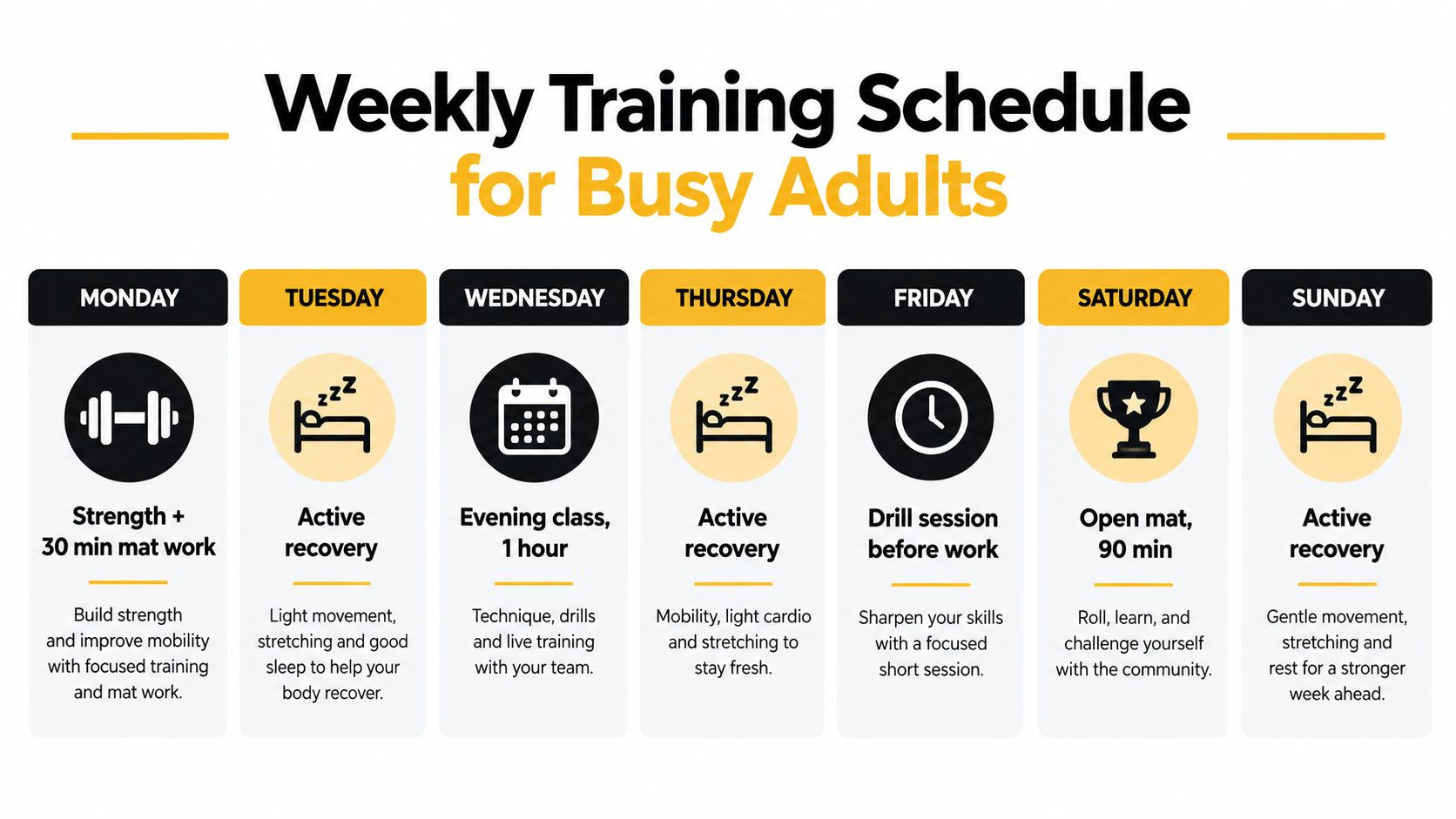
A weekly BJJ workout routine has to fit the life you live. A plan that looks impressive on paper but leaves you too sore for work, family, or the next useful session isn't sustainable. Adults usually improve more from repeatable training than from occasional weeks of heroic volume.
An Australian clinic specifically suggests that new adults begin with 1 to 2 BJJ sessions per week and leave at least one recovery day between demanding sessions, as referenced in the Australian sports-performance recovery guidance from the Australian Institute of Sport. That starting point gives your joints, connective tissue, sleep, and coordination time to adapt.
A practical three-session model
A simple template for a more established adult is:
Technical session: Focus on instruction, drilling, and light positional work. Keep live rounds limited if the week has already been demanding.
Sparring or strategy session: Use defined starting positions and a clear tactical goal. This is the day to test decisions, not to chase exhaustion.
Conditioning-focused session: Combine moderate strength, mobility, and selected mat movements. Keep enough energy to maintain sound mechanics.
Place rest or active recovery between hard sessions. Walking, gentle mobility, easy cycling, and relaxed movement can help you stay active without adding another stressful grappling load. Strength work should support your BJJ, with particular attention to the posterior chain, pulling capacity, trunk control, shoulders, hips, and grip.
Adjust the plan before your body forces you to
Use a simple readiness check before training. Consider sleep quality, lingering joint soreness, motivation, grip fatigue, and whether your movement feels coordinated during warm-up. If several markers are poor, make the session technical and reduce sparring rather than cancelling every opportunity to learn.
Periodisation doesn't require an elaborate spreadsheet. It means alternating demanding and easier work, building volume gradually, and scheduling recovery before you need emergency rest. Two well-managed sessions can be more productive for a beginner than frequent hard rolling that creates a cycle of soreness, missed classes, and rushed returns.
Maximizing Results with Local Academy Support
A routine only works when someone can help you apply it to your actual body and skill level. Written plans can't see whether your knee collapses during a shot, whether your elbow is exposed in side control, or whether your partner is using too much force. An experienced coach can change the starting position, reduce resistance, pair you appropriately, and give you a safer route to the same learning objective.
Locals Jiu Jitsu Zetland is one Sydney option with structured pathways for kids, beginners, advanced students, and No-Gi practitioners. Its approach combines coached technique, progressive drilling, positional work, and controlled sparring, which suits athletes who want a routine built around longevity rather than constant maximum effort.
The community setting matters as much as the class plan. Training partners who communicate clearly make it easier to agree on intensity, tap without hesitation, and stop when something feels wrong. That environment helps children build confidence, adults manage busy schedules, and experienced practitioners pursue technical depth without treating every round as a test of status.
Supplements shouldn't distract from the fundamentals. Before adding anything, review how to choose performance supplements wisely, then prioritise regular meals, hydration, sleep, coaching, and a training load you can repeat.
Locals Jiu Jitsu Zetland offers structured Kids, Beginners, Advanced, and No-Gi classes with progressive coaching in a controlled Sydney training environment. Visit Locals Jiu Jitsu Zetland to try a class, discuss your goals with the team, and build a BJJ workout routine that supports steady progress without sacrificing your health.
Comments